Question:
Let \(P\) be the point on the parabola \(y=x^2\) such that the slope of the tangent to the parabola at the point \(P\) is \(4\). Let \(Q\) be the point in the first quadrant lying on the circle
\[
x^2+y^2=2
\]
such that the slope of the tangent to the circle at the point \(Q\) is \(-1\). Let \(R\) be the point in the first quadrant lying on the ellipse
\[
x^2+4y^2=8
\]
such that the slope of the tangent to the ellipse at the point \(R\) is \(-\frac12\). Then the radius of the circle passing through the points \(P\), \(Q\) and \(R\) is:
Let \(P\) be the point on the parabola \(y=x^2\) such that the slope of the tangent to the parabola at the point \(P\) is \(4\). Let \(Q\) be the point in the first quadrant lying on the circle
\[
x^2+y^2=2
\]
such that the slope of the tangent to the circle at the point \(Q\) is \(-1\). Let \(R\) be the point in the first quadrant lying on the ellipse
\[
x^2+4y^2=8
\]
such that the slope of the tangent to the ellipse at the point \(R\) is \(-\frac12\). Then the radius of the circle passing through the points \(P\), \(Q\) and \(R\) is:
Show Hint
Find the three points P, Q and R one at a time using the given slope at each point, this only needs basic differentiation on the parabola, the circle and the ellipse in turn. Once you have all three coordinates, look closely at the three given slopes, 4, -1 and -1 over 2, and check whether any two of the three connecting lines have a special relationship with each other before jumping into the general circumcircle formula. Checking the slopes first can save a lot of algebra compared to writing out the full equation of a circle through three points.
Updated On: Aug 14, 2026
- \(\sqrt{10}\)
- \(\sqrt5\)
- \(\sqrt{\frac52}\)
- \(2\sqrt5\)
Show Solution

Verified By Collegedunia
The Correct Option is C
Approach Solution - 1
Step 1: Find point \(P\).
For parabola: \[ y=x^2 \] Slope of tangent: \[ \frac{dy}{dx}=2x \] Given: \[ 2x=4 \] \[ x=2 \] Thus: \[ y=2^2=4 \] Hence: \[ P=(2,4) \]
Step 2: Find point \(Q\).
Given circle: \[ x^2+y^2=2 \] Differentiating: \[ 2x+2y\frac{dy}{dx}=0 \] \[ \frac{dy}{dx}=-\frac{x}{y} \] Given slope: \[ -\frac{x}{y}=-1 \] \[ x=y \] Substituting in: \[ x^2+y^2=2 \] \[ 2x^2=2 \] \[ x=1 \] Since first quadrant: \[ y=1 \] Thus: \[ Q=(1,1) \]
Step 3: Find point \(R\).
Given ellipse: \[ x^2+4y^2=8 \] Differentiating: \[ 2x+8y\frac{dy}{dx}=0 \] \[ \frac{dy}{dx}=-\frac{x}{4y} \] Given: \[ -\frac{x}{4y}=-\frac12 \] \[ x=2y \] Substituting: \[ (2y)^2+4y^2=8 \] \[ 4y^2+4y^2=8 \] \[ 8y^2=8 \] \[ y=1 \] Thus: \[ x=2 \] Hence: \[ R=(2,1) \]
Step 4: Find the circumradius of triangle \(PQR\).
Coordinates: \[ P=(2,4),\quad Q=(1,1),\quad R=(2,1) \] Side lengths: \[ QR=1 \] \[ PR=3 \] \[ PQ=\sqrt{(2-1)^2+(4-1)^2} \] \[ =\sqrt{10} \] Triangle \(PQR\) is right angled at \(R\). Circumradius of right triangle: \[ =\frac{\text{Hypotenuse}}{2} \] Thus: \[ \text{Radius}=\frac{\sqrt{10}}{2} \] \[ =\sqrt{\frac52} \]
Step 5: Identify the correct option.
Therefore: \[ \boxed{\mathrm{(C)\ }\sqrt{\frac52}} \]
For parabola: \[ y=x^2 \] Slope of tangent: \[ \frac{dy}{dx}=2x \] Given: \[ 2x=4 \] \[ x=2 \] Thus: \[ y=2^2=4 \] Hence: \[ P=(2,4) \]
Step 2: Find point \(Q\).
Given circle: \[ x^2+y^2=2 \] Differentiating: \[ 2x+2y\frac{dy}{dx}=0 \] \[ \frac{dy}{dx}=-\frac{x}{y} \] Given slope: \[ -\frac{x}{y}=-1 \] \[ x=y \] Substituting in: \[ x^2+y^2=2 \] \[ 2x^2=2 \] \[ x=1 \] Since first quadrant: \[ y=1 \] Thus: \[ Q=(1,1) \]
Step 3: Find point \(R\).
Given ellipse: \[ x^2+4y^2=8 \] Differentiating: \[ 2x+8y\frac{dy}{dx}=0 \] \[ \frac{dy}{dx}=-\frac{x}{4y} \] Given: \[ -\frac{x}{4y}=-\frac12 \] \[ x=2y \] Substituting: \[ (2y)^2+4y^2=8 \] \[ 4y^2+4y^2=8 \] \[ 8y^2=8 \] \[ y=1 \] Thus: \[ x=2 \] Hence: \[ R=(2,1) \]
Step 4: Find the circumradius of triangle \(PQR\).
Coordinates: \[ P=(2,4),\quad Q=(1,1),\quad R=(2,1) \] Side lengths: \[ QR=1 \] \[ PR=3 \] \[ PQ=\sqrt{(2-1)^2+(4-1)^2} \] \[ =\sqrt{10} \] Triangle \(PQR\) is right angled at \(R\). Circumradius of right triangle: \[ =\frac{\text{Hypotenuse}}{2} \] Thus: \[ \text{Radius}=\frac{\sqrt{10}}{2} \] \[ =\sqrt{\frac52} \]
Step 5: Identify the correct option.
Therefore: \[ \boxed{\mathrm{(C)\ }\sqrt{\frac52}} \]
Was this answer helpful?
0
0
Show Solution
Verified By Collegedunia
Approach Solution -2
Concept:
Step 1: Find point $P$ on the parabola.
$y=x^2 \Rightarrow \dfrac{dy}{dx}=2x=4 \Rightarrow x=2,\ y=4$. So $P=(2,4)$.
Step 2: Find point $Q$ on the circle.
$x^2+y^2=2 \Rightarrow \dfrac{dy}{dx}=-\dfrac{x}{y}=-1 \Rightarrow x=y$. Substituting: $2x^2=2 \Rightarrow x=1,\ y=1$ (first quadrant). So $Q=(1,1)$.
Step 3: Find point $R$ on the ellipse.
$x^2+4y^2=8 \Rightarrow \dfrac{dy}{dx}=-\dfrac{x}{4y}=-\dfrac12 \Rightarrow x=2y$. Substituting: $8y^2=8 \Rightarrow y=1,\ x=2$. So $R=(2,1)$.
Step 4: Find the three side lengths.
$PQ=\sqrt{(2-1)^2+(4-1)^2}=\sqrt{10}$, $\ QR=\sqrt{(2-1)^2+(1-1)^2}=1$, $\ PR=\sqrt{(2-2)^2+(4-1)^2}=3$
Step 5: Find the area of triangle PQR using the coordinate (shoelace) formula.
$\text{Area}=\dfrac12\left|x_P(y_Q-y_R)+x_Q(y_R-y_P)+x_R(y_P-y_Q)\right|$
$=\dfrac12\left|2(1-1)+1(1-4)+2(4-1)\right|=\dfrac12|0-3+6|=1.5$
Step 6: Apply the circumradius formula.
$R=\dfrac{PQ\cdot QR\cdot PR}{4\cdot\text{Area}}=\dfrac{\sqrt{10}\times1\times3}{4\times1.5}=\dfrac{3\sqrt{10}}{6}=\dfrac{\sqrt{10}}{2}=\sqrt{\dfrac52}$
Final Answer: $\sqrt{\dfrac52}$
- Once P, Q and R are known, the circumradius of any triangle can be found from its three side lengths and its area using $R = \dfrac{abc}{4\cdot\text{Area}}$, without needing to notice any special angle first.
Step 1: Find point $P$ on the parabola.
$y=x^2 \Rightarrow \dfrac{dy}{dx}=2x=4 \Rightarrow x=2,\ y=4$. So $P=(2,4)$.
Step 2: Find point $Q$ on the circle.
$x^2+y^2=2 \Rightarrow \dfrac{dy}{dx}=-\dfrac{x}{y}=-1 \Rightarrow x=y$. Substituting: $2x^2=2 \Rightarrow x=1,\ y=1$ (first quadrant). So $Q=(1,1)$.
Step 3: Find point $R$ on the ellipse.
$x^2+4y^2=8 \Rightarrow \dfrac{dy}{dx}=-\dfrac{x}{4y}=-\dfrac12 \Rightarrow x=2y$. Substituting: $8y^2=8 \Rightarrow y=1,\ x=2$. So $R=(2,1)$.
Step 4: Find the three side lengths.
$PQ=\sqrt{(2-1)^2+(4-1)^2}=\sqrt{10}$, $\ QR=\sqrt{(2-1)^2+(1-1)^2}=1$, $\ PR=\sqrt{(2-2)^2+(4-1)^2}=3$
Step 5: Find the area of triangle PQR using the coordinate (shoelace) formula.
$\text{Area}=\dfrac12\left|x_P(y_Q-y_R)+x_Q(y_R-y_P)+x_R(y_P-y_Q)\right|$
$=\dfrac12\left|2(1-1)+1(1-4)+2(4-1)\right|=\dfrac12|0-3+6|=1.5$
Step 6: Apply the circumradius formula.
$R=\dfrac{PQ\cdot QR\cdot PR}{4\cdot\text{Area}}=\dfrac{\sqrt{10}\times1\times3}{4\times1.5}=\dfrac{3\sqrt{10}}{6}=\dfrac{\sqrt{10}}{2}=\sqrt{\dfrac52}$
Final Answer: $\sqrt{\dfrac52}$
Was this answer helpful?
0
0
Top JEE Advanced Mathematics Questions
- In a $\triangle$ ABC w ith fixed base BC, the vertex A moves such that cos B + cos C = 4 $ sin^2 \frac{A}{2}$. If a, b and c denote th e lengths of th e sides of th e triangle opposite to the angles A, B and C respectively, then
- Let $P=[a_{ij}]$ be a $3\times3$ matrix and let $Q=[b_{ij}]$ where $b_{ij}=2^{i+j} a_{ij}$ for $1 \le i, j \le $.If the determinant of $P$ is $2$, then the determinant of the matrix $Q$ is
- For the equation $3x^2+px+3=0,p>0,$ if one of the root is square of the other, then p is equal to
- The equation $\sqrt{x+1}-\sqrt{x-1}=\sqrt{4x-1}$ has
Let \(f(x)=x+log_{e}x−xlog_{e}x,\text{ }x∈(0,∞)\).
- Column 1 contains information about zeros of \(f(x)\), \(f'(x)\) and \(f''(x)\).
- Column 2 contains information about the limiting behavior of \(f(x)\), \(f'(x)\) and \(f''(x)\) at infinity.
- Column 3 contains information about increasing/decreasing nature of \(f(x)\) and \(f'(x)\).
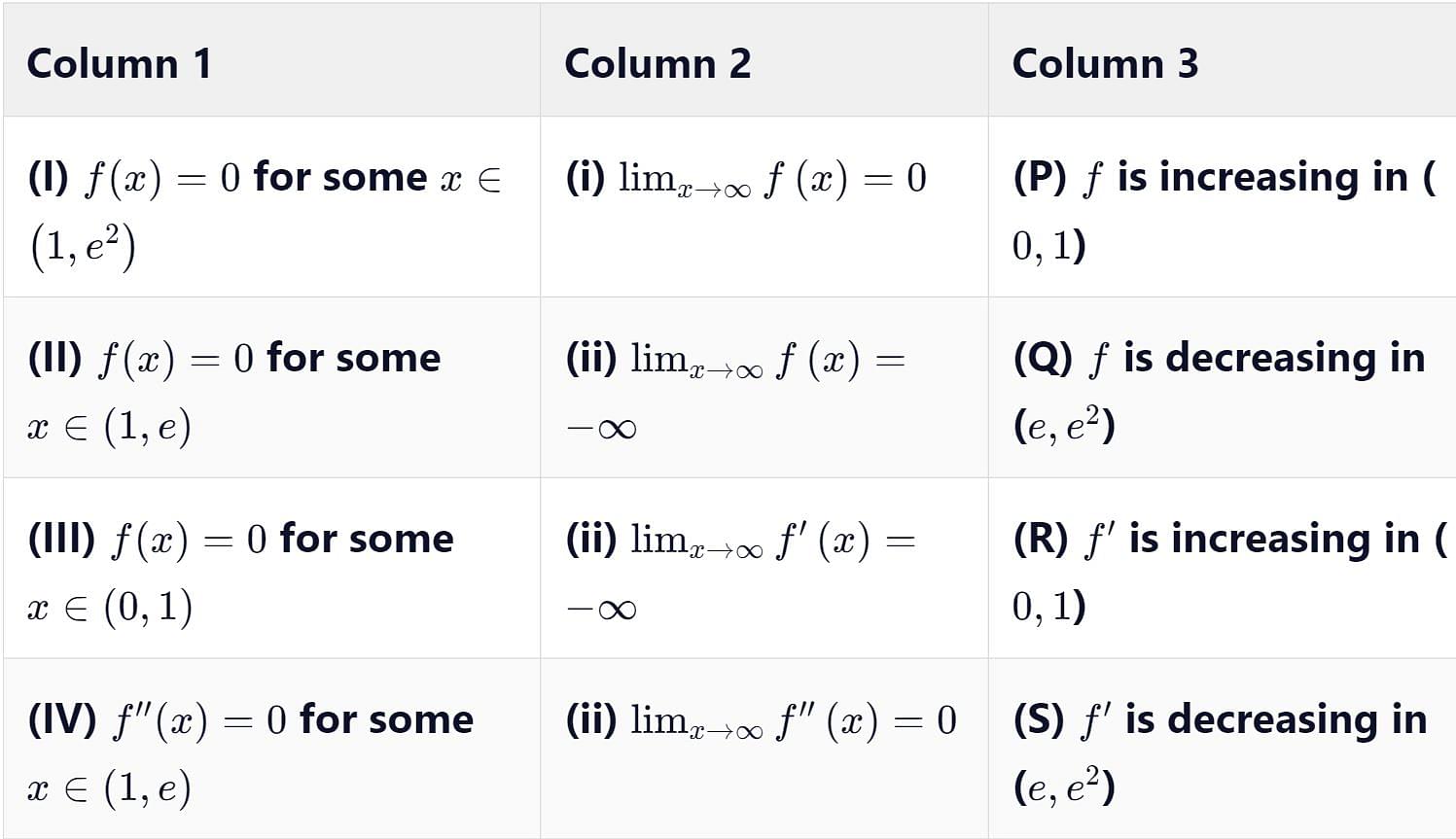
View More Questions
Top JEE Advanced Application of derivatives Questions
Let \(f(x)=x+log_{e}x−xlog_{e}x,\text{ }x∈(0,∞)\).
- Column 1 contains information about zeros of \(f(x)\), \(f'(x)\) and \(f''(x)\).
- Column 2 contains information about the limiting behavior of \(f(x)\), \(f'(x)\) and \(f''(x)\) at infinity.
- Column 3 contains information about increasing/decreasing nature of \(f(x)\) and \(f'(x)\).
- If '' > 0$ for all $
- If $f: R \rightarrow R$ is a differentiable function such that $f'(x)>2 f(x)$ for all $x \in R$, and $f(0)=1$, then
- f(x) is cubic polynomial with f(2) = 18 and f(1) = -1. Also f(x) has local maxima at x = -1 and f '(x) has local minima at x = 0, then
- For all $x\,\in\,(0,1)$
View More Questions
Top JEE Advanced Questions
- Yellow light is used in a single slit diffraction experiment with slit width of 0.6 mm. If yellow light is replaced by X-rays, then the observed pattern will reveal
- The size of the image of an object, which is at infinity, as formed by a convex lens of focal length 30 cm is 2 cm. If a concave lens of focal length 20 cm is placed between the convex lens and the image at a distance of 26 cm from the convex lens, calculate the new size of the image.
- A concave lens of glass, refractive index 1.5 has both surfaces of same radius of curvature R. On immersion in a medium of refractive index 1.75, it will behave as a
- The position vector $\vec{r}$ of a particle of mass $m$ is given by the following equation $\vec{r}(t)=\alpha t^{3} \hat{i}+\beta t^{2} \hat{j}$ where $\alpha=\frac{10}{3} \,ms ^{-3}, \beta=5\, ms ^{-2}$ and $m =0.1 \,kg$. At $t =1\, s$, which of the following statement (s) is (are) true about the particle?
- In an n-p-n transistor circuit, the collector current is 10 mA. If 90% of the electrons emitted reach the collector
View More Questions