Question:
Let \(M = \left(I_n - \frac{1}{n}\mathbf{1}\mathbf{1}^T\right)\) be a matrix, where \(\mathbf{1} = (1,1,1,\ldots,1)^T \in \mathbb{R}^n\) and \(I_n\) is the identity matrix of order \(n\).
Which of the following options is/are correct?
Let \(M = \left(I_n - \frac{1}{n}\mathbf{1}\mathbf{1}^T\right)\) be a matrix, where \(\mathbf{1} = (1,1,1,\ldots,1)^T \in \mathbb{R}^n\) and \(I_n\) is the identity matrix of order \(n\).
Which of the following options is/are correct?
Which of the following options is/are correct?
Show Hint
Use the identity \(\mathbf{1}^T\mathbf{1}=n\) to expand \(M^2\) and \(\text{Trace}(M)\); a symmetric idempotent matrix is by definition a projection matrix.
Updated On: Jul 22, 2026
- \(M^T = M\)
- \(M^2 = I_n\)
- \(\text{Trace}(M) = n\)
- \(M\) is a projection matrix
Show Solution

Verified By Collegedunia
The Correct Option is A, D
Solution and Explanation
Step 1: Understand the matrix M.
\(M = I_n - \frac{1}{n}\mathbf{1}\mathbf{1}^T\) is the well known centering matrix. \(\mathbf{1}\mathbf{1}^T\) is an \(n \times n\) matrix of all ones, so \(M\) subtracts the average of the entries of a vector from each of its components when applied. Before checking the options, note the key scalar fact \(\mathbf{1}^T\mathbf{1} = n\), since it is a sum of \(n\) ones.
Step 2: Check option (A), symmetry.
\(I_n\) is symmetric, and \(\mathbf{1}\mathbf{1}^T\) is symmetric because \((\mathbf{1}\mathbf{1}^T)^T = \mathbf{1}\mathbf{1}^T\) (the transpose of an outer product of a vector with itself is itself). A difference of two symmetric matrices is symmetric, so \(M^T = M\). Option (A) is correct.
Step 3: Check option (B), whether M squared is the identity.
Expand \(M^2\):
\[ M^2 = \left(I_n - \frac{1}{n}\mathbf{1}\mathbf{1}^T\right)^2 = I_n - \frac{2}{n}\mathbf{1}\mathbf{1}^T + \frac{1}{n^2}\mathbf{1}\mathbf{1}^T\mathbf{1}\mathbf{1}^T \]
Use \(\mathbf{1}^T\mathbf{1} = n\), so \(\mathbf{1}\mathbf{1}^T\mathbf{1}\mathbf{1}^T = \mathbf{1}(\mathbf{1}^T\mathbf{1})\mathbf{1}^T = n\,\mathbf{1}\mathbf{1}^T\).
\[ M^2 = I_n - \frac{2}{n}\mathbf{1}\mathbf{1}^T + \frac{1}{n^2}\cdot n\,\mathbf{1}\mathbf{1}^T = I_n - \frac{2}{n}\mathbf{1}\mathbf{1}^T + \frac{1}{n}\mathbf{1}\mathbf{1}^T = I_n - \frac{1}{n}\mathbf{1}\mathbf{1}^T = M \]
So \(M^2 = M\), not \(I_n\) (for \(n > 1\), \(M \neq I_n\)). Option (B) is incorrect.
Step 4: Check option (C), the trace.
\[ \text{Trace}(M) = \text{Trace}(I_n) - \frac{1}{n}\text{Trace}(\mathbf{1}\mathbf{1}^T) \]
\(\text{Trace}(I_n) = n\), and \(\text{Trace}(\mathbf{1}\mathbf{1}^T) = \mathbf{1}^T\mathbf{1} = n\) (the trace of an outer product equals the inner product).
\[ \text{Trace}(M) = n - \frac{1}{n}\cdot n = n - 1 \]
This is \(n-1\), not \(n\), so option (C) is incorrect.
Step 5: Check option (D), whether M is a projection matrix.
A matrix is called a projection matrix when it is symmetric and idempotent, meaning \(M^T = M\) and \(M^2 = M\). Step 2 showed \(M^T = M\) and Step 3 showed \(M^2 = M\). Both conditions hold, so \(M\) is indeed a (orthogonal) projection matrix, it projects any vector onto the subspace orthogonal to \(\mathbf{1}\). Option (D) is correct.
Final Answer:
Options (A) and (D) are correct. \[ \boxed{\text{(A), (D)}} \]
\(M = I_n - \frac{1}{n}\mathbf{1}\mathbf{1}^T\) is the well known centering matrix. \(\mathbf{1}\mathbf{1}^T\) is an \(n \times n\) matrix of all ones, so \(M\) subtracts the average of the entries of a vector from each of its components when applied. Before checking the options, note the key scalar fact \(\mathbf{1}^T\mathbf{1} = n\), since it is a sum of \(n\) ones.
Step 2: Check option (A), symmetry.
\(I_n\) is symmetric, and \(\mathbf{1}\mathbf{1}^T\) is symmetric because \((\mathbf{1}\mathbf{1}^T)^T = \mathbf{1}\mathbf{1}^T\) (the transpose of an outer product of a vector with itself is itself). A difference of two symmetric matrices is symmetric, so \(M^T = M\). Option (A) is correct.
Step 3: Check option (B), whether M squared is the identity.
Expand \(M^2\):
\[ M^2 = \left(I_n - \frac{1}{n}\mathbf{1}\mathbf{1}^T\right)^2 = I_n - \frac{2}{n}\mathbf{1}\mathbf{1}^T + \frac{1}{n^2}\mathbf{1}\mathbf{1}^T\mathbf{1}\mathbf{1}^T \]
Use \(\mathbf{1}^T\mathbf{1} = n\), so \(\mathbf{1}\mathbf{1}^T\mathbf{1}\mathbf{1}^T = \mathbf{1}(\mathbf{1}^T\mathbf{1})\mathbf{1}^T = n\,\mathbf{1}\mathbf{1}^T\).
\[ M^2 = I_n - \frac{2}{n}\mathbf{1}\mathbf{1}^T + \frac{1}{n^2}\cdot n\,\mathbf{1}\mathbf{1}^T = I_n - \frac{2}{n}\mathbf{1}\mathbf{1}^T + \frac{1}{n}\mathbf{1}\mathbf{1}^T = I_n - \frac{1}{n}\mathbf{1}\mathbf{1}^T = M \]
So \(M^2 = M\), not \(I_n\) (for \(n > 1\), \(M \neq I_n\)). Option (B) is incorrect.
Step 4: Check option (C), the trace.
\[ \text{Trace}(M) = \text{Trace}(I_n) - \frac{1}{n}\text{Trace}(\mathbf{1}\mathbf{1}^T) \]
\(\text{Trace}(I_n) = n\), and \(\text{Trace}(\mathbf{1}\mathbf{1}^T) = \mathbf{1}^T\mathbf{1} = n\) (the trace of an outer product equals the inner product).
\[ \text{Trace}(M) = n - \frac{1}{n}\cdot n = n - 1 \]
This is \(n-1\), not \(n\), so option (C) is incorrect.
Step 5: Check option (D), whether M is a projection matrix.
A matrix is called a projection matrix when it is symmetric and idempotent, meaning \(M^T = M\) and \(M^2 = M\). Step 2 showed \(M^T = M\) and Step 3 showed \(M^2 = M\). Both conditions hold, so \(M\) is indeed a (orthogonal) projection matrix, it projects any vector onto the subspace orthogonal to \(\mathbf{1}\). Option (D) is correct.
Final Answer:
Options (A) and (D) are correct. \[ \boxed{\text{(A), (D)}} \]
Was this answer helpful?
0
0
Top GATE DA Data Science and Artificial Intelligence Questions
- Consider performing depth-first search (DFS) on an undirected and unweighted graph G starting at vertex s. For any vertex u in G, d[u] is the length of the shortest path from s to u. Let (u, v) be an edge in G such that d[u] < d[v]. If the edge (u, v) is explored first in the direction from u to v during the above DFS, then (u, v) becomes a _____ edge.
- Three fair coins are tossed independently. T is the event that two or more tosses result in heads. S is the event that two or more tosses result in tails. What is the probability of the event T ∩ S?
- Consider the matrix \(M=\begin{bmatrix} 2 & -1 \\ 3 & 1 \end{bmatrix}\).
Which ONE of the following statements is TRUE ? - For any twice differentiable function ƒ: R → R, if at some x* ∈ R, f'(x*) = 0 and f'(x*) > 0, then the function f necessarily has a ______ at x = x*.
Note : R denotes the set of real numbers. - Match the items in Column 1 with the items in Column 2 in the following table :
Column 1 Column 2 (p) First In First Out (i) Stacks (q) Lookup Operation (ii) Queues (r) Last In First Out (iii) Hash Tables
View More Questions
Top GATE DA Linear Algebra Questions
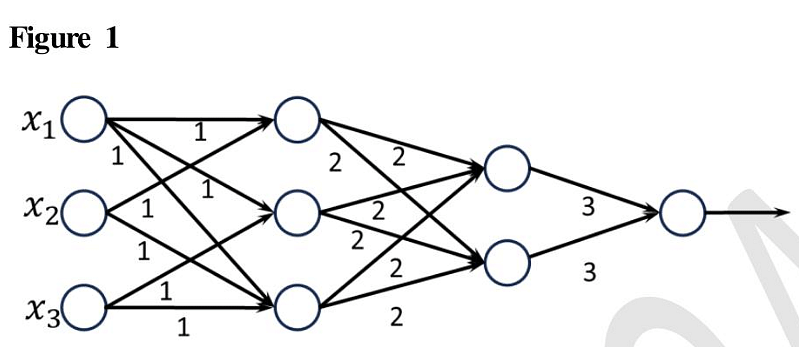
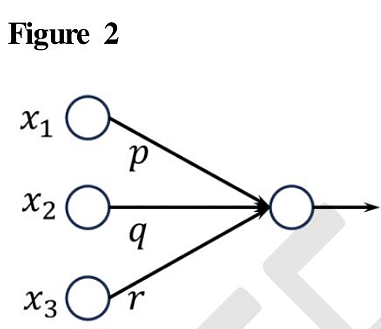
- Consider the two neural networks (NNs) shown in Figures 1 and 2, with ReLU activation (ReLU(z) = max{0, z}, ∀z ∈ R). R denotes the set of real numbers. The connections and their corresponding weights are shown in the Figures. The biases at every neuron are set to 0. For what values of p, q, r in Figure 2 are the two NNs equivalent, when x1, x2, x3 are positive ?
- Select all choices that are subspaces of \(\R^3\).
Note : \(\R\) denotes the set of real numbers. - Which of the following statements is/are TRUE ?
Note: \(\R\) denotes the set of real numbers. - Let \(\R\) be the set of real numbers, U be a subspace of \(\R^3\) and M ∈ \(\R^{3×3}\) be the matrix corresponding to the projection on to the subspace U.
Which of the following statements is/are TRUE ? - Consider the directed acyclic graph (DAG) below :
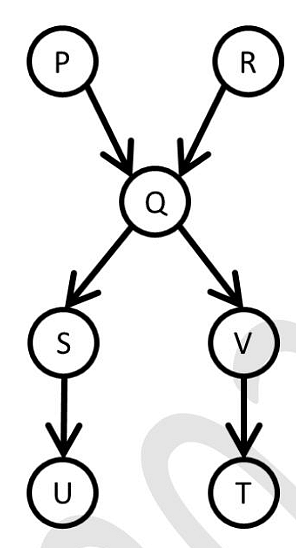
Which of the following is/are valid vertex orderings that can be obtained from a topological sort of the DAG ?
View More Questions
Top GATE DA Questions
- Consider performing depth-first search (DFS) on an undirected and unweighted graph G starting at vertex s. For any vertex u in G, d[u] is the length of the shortest path from s to u. Let (u, v) be an edge in G such that d[u] < d[v]. If the edge (u, v) is explored first in the direction from u to v during the above DFS, then (u, v) becomes a _____ edge.
- Three fair coins are tossed independently. T is the event that two or more tosses result in heads. S is the event that two or more tosses result in tails. What is the probability of the event T ∩ S?
- Consider the matrix \(M=\begin{bmatrix} 2 & -1 \\ 3 & 1 \end{bmatrix}\).
Which ONE of the following statements is TRUE ? - For any twice differentiable function ƒ: R → R, if at some x* ∈ R, f'(x*) = 0 and f'(x*) > 0, then the function f necessarily has a ______ at x = x*.
Note : R denotes the set of real numbers. - Match the items in Column 1 with the items in Column 2 in the following table :
Column 1 Column 2 (p) First In First Out (i) Stacks (q) Lookup Operation (ii) Queues (r) Last In First Out (iii) Hash Tables
View More Questions