Question:
Let $L$ be the straight line joining the points $P(1, 2, -1)$ and $Q(2, 3, 1)$. Let $S$ be the foot of the perpendicular drawn from the point $R(4, -1, 5)$ to the line $L$. Another line passing through $R$ intersects $L$ at a point $T$ such that the point $S$ divides the line segment $PT$ internally in the ratio $|PS| : |ST| = 1 : 2$, where $|PS|$ and $|ST|$ are the lengths of the line segments $PS$ and $ST$, respectively.
Then which of the following statements is (are) TRUE?
Let $L$ be the straight line joining the points $P(1, 2, -1)$ and $Q(2, 3, 1)$. Let $S$ be the foot of the perpendicular drawn from the point $R(4, -1, 5)$ to the line $L$. Another line passing through $R$ intersects $L$ at a point $T$ such that the point $S$ divides the line segment $PT$ internally in the ratio $|PS| : |ST| = 1 : 2$, where $|PS|$ and $|ST|$ are the lengths of the line segments $PS$ and $ST$, respectively.
Then which of the following statements is (are) TRUE?
Show Hint
In a triangle where the foot of the altitude from one vertex is known on the opposite side, the orthocentre is easily found by parameterizing the altitude line and using the dot product with another side vector.
Updated On: Jun 4, 2026
- The orthocentre of the triangle $PRT$ is $\left( \frac{23}{5}, -4, \frac{31}{5} \right)$
- The orthocentre of the triangle $PRT$ is $(4, 3, 5)$
- The area of the triangle $PRT$ is $6\sqrt{5}$
- The area of the triangle $PRT$ is $18\sqrt{5}$
Show Solution

Verified By Collegedunia
The Correct Option is A
Solution and Explanation
Step 1: Understanding the Question:
This 3D geometry problem involves finding coordinates of specific points relative to a line and then analyzing properties of a triangle formed by these points.
Step 2: Key Formula or Approach:
• Equation of line through $(x_1, y_1, z_1)$ and $(x_2, y_2, z_2)$.
• Foot of perpendicular using dot product of direction vectors.
• Section formula for internal division.
• Orthocentre is the intersection of altitudes.
Step 3: Detailed Explanation:
• Line $L$ passes through $P(1,2,-1)$ and $Q(2,3,1)$. Direction vector $\vec{d} = (1, 1, 2)$.
• Equation of $L: \vec{r} = (1,2,-1) + \lambda(1,1,2)$.
• Point $S$ on $L$: $S = (1+\lambda, 2+\lambda, -1+2\lambda)$. Vector $\vec{RS} = (\lambda-3, \lambda+3, 2\lambda-6)$.
• $\vec{RS} \cdot \vec{d} = 0 \implies (\lambda-3) + (\lambda+3) + 2(2\lambda-6) = 0 \implies 6\lambda - 12 = 0 \implies \lambda = 2$.
• So, $S = (3, 4, 3)$. Length $|PS| = \sqrt{(3-1)^2 + (4-2)^2 + (3-(-1))^2} = \sqrt{4+4+16} = \sqrt{24} = 2\sqrt{6}$.
• $S$ divides $PT$ in $1:2$ ratio: $\vec{S} = \frac{1\vec{T} + 2\vec{P}}{3} \implies \vec{T} = 3\vec{S} - 2\vec{P}$.
\[ T = 3(3,4,3) - 2(1,2,-1) = (9,12,9) - (2,4,-2) = (7, 8, 11). \]
• $|PT| = \sqrt{(7-1)^2 + (8-2)^2 + (11-(-1))^2} = \sqrt{36+36+144} = \sqrt{216} = 6\sqrt{6}$.
• Altitude $|RS| = \sqrt{(4-3)^2 + (-1-4)^2 + (5-3)^2} = \sqrt{1+25+4} = \sqrt{30}$.
• Area of $\triangle PRT$: Base is $PT$, height is $RS$ (since $RS \perp L$ and $P, T$ are on $L$). \[ \text{Area} = \frac{1}{2} \times 6\sqrt{6} \times \sqrt{30} = 3\sqrt{180} = 3 \times 6\sqrt{5} = 18\sqrt{5}. \] Statement (D) is TRUE, (C) is FALSE.
• Orthocentre $H$: Lies on altitude $RS$. $H = (3+k, 4-5k, 3+2k)$ (dir of $RS$ is $(1,-5,2)$).
Altitude from $P$ to $RT$ must pass through $H$. Vector $\vec{PH} = (2+k, 2-5k, 4+2k)$ is perp to $\vec{RT} = (3, 9, 6)$.
\[ 3(2+k) + 9(2-5k) + 6(4+2k) = 0 \implies 6+3k + 18-45k + 24+12k = 0 \implies -30k + 48 = 0 \] \[\implies k = 1.6 = \frac{8}{5}. \] \[ H = \left( 3 + \frac{8}{5}, 4 - 8, 3 + \frac{16}{5} \right) = \left( \frac{23}{5}, -4, \frac{31}{5} \right). \] Statement (A) is TRUE.
Step 4: Final Answer:
The true statements are (A) and (D).
This 3D geometry problem involves finding coordinates of specific points relative to a line and then analyzing properties of a triangle formed by these points.
Step 2: Key Formula or Approach:
• Equation of line through $(x_1, y_1, z_1)$ and $(x_2, y_2, z_2)$.
• Foot of perpendicular using dot product of direction vectors.
• Section formula for internal division.
• Orthocentre is the intersection of altitudes.
Step 3: Detailed Explanation:
• Line $L$ passes through $P(1,2,-1)$ and $Q(2,3,1)$. Direction vector $\vec{d} = (1, 1, 2)$.
• Equation of $L: \vec{r} = (1,2,-1) + \lambda(1,1,2)$.
• Point $S$ on $L$: $S = (1+\lambda, 2+\lambda, -1+2\lambda)$. Vector $\vec{RS} = (\lambda-3, \lambda+3, 2\lambda-6)$.
• $\vec{RS} \cdot \vec{d} = 0 \implies (\lambda-3) + (\lambda+3) + 2(2\lambda-6) = 0 \implies 6\lambda - 12 = 0 \implies \lambda = 2$.
• So, $S = (3, 4, 3)$. Length $|PS| = \sqrt{(3-1)^2 + (4-2)^2 + (3-(-1))^2} = \sqrt{4+4+16} = \sqrt{24} = 2\sqrt{6}$.
• $S$ divides $PT$ in $1:2$ ratio: $\vec{S} = \frac{1\vec{T} + 2\vec{P}}{3} \implies \vec{T} = 3\vec{S} - 2\vec{P}$.
\[ T = 3(3,4,3) - 2(1,2,-1) = (9,12,9) - (2,4,-2) = (7, 8, 11). \]
• $|PT| = \sqrt{(7-1)^2 + (8-2)^2 + (11-(-1))^2} = \sqrt{36+36+144} = \sqrt{216} = 6\sqrt{6}$.
• Altitude $|RS| = \sqrt{(4-3)^2 + (-1-4)^2 + (5-3)^2} = \sqrt{1+25+4} = \sqrt{30}$.
• Area of $\triangle PRT$: Base is $PT$, height is $RS$ (since $RS \perp L$ and $P, T$ are on $L$). \[ \text{Area} = \frac{1}{2} \times 6\sqrt{6} \times \sqrt{30} = 3\sqrt{180} = 3 \times 6\sqrt{5} = 18\sqrt{5}. \] Statement (D) is TRUE, (C) is FALSE.
• Orthocentre $H$: Lies on altitude $RS$. $H = (3+k, 4-5k, 3+2k)$ (dir of $RS$ is $(1,-5,2)$).
Altitude from $P$ to $RT$ must pass through $H$. Vector $\vec{PH} = (2+k, 2-5k, 4+2k)$ is perp to $\vec{RT} = (3, 9, 6)$.
\[ 3(2+k) + 9(2-5k) + 6(4+2k) = 0 \implies 6+3k + 18-45k + 24+12k = 0 \implies -30k + 48 = 0 \] \[\implies k = 1.6 = \frac{8}{5}. \] \[ H = \left( 3 + \frac{8}{5}, 4 - 8, 3 + \frac{16}{5} \right) = \left( \frac{23}{5}, -4, \frac{31}{5} \right). \] Statement (A) is TRUE.
Step 4: Final Answer:
The true statements are (A) and (D).
Was this answer helpful?
0
1
Top JEE Advanced Mathematics Questions
- In a $\triangle$ ABC w ith fixed base BC, the vertex A moves such that cos B + cos C = 4 $ sin^2 \frac{A}{2}$. If a, b and c denote th e lengths of th e sides of th e triangle opposite to the angles A, B and C respectively, then
- Let $P=[a_{ij}]$ be a $3\times3$ matrix and let $Q=[b_{ij}]$ where $b_{ij}=2^{i+j} a_{ij}$ for $1 \le i, j \le $.If the determinant of $P$ is $2$, then the determinant of the matrix $Q$ is
- For the equation $3x^2+px+3=0,p>0,$ if one of the root is square of the other, then p is equal to
- The equation $\sqrt{x+1}-\sqrt{x-1}=\sqrt{4x-1}$ has
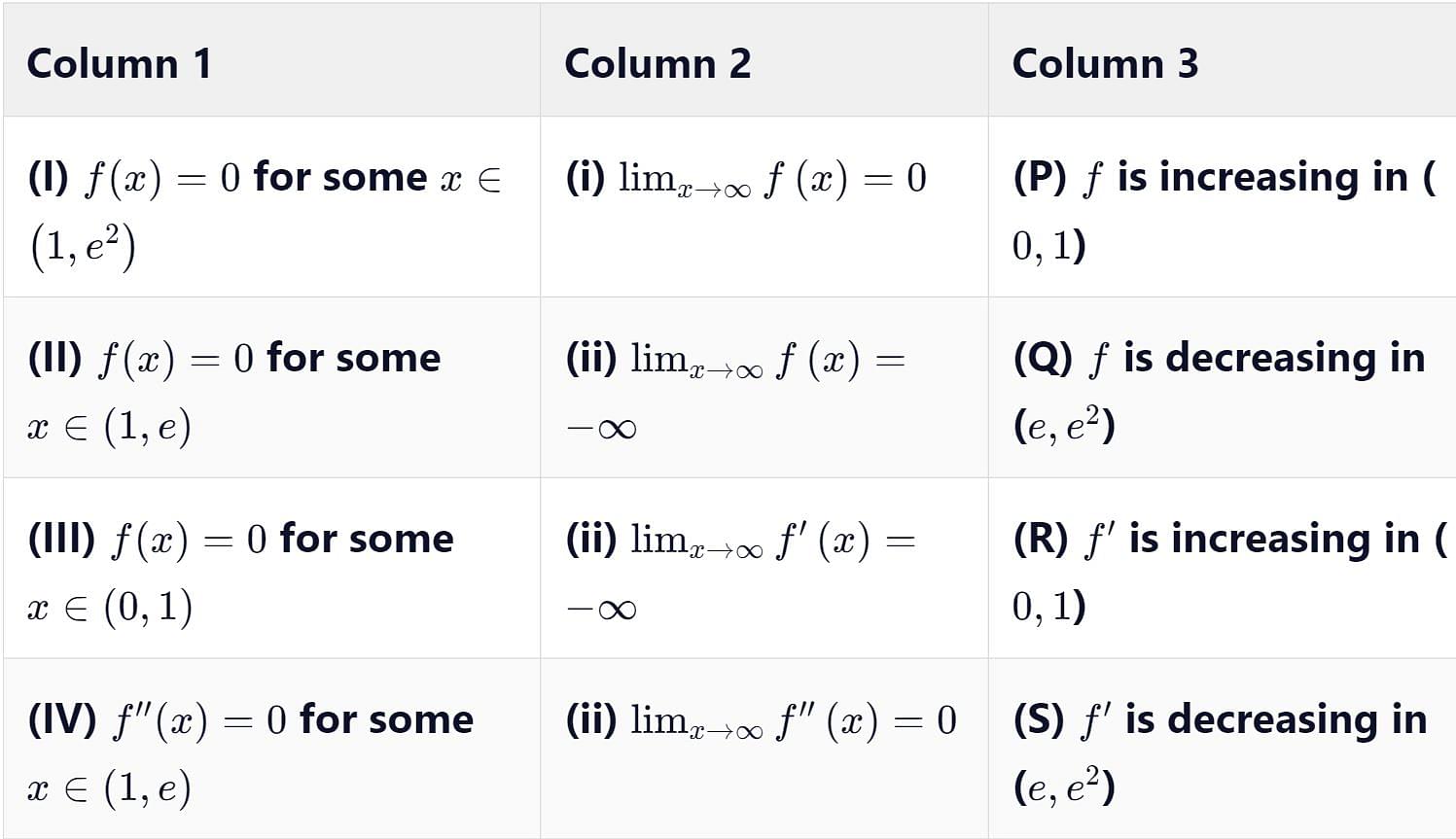
Let \(f(x)=x+log_{e}x−xlog_{e}x,\text{ }x∈(0,∞)\).
- Column 1 contains information about zeros of \(f(x)\), \(f'(x)\) and \(f''(x)\).
- Column 2 contains information about the limiting behavior of \(f(x)\), \(f'(x)\) and \(f''(x)\) at infinity.
- Column 3 contains information about increasing/decreasing nature of \(f(x)\) and \(f'(x)\).
View More Questions
Top JEE Advanced Three Dimensional Geometry Questions
- The equation of the plane passing through the point $(1, 1, 1)$ and perpendicular to the planes $2
- In $R^3$, consider the planes $P_1 : y = 0$ and $P_2 : x + z = 1$. Let $P_3$ be a plane, different from $P_1$ and $P_2$, which passes through the intersection of $P_1$ and $P_2$. If the distance of the point $(0, 1, 0)$ from $P_3$ is $1$ and the distance of a point $(\alpha, \beta, \gamma)$ from $P_3$ is $2$, then which of the following relations is (are) true ?
- In $R^3$, Let $L$ be a straight line passing through the origin. Suppose that all the points on $L$ are at a constant distance from the two planes $P_1 : x + 2y - z + 1 = 0$ and $P_2 : 2x - y + z - 1 = 0$. Let $M$ be the locus of the feet of the perpendiculars drawn from the points on $L$ to the plane $P_1$. Which of the following points lie(s) on $M$ ?
- If the distance of the point $P (1, - 2,1)$ from the plane $x + 2y - 2z = a$, where $a > 0$, is $5$, then the foot of the perpendicular form $ P$ to the plane is
- Equation of the plane containing the straight line $\frac{x}{2}=\frac{y}{3}= \frac{z}{4}$ and perpendicular to the plane containing the staight lines $\frac{x}{2}=\frac{y}{4}= \frac{z}{2}$ and $\frac{x}{4}=\frac{y}{2}= \frac{z}{3}$ is
View More Questions
Top JEE Advanced Questions
- Yellow light is used in a single slit diffraction experiment with slit width of 0.6 mm. If yellow light is replaced by X-rays, then the observed pattern will reveal
- The size of the image of an object, which is at infinity, as formed by a convex lens of focal length 30 cm is 2 cm. If a concave lens of focal length 20 cm is placed between the convex lens and the image at a distance of 26 cm from the convex lens, calculate the new size of the image.
- A concave lens of glass, refractive index 1.5 has both surfaces of same radius of curvature R. On immersion in a medium of refractive index 1.75, it will behave as a
- The position vector $\vec{r}$ of a particle of mass $m$ is given by the following equation $\vec{r}(t)=\alpha t^{3} \hat{i}+\beta t^{2} \hat{j}$ where $\alpha=\frac{10}{3} \,ms ^{-3}, \beta=5\, ms ^{-2}$ and $m =0.1 \,kg$. At $t =1\, s$, which of the following statement (s) is (are) true about the particle?
- In an n-p-n transistor circuit, the collector current is 10 mA. If 90% of the electrons emitted reach the collector
View More Questions