Let $f: R \rightarrow R$ be defined by $f(x)=\frac{x^{2}-3 x-6}{x^{2}+2 x+4}$. Then which of the following statements is(are) TRUE?
- $f$ is decreasing in the interval $(-2,-1)$
- $f$ is increasing in the interval $(1,2)$
- $f$ is onto
- Range of $f$ is $\left[-\frac{3}{2}, 2\right]$

The Correct Option is A, B
Solution and Explanation
Step 1: Given Function
The given function is \( f(x) = \frac{x^2 - 3x - 6}{x^2 + 2x + 4} \), and we need to determine whether the function is increasing or decreasing in the specified intervals.
Step 2: First Derivative Calculation
To determine whether \( f(x) \) is increasing or decreasing in a given interval, we need to find the first derivative \( f'(x) \). Using the quotient rule for differentiation, we have:
\[
f'(x) = \frac{(x^2 + 2x + 4)(2x - 3) - (x^2 - 3x - 6)(2x + 2)}{(x^2 + 2x + 4)^2}
\]
Let's simplify the numerator:
\[
\text{Numerator} = (x^2 + 2x + 4)(2x - 3) - (x^2 - 3x - 6)(2x + 2)
\]
Expanding both terms:
\[
(x^2 + 2x + 4)(2x - 3) = 2x^3 - 3x^2 + 4x^2 - 6x + 8x - 12 = 2x^3 + x^2 + 2x - 12
\]
\[
(x^2 - 3x - 6)(2x + 2) = 2x^3 + 2x^2 - 6x^2 - 6x - 12x - 12 = 2x^3 - 4x^2 - 18x - 12
\]
Subtracting the two expressions:
\[
\text{Numerator} = (2x^3 + x^2 + 2x - 12) - (2x^3 - 4x^2 - 18x - 12) = 5x^2 + 20x
\]
Thus, the derivative becomes:
\[
f'(x) = \frac{5x^2 + 20x}{(x^2 + 2x + 4)^2}
\]
Step 3: Analyze the Sign of the Derivative
To determine whether the function is increasing or decreasing in an interval, we need to analyze the sign of \( f'(x) \). The denominator \( (x^2 + 2x + 4)^2 \) is always positive since the quadratic \( x^2 + 2x + 4 \) has no real roots and is always positive for all \( x \). Therefore, the sign of \( f'(x) \) depends on the numerator \( 5x^2 + 20x \), which can be factored as:
\[
f'(x) = \frac{5x(x + 4)}{(x^2 + 2x + 4)^2}
\]
The critical points are the values of \( x \) where \( f'(x) = 0 \), which occur when \( x = 0 \) or \( x = -4 \).
Step 4: Interval Analysis for Statement A
We are asked to check if \( f(x) \) is decreasing in the interval \( (-2, -1) \). To do this, we need to check the sign of \( f'(x) \) in this interval. Since the critical points are \( x = -4 \) and \( x = 0 \), we evaluate the sign of \( f'(x) \) in the interval \( (-2, -1) \). Choosing a test point, say \( x = -1.5 \), we find:
\[
f'(-1.5) = \frac{5(-1.5)(-1.5 + 4)}{( (-1.5)^2 + 2(-1.5) + 4 )^2}
\]
Simplifying:
\[
f'(-1.5) = \frac{5(-1.5)(2.5)}{(2.25 - 3 + 4)^2} = \frac{-18.75}{(3.25)^2} < 0
\]
Since \( f'(-1.5) < 0 \), the function is decreasing in the interval \( (-2, -1) \). Hence, statement (A) is true.
Step 5: Interval Analysis for Statement B
We are asked to check if \( f(x) \) is increasing in the interval \( (1, 2) \). Again, we check the sign of \( f'(x) \) in this interval. The critical points \( x = -4 \) and \( x = 0 \) are not in this interval, so we check the sign of \( f'(x) \) for \( x = 1.5 \):
\[
f'(1.5) = \frac{5(1.5)(1.5 + 4)}{( (1.5)^2 + 2(1.5) + 4 )^2}
\]
Simplifying:
\[
f'(1.5) = \frac{5(1.5)(5.5)}{(2.25 + 3 + 4)^2} = \frac{41.25}{9.25^2} > 0
\]
Since \( f'(1.5) > 0 \), the function is increasing in the interval \( (1, 2) \). Hence, statement (B) is true.
Final Answer:
Both statements (A) and (B) are correct:
- (A) \( f(x) \) is decreasing in the interval \( (-2, -1) \).
- (B) \( f(x) \) is increasing in the interval \( (1, 2) \).
Top JEE Advanced Mathematics Questions
- In a $\triangle$ ABC w ith fixed base BC, the vertex A moves such that cos B + cos C = 4 $ sin^2 \frac{A}{2}$. If a, b and c denote th e lengths of th e sides of th e triangle opposite to the angles A, B and C respectively, then
- Let $P=[a_{ij}]$ be a $3\times3$ matrix and let $Q=[b_{ij}]$ where $b_{ij}=2^{i+j} a_{ij}$ for $1 \le i, j \le $.If the determinant of $P$ is $2$, then the determinant of the matrix $Q$ is
- For the equation $3x^2+px+3=0,p>0,$ if one of the root is square of the other, then p is equal to
- The equation $\sqrt{x+1}-\sqrt{x-1}=\sqrt{4x-1}$ has
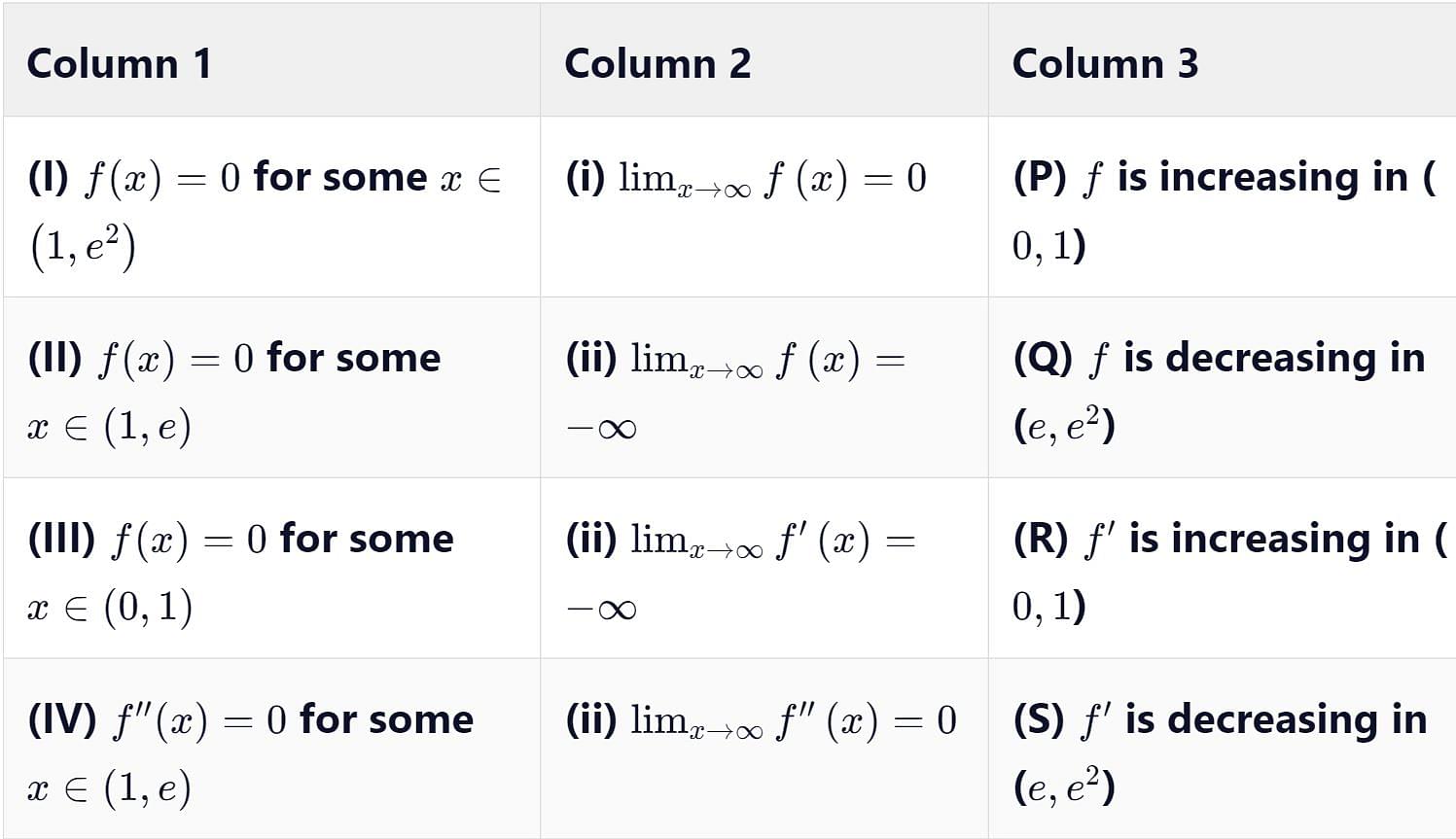
Let \(f(x)=x+log_{e}x−xlog_{e}x,\text{ }x∈(0,∞)\).
- Column 1 contains information about zeros of \(f(x)\), \(f'(x)\) and \(f''(x)\).
- Column 2 contains information about the limiting behavior of \(f(x)\), \(f'(x)\) and \(f''(x)\) at infinity.
- Column 3 contains information about increasing/decreasing nature of \(f(x)\) and \(f'(x)\).
Top JEE Advanced Relations Questions
Top JEE Advanced Questions
- Yellow light is used in a single slit diffraction experiment with slit width of 0.6 mm. If yellow light is replaced by X-rays, then the observed pattern will reveal
- The size of the image of an object, which is at infinity, as formed by a convex lens of focal length 30 cm is 2 cm. If a concave lens of focal length 20 cm is placed between the convex lens and the image at a distance of 26 cm from the convex lens, calculate the new size of the image.
- A concave lens of glass, refractive index 1.5 has both surfaces of same radius of curvature R. On immersion in a medium of refractive index 1.75, it will behave as a
- The position vector $\vec{r}$ of a particle of mass $m$ is given by the following equation $\vec{r}(t)=\alpha t^{3} \hat{i}+\beta t^{2} \hat{j}$ where $\alpha=\frac{10}{3} \,ms ^{-3}, \beta=5\, ms ^{-2}$ and $m =0.1 \,kg$. At $t =1\, s$, which of the following statement (s) is (are) true about the particle?
- In an n-p-n transistor circuit, the collector current is 10 mA. If 90% of the electrons emitted reach the collector
Concepts Used:
Relations and functions
A relation R from a non-empty set B is a subset of the cartesian product A × B. The subset is derived by describing a relationship between the first element and the second element of the ordered pairs in A × B.
A relation f from a set A to a set B is said to be a function if every element of set A has one and only one image in set B. In other words, no two distinct elements of B have the same pre-image.
Representation of Relation and Function
Relations and functions can be represented in different forms such as arrow representation, algebraic form, set-builder form, graphically, roster form, and tabular form. Define a function f: A = {1, 2, 3} → B = {1, 4, 9} such that f(1) = 1, f(2) = 4, f(3) = 9. Now, represent this function in different forms.
- Set-builder form - {(x, y): f(x) = y2, x ∈ A, y ∈ B}
- Roster form - {(1, 1), (2, 4), (3, 9)}
- Arrow Representation
