Let $f: R \rightarrow R$ be defined as,
$f(x) =
\begin{cases}
-55x, & \text{if } x < -5 \\
2x^3 -3x^2 -120x, & \text{if } 5 \le x \le 4 \\
2x^3 -3x^2-36x-336& \text{if } x > 4,
\end{cases} $
Let $A=\{ x \in R : f$ is increasing $\} .$ Then $A$ is equal to
- $(-\infty,-5) \cup(4, \infty)$
- $(-5, \infty)$
- $(-\infty,-5) \cup(-4, \infty)$
- (-5,-4)$\cup(4, \infty)$

The Correct Option is D
Approach Solution - 1
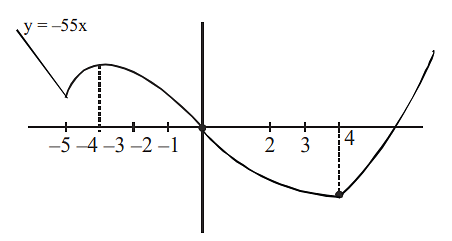
Approach Solution -2
The correct answer is (D) : (-5,-4)\(\cup(4, \infty)\)
For f'(x) ≥ 0
Case I :- -5 < x < 4
Then f'(x) ≥ 0 ≥ 0 implies
6x2 - 6x - 120 ≥ 0
⇒ x2 - x - 20 ≥ 0
⇒ (x - 5) (x + 4) ≥ 0
⇒ x ≤ - 4 or x ≥ 5
But -5 <x <4
∴ -5 < x < 4
Hence, function f(x) increases in domain x ∈ (-5, -4)
Case II :- x > 4
Then f'(x) ≥ ≥ 0 implies
6x2 - 6x - 36 ≥ 0
⇒ x2 - x - 6 ≥ 0
⇒ (x - 3) (x + 2) ≥ 0
⇒ x ≤ - 2 or x ≥ 3
But x > 4
Hence, f(x) increases in (4, ∞ )
From both cases, we can say that f(x) is increases in (-5, -4) U (4, ∞ ).
A = {x|x ∈ (-5, -4) U (4, ∞ )}
Top JEE Main Mathematics Questions
- The value of is
- The number of terms of an is even. The sum of the odd terms is and of the even terms is . The last term exceeds the first by . Then the number of terms in the series is ______.
- If , then the general value of is:
- The general solution of
- If the constant term in the binomial expansion of $\left(\frac{x^{\frac{3}{2}}}{2}-\frac{4}{x^l}\right)^9$ is $-84$ and the coefficient of $x^{-3 l}$ is $2^\alpha \beta$, where $\beta<0$ is an odd number, then $|\alpha l-\beta|$ is equal to_____
Top JEE Main Functions Questions
The domain of \(y= cos^{-1}|\frac{2-|x|}{4}| log(3 - x)^{-1}\) is [α, β) - {y} then the value of α+β-y =?
- If the domain of the function \(f(x)\) = \(\frac{\sqrt{x^2-25}}{(4-x^2)}+ \log(x^2+2x-15)\) is \((-∞, α) ∪ (β, ∞)\), then \(α^2+β^2\) is equal to \(b\)
- If the domain of the function \[ f(x) = \cos^{-1} \left( \frac{2 - |x|}{4} \right) + \left( \log_e (3 - x) \right)^{-1} \] is \([-\alpha, \beta) - \{ \gamma \}\), then \( \alpha + \beta + \gamma \) is equal to:
- If the function \( f(x) = \begin{cases} \frac{1}{|x|}, & |x| \geq 2 \\ ax^2 + 2b, & |x| < 2 \end{cases} \) is differentiable on \( \mathbb{R} \), then \( 48 (a + b) \) is equal to \(\_\_\_\_\_\_\_\_\_\).
- Consider the function \( f : (0, 2) \to \mathbb{R} \) defined by \[ f(x) = \frac{x}{2} + \frac{2}{x} \] and the function \( g(x) \) defined by \[ g(x) = \begin{cases} \min\{f(t)\}, & 0 < t \leq x \text{ and } 0 < x \leq 1 \\ \frac{3}{2} + x, & 1 < x < 2 \end{cases} \] Then:
Top JEE Main Questions
- Two masses $m$ and $\frac{m}{2}$ are connected at the two ends of a massless rigid rod of length $l$. The rod is suspended by a thin wire of torsional constant $k$ at the centre of mass of the rod-mass system(see figure). Because of torsional constant $k$, the restoring torque is $\tau =k\theta$ for angular displacement $\theta$. If the rod is rota ted by $\theta_0$ and released, the tension in it when it passes through its mean position will be:
What will be the equilibrium constant of the given reaction carried out in a \(5 \,L\) vessel and having equilibrium amounts of \(A_2\) and \(A\) as \(0.5\) mole and \(2 \times 10^{-6}\) mole respectively?
The reaction : \(A_2 \rightleftharpoons 2A\)- The value of is
- The number of terms of an is even. The sum of the odd terms is and of the even terms is . The last term exceeds the first by . Then the number of terms in the series is ______.
A black body is at a temperature of 2880 K. The energy of radiation emitted by this body with wavelength between 499 nm and 500 nm is U1, between 999 nm and 1000 nm is U2 and between 1499 nm and 1500 nm is U3. The Wien's constant, b = 2.88×10⁶ nm-K. Then,
Concepts Used:
Functions
A function is a relation between a set of inputs and a set of permissible outputs with the property that each input is related to exactly one output. Let A & B be any two non-empty sets, mapping from A to B will be a function only when every element in set A has one end only one image in set B.
Kinds of Functions
The different types of functions are -
One to One Function: When elements of set A have a separate component of set B, we can determine that it is a one-to-one function. Besides, you can also call it injective.
Many to One Function: As the name suggests, here more than two elements in set A are mapped with one element in set B.
Moreover, if it happens that all the elements in set B have pre-images in set A, it is called an onto function or surjective function.
Also, if a function is both one-to-one and onto function, it is known as a bijective. This means, that all the elements of A are mapped with separate elements in B, and A holds a pre-image of elements of B.
Read More: Relations and Functions