Let $\alpha$ and $\beta$ be real numbers such that $-\frac{\pi}{4}<\beta<0<\alpha<\frac{\pi}{4}$ If $\sin (\alpha+\beta)=\frac{1}{3}$ and $\cos (\alpha-\beta)=\frac{2}{3}$, then the greatest integer less than or equal to $\left(\frac{\sin \alpha}{\cos \beta}+\frac{\cos \beta}{\sin \alpha}+\frac{\cos \alpha}{\sin \beta}+\frac{\sin \beta}{\cos \alpha}\right)^2$ is ____.
Let $\alpha$ and $\beta$ be real numbers such that $-\frac{\pi}{4}<\beta<0<\alpha<\frac{\pi}{4}$ If $\sin (\alpha+\beta)=\frac{1}{3}$ and $\cos (\alpha-\beta)=\frac{2}{3}$, then the greatest integer less than or equal to $\left(\frac{\sin \alpha}{\cos \beta}+\frac{\cos \beta}{\sin \alpha}+\frac{\cos \alpha}{\sin \beta}+\frac{\sin \beta}{\cos \alpha}\right)^2$ is ____.

Correct Answer: 1
Solution and Explanation
The answer is 1.
Top JEE Advanced Mathematics Questions
- In a $\triangle$ ABC w ith fixed base BC, the vertex A moves such that cos B + cos C = 4 $ sin^2 \frac{A}{2}$. If a, b and c denote th e lengths of th e sides of th e triangle opposite to the angles A, B and C respectively, then
- Let $P=[a_{ij}]$ be a $3\times3$ matrix and let $Q=[b_{ij}]$ where $b_{ij}=2^{i+j} a_{ij}$ for $1 \le i, j \le $.If the determinant of $P$ is $2$, then the determinant of the matrix $Q$ is
- For the equation $3x^2+px+3=0,p>0,$ if one of the root is square of the other, then p is equal to
- The equation $\sqrt{x+1}-\sqrt{x-1}=\sqrt{4x-1}$ has
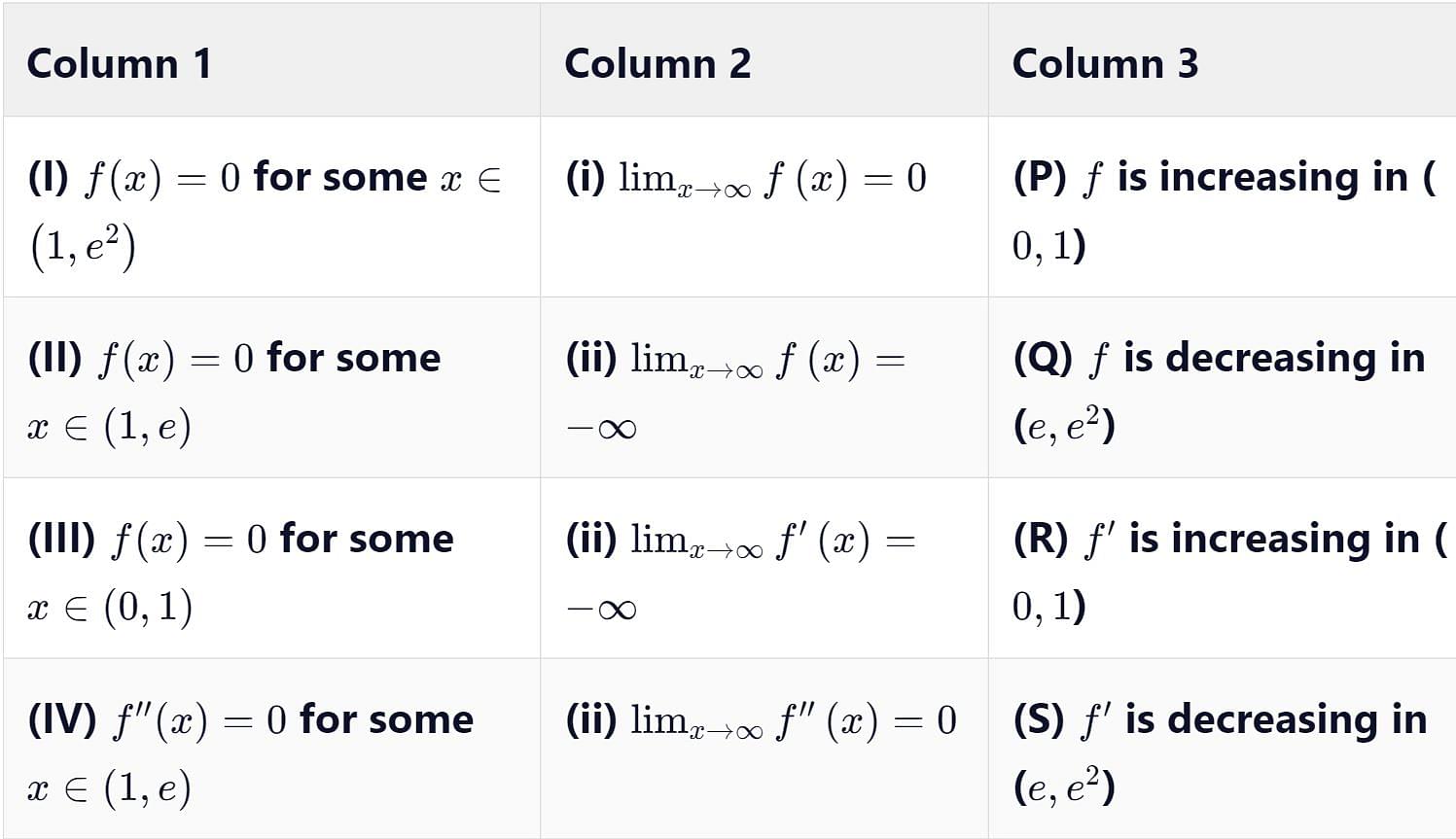
Let \(f(x)=x+log_{e}x−xlog_{e}x,\text{ }x∈(0,∞)\).
- Column 1 contains information about zeros of \(f(x)\), \(f'(x)\) and \(f''(x)\).
- Column 2 contains information about the limiting behavior of \(f(x)\), \(f'(x)\) and \(f''(x)\) at infinity.
- Column 3 contains information about increasing/decreasing nature of \(f(x)\) and \(f'(x)\).
Top JEE Advanced Some Applications of Trigonometry Questions
- Let $\alpha$ and $\beta$ be real numbers such that $-\frac{\pi}{4}<\beta<0<\alpha<\frac{\pi}{4}$. If $\sin (\alpha+\beta)=\frac{1}{3}$ and $\cos (\alpha-\beta)=\frac{2}{3}$, then the greatest integer less than or equal to $\left(\frac{\sin \alpha}{\cos \beta}+\frac{\cos \beta}{\sin \alpha}+\frac{\cos \alpha}{\sin \beta}+\frac{\sin \beta}{\cos \alpha}\right)^2$ is ____.
- Let $PQRS$ be a quadrilateral in a plane, where $QR =1, \angle PQR =\angle QRS =70^{\circ}, \angle PQS =15^{\circ}$ and $\angle PRS =40^{\circ}$. If $\angle RPS =\theta^{\circ}, PQ =\alpha$ and $PS =\beta$, then the interval(s) that contain(s) the value of $4 \alpha \beta \sin \theta^{\circ}$ is/are
Let \(\alpha\ and\ \beta\) be real numbers such that \(-\frac{\pi}{4}<\beta<0<\alpha<\frac{\pi}{4}\). If \(\sin (\alpha+\beta)=\frac{1}{3}\ and\ \cos (\alpha-\beta)=\frac{2}{3}\), then the greatest integer less than or equal to
\(\left(\frac{\sin \alpha}{\cos \beta}+\frac{\cos \beta}{\sin \alpha}+\frac{\cos \alpha}{\sin \beta}+\frac{\sin \beta}{\cos \alpha}\right)^2\) is ____- Let $PQRS$ be a quadrilateral in a plane, where $QR =1, \angle PQR =\angle QRS =70^{\circ}, \angle PQS =15^{\circ}$ and $\angle PRS =40^{\circ}$. If $\angle RPS =\theta^{\circ}, PQ =\alpha$ and $PS =\beta$, then the interval(s) that contain(s) the value of $4 \alpha \beta \sin \theta^{\circ}$ is/are
- Consider the following lists:
List I
List II
I $\left\{x \in\left[-\frac{2 \pi}{3}, \frac{2 \pi}{3}\right]: \cos x+\sin x=1\right\}$ P has two elements II $\left\{x \in\left[-\frac{5 \pi}{18}, \frac{5 \pi}{18}\right]: \sqrt{3} \tan 3 x=1\right\} $ Q has three elements III $ \left\{x \in\left[-\frac{6 \pi}{5}, \frac{6 \pi}{5}\right]: 2 \cos (2 x)=\sqrt{3}\right\} $ R has four elements IV $ \left\{x \in\left[-\frac{7 \pi}{4}, \frac{7 \pi}{4}\right]: \sin x-\cos x=1\right\}$ S has five elements T has six elements
The correct option is:
Top JEE Advanced Questions
- Yellow light is used in a single slit diffraction experiment with slit width of 0.6 mm. If yellow light is replaced by X-rays, then the observed pattern will reveal
- The size of the image of an object, which is at infinity, as formed by a convex lens of focal length 30 cm is 2 cm. If a concave lens of focal length 20 cm is placed between the convex lens and the image at a distance of 26 cm from the convex lens, calculate the new size of the image.
- A concave lens of glass, refractive index 1.5 has both surfaces of same radius of curvature R. On immersion in a medium of refractive index 1.75, it will behave as a
- The position vector $\vec{r}$ of a particle of mass $m$ is given by the following equation $\vec{r}(t)=\alpha t^{3} \hat{i}+\beta t^{2} \hat{j}$ where $\alpha=\frac{10}{3} \,ms ^{-3}, \beta=5\, ms ^{-2}$ and $m =0.1 \,kg$. At $t =1\, s$, which of the following statement (s) is (are) true about the particle?
- In an n-p-n transistor circuit, the collector current is 10 mA. If 90% of the electrons emitted reach the collector
Concepts Used:
Trigonometric Functions
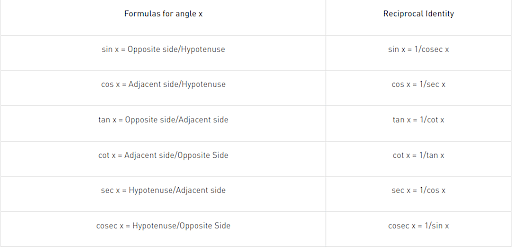
The relationship between the sides and angles of a right-angle triangle is described by trigonometry functions, sometimes known as circular functions. These trigonometric functions derive the relationship between the angles and sides of a triangle. In trigonometry, there are three primary functions of sine (sin), cosine (cos), tangent (tan). The other three main functions can be derived from the primary functions as cotangent (cot), secant (sec), and cosecant (cosec).
Six Basic Trigonometric Functions:
- Sine Function: The ratio between the length of the opposite side of the triangle to the length of the hypotenuse of the triangle.
sin x = a/h
- Cosine Function: The ratio between the length of the adjacent side of the triangle to the length of the hypotenuse of the triangle.
cos x = b/h
- Tangent Function: The ratio between the length of the opposite side of the triangle to the adjacent side length.
tan x = a/b
Tan x can also be represented as sin x/cos x
- Secant Function: The reciprocal of the cosine function.
sec x = 1/cosx = h/b
- Cosecant Function: The reciprocal of the sine function.
cosec x = 1/sinx = h/a
- Cotangent Function: The reciprocal of the tangent function.
cot x = 1/tan x = b/a
Formulas of Trigonometric Functions: