Question:
Let \(A = \left(I_n - \frac{1}{n}\mathbf{1}\mathbf{1}^T\right)\) be a matrix, where \(\mathbf{1} = (1,1,1,\ldots,1)^T \in \mathbb{R}^n\) and \(I_n\) is the identity matrix of order \(n\).
The value of \(\max_{S} x^TAx\), where \(S = \{x \in \mathbb{R}^n \mid x^Tx = 1\}\), is __________. (Answer in integer)
Let \(A = \left(I_n - \frac{1}{n}\mathbf{1}\mathbf{1}^T\right)\) be a matrix, where \(\mathbf{1} = (1,1,1,\ldots,1)^T \in \mathbb{R}^n\) and \(I_n\) is the identity matrix of order \(n\).
The value of \(\max_{S} x^TAx\), where \(S = \{x \in \mathbb{R}^n \mid x^Tx = 1\}\), is __________. (Answer in integer)
The value of \(\max_{S} x^TAx\), where \(S = \{x \in \mathbb{R}^n \mid x^Tx = 1\}\), is __________. (Answer in integer)
Show Hint
Check that \(A\) is symmetric and idempotent (\(A^2=A\)), so its eigenvalues can only be 0 or 1. The maximum of \(x^TAx\) on the unit sphere equals the largest eigenvalue.
Updated On: Jul 22, 2026
Show Solution

Verified By Collegedunia
Correct Answer: 1
Solution and Explanation
Step 1: Recognize the structure of the matrix.
The matrix \(A = I_n - \frac{1}{n}\mathbf{1}\mathbf{1}^T\) is the well known centering matrix used in statistics to subtract the mean from a vector.
It is symmetric, since \(A^T = I_n^T - \frac{1}{n}(\mathbf{1}\mathbf{1}^T)^T = I_n - \frac{1}{n}\mathbf{1}\mathbf{1}^T = A\).
It is also idempotent, meaning \(A^2 = A\), which we can check directly.
Step 2: Show A is idempotent.
\[ A^2 = \left(I_n - \frac{1}{n}\mathbf{1}\mathbf{1}^T\right)\left(I_n - \frac{1}{n}\mathbf{1}\mathbf{1}^T\right) = I_n - \frac{2}{n}\mathbf{1}\mathbf{1}^T + \frac{1}{n^2}\mathbf{1}(\mathbf{1}^T\mathbf{1})\mathbf{1}^T \]
Since \(\mathbf{1}^T\mathbf{1} = n\) (the dot product of the all ones vector with itself, summing \(n\) ones), the last term becomes \(\frac{1}{n^2}\mathbf{1}\cdot n \cdot \mathbf{1}^T = \frac{1}{n}\mathbf{1}\mathbf{1}^T\).
\[ A^2 = I_n - \frac{2}{n}\mathbf{1}\mathbf{1}^T + \frac{1}{n}\mathbf{1}\mathbf{1}^T = I_n - \frac{1}{n}\mathbf{1}\mathbf{1}^T = A \]
So \(A\) is idempotent and symmetric, which makes it a projection matrix.
Step 3: Use the property of symmetric idempotent matrices.
A real symmetric matrix is orthogonally diagonalizable, and all its eigenvalues are real.
For an idempotent matrix, if \(\lambda\) is an eigenvalue with eigenvector \(v\), then \(Av = \lambda v\) implies \(A^2v = \lambda^2 v\), but also \(A^2v = Av = \lambda v\).
So \(\lambda^2 v = \lambda v\), which forces \(\lambda^2 = \lambda\), so \(\lambda\) can only be 0 or 1.
For a symmetric matrix, \(x^TAx\) for a unit vector \(x\) is maximized exactly at the largest eigenvalue of \(A\) (the Rayleigh quotient result).
So we only need to check whether \(A\) actually has an eigenvalue equal to 1.
Step 4: Find an eigenvector with eigenvalue 1.
Take any vector \(v\) that is orthogonal to \(\mathbf{1}\), meaning \(\mathbf{1}^Tv = 0\) (its entries sum to zero). Such vectors exist whenever \(n \geq 2\).
\[ Av = \left(I_n - \frac{1}{n}\mathbf{1}\mathbf{1}^T\right)v = v - \frac{1}{n}\mathbf{1}(\mathbf{1}^Tv) = v - \frac{1}{n}\mathbf{1}\cdot 0 = v \]
So every vector orthogonal to \(\mathbf{1}\) is an eigenvector of \(A\) with eigenvalue 1. This subspace has dimension \(n-1\), so 1 is indeed an eigenvalue, with multiplicity \(n-1\).
Picking any unit vector \(x\) from this subspace gives \(x^TAx = x^Tx = 1\).
Step 5: Conclude the maximum.
Since the eigenvalues of \(A\) are only 0 and 1, and 1 is attained, the largest eigenvalue is 1.
So the maximum of \(x^TAx\) over all unit vectors \(x\) is exactly 1.
Final Answer:
The value of \(\max_{S} x^TAx\) is 1. \[ \boxed{1} \]
The matrix \(A = I_n - \frac{1}{n}\mathbf{1}\mathbf{1}^T\) is the well known centering matrix used in statistics to subtract the mean from a vector.
It is symmetric, since \(A^T = I_n^T - \frac{1}{n}(\mathbf{1}\mathbf{1}^T)^T = I_n - \frac{1}{n}\mathbf{1}\mathbf{1}^T = A\).
It is also idempotent, meaning \(A^2 = A\), which we can check directly.
Step 2: Show A is idempotent.
\[ A^2 = \left(I_n - \frac{1}{n}\mathbf{1}\mathbf{1}^T\right)\left(I_n - \frac{1}{n}\mathbf{1}\mathbf{1}^T\right) = I_n - \frac{2}{n}\mathbf{1}\mathbf{1}^T + \frac{1}{n^2}\mathbf{1}(\mathbf{1}^T\mathbf{1})\mathbf{1}^T \]
Since \(\mathbf{1}^T\mathbf{1} = n\) (the dot product of the all ones vector with itself, summing \(n\) ones), the last term becomes \(\frac{1}{n^2}\mathbf{1}\cdot n \cdot \mathbf{1}^T = \frac{1}{n}\mathbf{1}\mathbf{1}^T\).
\[ A^2 = I_n - \frac{2}{n}\mathbf{1}\mathbf{1}^T + \frac{1}{n}\mathbf{1}\mathbf{1}^T = I_n - \frac{1}{n}\mathbf{1}\mathbf{1}^T = A \]
So \(A\) is idempotent and symmetric, which makes it a projection matrix.
Step 3: Use the property of symmetric idempotent matrices.
A real symmetric matrix is orthogonally diagonalizable, and all its eigenvalues are real.
For an idempotent matrix, if \(\lambda\) is an eigenvalue with eigenvector \(v\), then \(Av = \lambda v\) implies \(A^2v = \lambda^2 v\), but also \(A^2v = Av = \lambda v\).
So \(\lambda^2 v = \lambda v\), which forces \(\lambda^2 = \lambda\), so \(\lambda\) can only be 0 or 1.
For a symmetric matrix, \(x^TAx\) for a unit vector \(x\) is maximized exactly at the largest eigenvalue of \(A\) (the Rayleigh quotient result).
So we only need to check whether \(A\) actually has an eigenvalue equal to 1.
Step 4: Find an eigenvector with eigenvalue 1.
Take any vector \(v\) that is orthogonal to \(\mathbf{1}\), meaning \(\mathbf{1}^Tv = 0\) (its entries sum to zero). Such vectors exist whenever \(n \geq 2\).
\[ Av = \left(I_n - \frac{1}{n}\mathbf{1}\mathbf{1}^T\right)v = v - \frac{1}{n}\mathbf{1}(\mathbf{1}^Tv) = v - \frac{1}{n}\mathbf{1}\cdot 0 = v \]
So every vector orthogonal to \(\mathbf{1}\) is an eigenvector of \(A\) with eigenvalue 1. This subspace has dimension \(n-1\), so 1 is indeed an eigenvalue, with multiplicity \(n-1\).
Picking any unit vector \(x\) from this subspace gives \(x^TAx = x^Tx = 1\).
Step 5: Conclude the maximum.
Since the eigenvalues of \(A\) are only 0 and 1, and 1 is attained, the largest eigenvalue is 1.
So the maximum of \(x^TAx\) over all unit vectors \(x\) is exactly 1.
Final Answer:
The value of \(\max_{S} x^TAx\) is 1. \[ \boxed{1} \]
Was this answer helpful?
0
0
Top GATE DA Data Science and Artificial Intelligence Questions
- Consider performing depth-first search (DFS) on an undirected and unweighted graph G starting at vertex s. For any vertex u in G, d[u] is the length of the shortest path from s to u. Let (u, v) be an edge in G such that d[u] < d[v]. If the edge (u, v) is explored first in the direction from u to v during the above DFS, then (u, v) becomes a _____ edge.
- Three fair coins are tossed independently. T is the event that two or more tosses result in heads. S is the event that two or more tosses result in tails. What is the probability of the event T ∩ S?
- Consider the matrix \(M=\begin{bmatrix} 2 & -1 \\ 3 & 1 \end{bmatrix}\).
Which ONE of the following statements is TRUE ? - For any twice differentiable function ƒ: R → R, if at some x* ∈ R, f'(x*) = 0 and f'(x*) > 0, then the function f necessarily has a ______ at x = x*.
Note : R denotes the set of real numbers. - Match the items in Column 1 with the items in Column 2 in the following table :
Column 1 Column 2 (p) First In First Out (i) Stacks (q) Lookup Operation (ii) Queues (r) Last In First Out (iii) Hash Tables
View More Questions
Top GATE DA Linear Algebra Questions
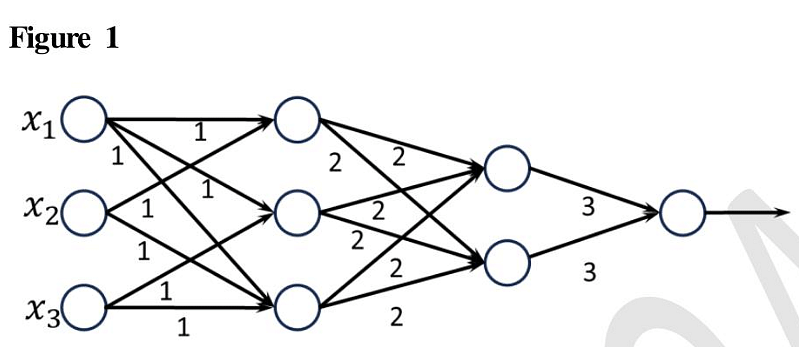
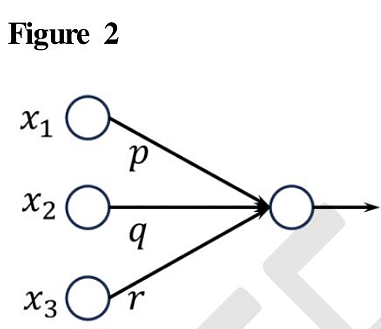
- Consider the two neural networks (NNs) shown in Figures 1 and 2, with ReLU activation (ReLU(z) = max{0, z}, ∀z ∈ R). R denotes the set of real numbers. The connections and their corresponding weights are shown in the Figures. The biases at every neuron are set to 0. For what values of p, q, r in Figure 2 are the two NNs equivalent, when x1, x2, x3 are positive ?
- Select all choices that are subspaces of \(\R^3\).
Note : \(\R\) denotes the set of real numbers. - Which of the following statements is/are TRUE ?
Note: \(\R\) denotes the set of real numbers. - Let \(\R\) be the set of real numbers, U be a subspace of \(\R^3\) and M ∈ \(\R^{3×3}\) be the matrix corresponding to the projection on to the subspace U.
Which of the following statements is/are TRUE ? - Consider the directed acyclic graph (DAG) below :
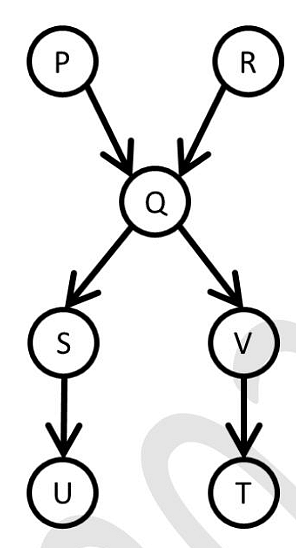
Which of the following is/are valid vertex orderings that can be obtained from a topological sort of the DAG ?
View More Questions
Top GATE DA Questions
- Consider performing depth-first search (DFS) on an undirected and unweighted graph G starting at vertex s. For any vertex u in G, d[u] is the length of the shortest path from s to u. Let (u, v) be an edge in G such that d[u] < d[v]. If the edge (u, v) is explored first in the direction from u to v during the above DFS, then (u, v) becomes a _____ edge.
- Three fair coins are tossed independently. T is the event that two or more tosses result in heads. S is the event that two or more tosses result in tails. What is the probability of the event T ∩ S?
- Consider the matrix \(M=\begin{bmatrix} 2 & -1 \\ 3 & 1 \end{bmatrix}\).
Which ONE of the following statements is TRUE ? - For any twice differentiable function ƒ: R → R, if at some x* ∈ R, f'(x*) = 0 and f'(x*) > 0, then the function f necessarily has a ______ at x = x*.
Note : R denotes the set of real numbers. - Match the items in Column 1 with the items in Column 2 in the following table :
Column 1 Column 2 (p) First In First Out (i) Stacks (q) Lookup Operation (ii) Queues (r) Last In First Out (iii) Hash Tables
View More Questions