Kranz anatomy can be seen in
- Maize
- Tomato
- Potato
- Pea

The Correct Option is A
Approach Solution - 1
The correct answer is:
Option 1: Maize
Explanation:
Kranz anatomy is a specialized leaf structure found in plants that perform C4 photosynthesis, such as maize (corn), sorghum, and sugarcane.
In Kranz anatomy, the leaf has two distinct types of cells:
Bundle sheath cells: These cells are located around the vascular bundles and contain large amounts of chloroplasts for the Calvin cycle.
Mesophyll cells: These cells are located between the epidermis and bundle sheath and are involved in the initial fixation of carbon dioxide.
This adaptation helps C4 plants minimize photorespiration and efficiently fix carbon in hot, dry environments.
The other options (Tomato, Potato, Pea) are C3 plants and do not exhibit Kranz anatomy.
Approach Solution -2
Kranz anatomy is a specialized leaf structure found in C4 plants. It is characterized by two distinct types of photosynthetic cells:
- Mesophyll cells: These cells are arranged in a typical fashion.
- Bundle sheath cells: These cells surround the vascular bundles (veins) in a tightly packed ring.
This unique arrangement is advantageous for C4 photosynthesis, as it concentrates CO2 around the enzyme RuBisCO in the bundle sheath cells, minimizing photorespiration.
Now, let's consider which of the given plants are C4 plants:
- **Maize (corn):** This is a C4 plant. It exhibits Kranz anatomy in its leaves.
- Tomato:** This is a C3 plant and does not have Kranz anatomy.
Therefore, the correct answer is Maize.
Top KCET Biology Questions
- Relate Column I with Column II with regard to predatory behaviour:
Column I Column II 1. Calotropis p. Invertebrates 2. Pisaster q. Distasteful 3. Monarch butterfly r. Cryptically colored 4. Frogs s. Cardioglycoside - Small mammals and birds are rarely found in polar regions. The reason is that
Match Column I and Column I
Column I Column II 1 Narrowly utilitarian argument p Conserving biodiversity for major ecosystem services 2 Broadly utilitarian argument q Every species has an intrinsic value and moral duty to pass our biological legacy in good order to future generation. 3 Ethical argument r Receiving benefits like food, medicine & industrial products. - Identify the correct statement/s about ex situ conservation. Advanced ex situ conservation includes i. Cryopreservation of gametes. ii. Plant tissue culture method. iii. Seed bank. iv. In vitro fertilisation.
- Identify the odd one out.
Top KCET Anatomy of Dicotyledonous and Monocotyledonous Plants Questions
- Read the following statements A and B. A : Many organs of aquatic plants float in water. B : Large air gaps are present, in the collenchyma tissues of lotus leaf. Select the correct answer.
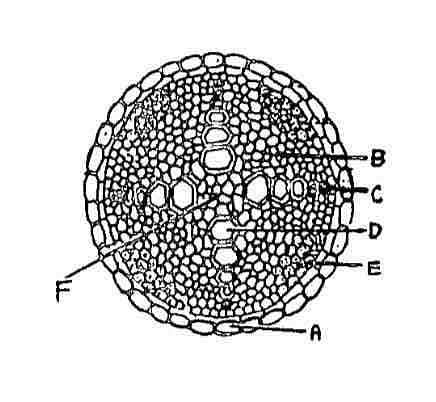
In the diagram of T.S. of Stele of Dicot Root, the different parts have been indicated by alphabets; choose the answer in which these alphabets correctly match with the parts they indicate:
- Conjunctive tissue is present between (i) and (ii) in (iii) .
- Stalk of the Stamen is
Top KCET Questions
- Which of the following is not true for oxidation?
- If $a, b$ and $c \in N$ which one of the following is not true ?
- When $50\, cm ^{3}$ of $0.2\, N$ $H_{2} SO _{4}$ is mixed with $50 cm ^{3}$ of $1 N\, KOH$, the heat liberated is :
- If $a | (b + c)$ and $a| (b-c)$ where $a,b,c \in \, N $ then
- Which of the following is NOT a pair of functional isomers?