A binary compound has Y-atoms forming FCC unit cell and another type of X-atoms occupying \(\frac{1}{3}\)rd of tetrahedral voids. Find out the molecular formula of the compound
A binary compound has Y-atoms forming FCC unit cell and another type of X-atoms occupying \(\frac{1}{3}\)rd of tetrahedral voids. Find out the molecular formula of the compound

Correct Answer: 23
Approach Solution - 1
For 1 unit cell,
No. of particles
X = \(\frac{1}{3}\times8\)
Y = 4
∴ The formula of Ionic solid = \(X_{\frac{8}{3}}Y_4\) =\(X_2Y_3\)
Approach Solution -2
The formula of the compound can be determined as follows:
In an FCC unit cell, there are 4 atoms located at the corners and one atom at the center of each face. Thus, the total number of Y atoms in the unit cell is 4 from the corners.
In a FCC unit cell, there are tetrahedral voids and octahedral voids. Each void can accommodate one atom. The number of tetrahedral voids in a FCC unit cell is twice the number of atoms per unit cell, which is 4 in this case. Therefore, there are 8 tetrahedral voids in the unit cell. Since X atoms occupy \(\frac{1}{3}\) of the tetrahedral voids, there are \(8\times \frac{1}{3}=\frac{8}{3}\) X atoms in the unit cell.
The ratio of X atoms to Y atoms in the unit cell is therefore \(\frac{(\frac{8}{3})}{4}=\frac{2}{3}\). This means that the molecular formula of the compound is X2Y3. Therefore, option B (X2Y3) is the correct answer.
Top JEE Main Chemistry Questions
What will be the equilibrium constant of the given reaction carried out in a \(5 \,L\) vessel and having equilibrium amounts of \(A_2\) and \(A\) as \(0.5\) mole and \(2 \times 10^{-6}\) mole respectively?
The reaction : \(A_2 \rightleftharpoons 2A\)- At equilibrium the concentrations of and in a sealed vessel at . What will be for the reaction
- Find out the major products from the following reactions

Cobalt chloride when dissolved in water forms pink colored complex $X$ which has octahedral geometry. This solution on treating with cone $HCl$ forms deep blue complex, $\underline{Y}$ which has a $\underline{Z}$ geometry $X, Y$ and $Z$, respectively, are
- The correct order of atomic radii is:
Top JEE Main The solid state Questions
- The unit cell of copper corresponds to a face centered cube of edge length 3.596 Å with one copper atom at each lattice point. The calculated density of copper in kg/m³ is ________ . [Molar mass of Cu: 63.54 g; Avogadro Number=6.022$\times$10²³]
- Which of the following material is not a semiconductor.
- What are the constituents of Natalite?
A cubic solid is made up of two elements $X$ and $Y$ Atoms of $X$ are present on every alternate corner and one at the enter of cube $Y$ is at $\frac{1}{3} td$ of the total faces The empirical formula of the compound is
- A cubic solid is made up of two elements $X$ and $Y$ Atoms of $X$ are present on every alternate corner and one at the center of cube $Y$ is at $\frac{1}{3} rd$ of the total faces. The empirical formula of the compound is
Top JEE Main Questions
- Two masses $m$ and $\frac{m}{2}$ are connected at the two ends of a massless rigid rod of length $l$. The rod is suspended by a thin wire of torsional constant $k$ at the centre of mass of the rod-mass system(see figure). Because of torsional constant $k$, the restoring torque is $\tau =k\theta$ for angular displacement $\theta$. If the rod is rota ted by $\theta_0$ and released, the tension in it when it passes through its mean position will be:
What will be the equilibrium constant of the given reaction carried out in a \(5 \,L\) vessel and having equilibrium amounts of \(A_2\) and \(A\) as \(0.5\) mole and \(2 \times 10^{-6}\) mole respectively?
The reaction : \(A_2 \rightleftharpoons 2A\)- The value of is
- The number of terms of an is even. The sum of the odd terms is and of the even terms is . The last term exceeds the first by . Then the number of terms in the series is ______.
A black body is at a temperature of 2880 K. The energy of radiation emitted by this body with wavelength between 499 nm and 500 nm is U1, between 999 nm and 1000 nm is U2 and between 1499 nm and 1500 nm is U3. The Wien's constant, b = 2.88×10⁶ nm-K. Then,
Concepts Used:
Solid State
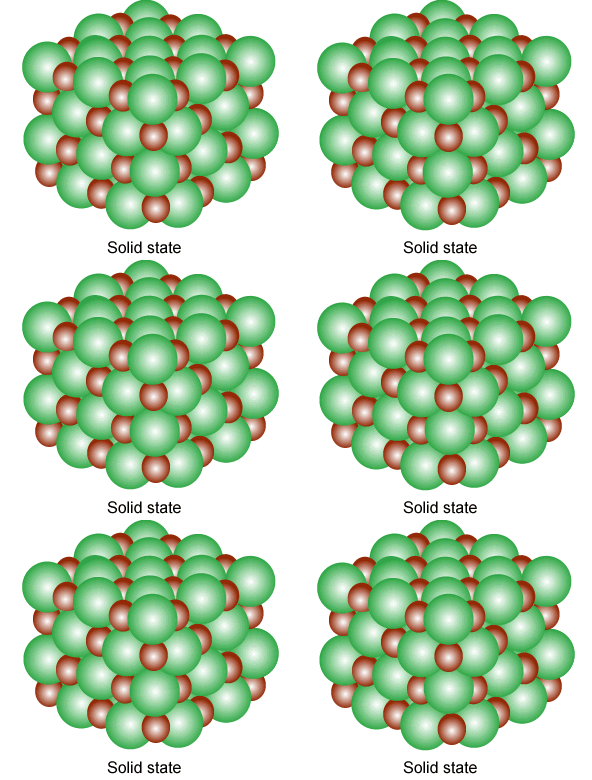
Solids are substances that are featured by a definite shape, volume, and high density. In the solid-state, the composed particles are arranged in several manners. Solid-state, in simple terms, means "no moving parts." Thus solid-state electronic devices are the ones inclusive of solid components that don’t change their position. Solid is a state of matter where the composed particles are arranged close to each other. The composed particles can be either atoms, molecules, or ions.
Types of Solids:
Based on the nature of the order that is present in the arrangement of their constituent particles solids can be divided into two types;
- Amorphous solids behave the same as super cool liquids due to the arrangement of constituent particles in short-range order. They are isotropic and have a broad melting point (range is about greater than 5°C).
- Crystalline solids have a fixed shape and the constituent particles are arranged in a long-range order.