Question:
In a male fetus, ultrasonography identification of bilateral hydronephrosis and bladder dilatation is diagnostic of
In a male fetus, ultrasonography identification of bilateral hydronephrosis and bladder dilatation is diagnostic of
Show Hint
Bilateral hydronephrosis plus a dilated bladder in a male fetus points to a urethral outflow obstruction.
Updated On: Jul 7, 2026
- Polycystic kidney disease
- Multicystic dysplastic kidney
- Uteropelvic junction obstruction
- Posterior urethral valve syndrome
Show Solution

Verified By Collegedunia
The Correct Option is D
Solution and Explanation
Step 1: Note the two key findings together.
The scan shows two things at once, both kidneys backed up (bilateral hydronephrosis) and a large bladder. Seeing both together in a male fetus points to a block low down in the urinary tract that is holding back urine from everywhere above it.
Step 2: Recall posterior urethral valve syndrome.
In posterior urethral valve syndrome, a fold of tissue in the posterior urethra of a male fetus blocks the free flow of urine out of the bladder. Urine backs up first into the bladder, which becomes thick walled and distended, then further back into both ureters and both kidneys, producing bilateral hydronephrosis. The classic scan picture is a dilated posterior urethra behind a distended bladder, described as a keyhole sign.
Step 3: Rule out polycystic kidney disease.
Polycystic kidney disease gives bilateral enlarged kidneys packed with cysts, but the bladder is not primarily affected, so bladder dilatation is not expected.
Step 4: Rule out multicystic dysplastic kidney.
Multicystic dysplastic kidney usually affects one kidney, replacing it with a cluster of non functioning cysts, and again the bladder is normal.
Step 5: Rule out uteropelvic junction obstruction.
Uteropelvic junction obstruction blocks urine flow at the point where the kidney's pelvis meets the ureter, usually on one side, causing hydronephrosis of that kidney alone without any bladder dilatation.
Final Answer:
Bilateral hydronephrosis with bladder dilatation in a male fetus is diagnostic of posterior urethral valve syndrome.
The scan shows two things at once, both kidneys backed up (bilateral hydronephrosis) and a large bladder. Seeing both together in a male fetus points to a block low down in the urinary tract that is holding back urine from everywhere above it.
Step 2: Recall posterior urethral valve syndrome.
In posterior urethral valve syndrome, a fold of tissue in the posterior urethra of a male fetus blocks the free flow of urine out of the bladder. Urine backs up first into the bladder, which becomes thick walled and distended, then further back into both ureters and both kidneys, producing bilateral hydronephrosis. The classic scan picture is a dilated posterior urethra behind a distended bladder, described as a keyhole sign.
Step 3: Rule out polycystic kidney disease.
Polycystic kidney disease gives bilateral enlarged kidneys packed with cysts, but the bladder is not primarily affected, so bladder dilatation is not expected.
Step 4: Rule out multicystic dysplastic kidney.
Multicystic dysplastic kidney usually affects one kidney, replacing it with a cluster of non functioning cysts, and again the bladder is normal.
Step 5: Rule out uteropelvic junction obstruction.
Uteropelvic junction obstruction blocks urine flow at the point where the kidney's pelvis meets the ureter, usually on one side, causing hydronephrosis of that kidney alone without any bladder dilatation.
Final Answer:
Bilateral hydronephrosis with bladder dilatation in a male fetus is diagnostic of posterior urethral valve syndrome.
Was this answer helpful?
0
0
Top NEET PG Gynaecology and Obstetrics Questions
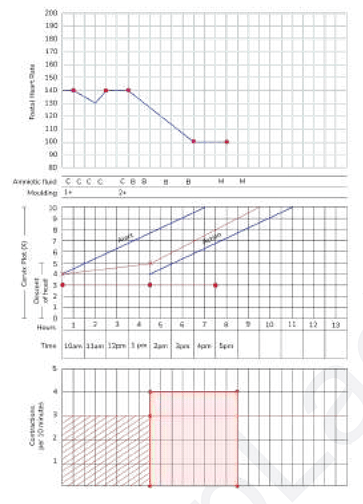
- A partogram of a woman who is in labor is shown below. Oxytocin infusion is already given. How will you manage the condition?
- A woman presents to you at 36 weeks of gestation with complaints of breathlessness and excessive abdominal distension. Fetal movements are normal. On examination, fetal parts are not easily felt and fetal heartbeat is heard but it is muffled. Her symphysis fundal height is 41 cm. Her abdomen is tense but not tender. What is the most likely diagonosis?
- For which of the following procedures in the given OT list, can you preferably do a hysteroscopy ?
- A primigravida presents to you with anemia early in her pregnancy. She is 7 weeks pregnant as seen on ultrasound. Her hemoglobin level is 9 g/dL. When should the iron supplements be started for her?
- A 23-year-old woman accompanied by her mother-in-law comes to the infertility clinic. She has been having regular intercourse for 6 months but is not able to conceive. What is the next best step?
View More Questions
Top NEET PG Questions
- A patient hailing from Delhi presents with fever, arthralgia, and extensive petechial rash for 3 days. Lab investigations revealed a hemoglobin of 9 g/ dL, a white blood cell count of 9000 cells/mm3, a platelet count of 20000 cells/mm3, and a prolonged bleeding time. The clotting time was normal. What is the most likely diagnosis?
- Which of the following statements is true about Trichomonas vaginalis?
- A lady from West Rajasthan presented with an ulcer surrounded by erythema on the right leg. Microscopy of the biopsy from the edge of the ulcer showed organisms with dark staining nuclei and kinetoplast. What is the most likely causative agent?
- A child presents with a fever and a rash. Urine examination showed cells with owl's eye appearance. What is the most likely diagnosis?
- Infection with Clonorchis sinensis is associated with an increased risk of__?
View More Questions