In a hadronic interaction, \(\pi^0\)'s are produced with different momenta, and they immediately decay into two photons with an opening angle \(\theta\) between them. Assuming that all these decays occur in one plane, which one of the following figures depicts the behaviour of \(\theta\) as a function of the \(\pi^0\) momentum \(p\)?

In a hadronic interaction, \(\pi^0\)'s are produced with different momenta, and they immediately decay into two photons with an opening angle \(\theta\) between them. Assuming that all these decays occur in one plane, which one of the following figures depicts the behaviour of \(\theta\) as a function of the \(\pi^0\) momentum \(p\)?
Show Hint
A
B
C
D

The Correct Option is A
Solution and Explanation
- As the momentum increases, the opening angle decreases due to the relativistic motion of the photons. The correct representation of this relationship is given by option (A), where the opening angle decreases as the momentum increases.
Top GATE PH Physics Questions
- An infinite one-dimensional lattice extends along the x-axis. At each lattice site, there exists an ion with spin 1/2. The spin can point either in the +z or -z direction only. Let \( S_P \), \( S_F \), and \( S_A \) denote the entropies of paramagnetic, ferromagnetic, and antiferromagnetic configurations, respectively. Which of the following relations is/are true?
- Two point charges of charge \( +q \) each are placed a distance \( 2d \) apart. A grounded solid conducting sphere of radius \( a \) is placed midway between them. Assume \( a^2 \ll d^2 \). Which of the following statements is/are true?
- A particle of mass $m$ is moving in the potential
\[ V(x) = \begin{cases} V_0 + \frac{1}{2} m \omega_{0P}^2 x^2 & \quad \text{if } x > 0 \\ \infty & \quad \text{if } x \leq 0 \end{cases} \]
Figures P, Q, R, and S show different combinations of the values of $ \omega_0 $ and $ V_0 $. - Decays of mesons and baryons can be categorized as weak, strong and electromagnetic decays depending upon the interactions involved in the processes. Which of the following option is/are true?
- The temperature \( T \) dependence of magnetic susceptibility \( \chi \) (Column I) of certain magnetic materials (Column II) are given below. Which of the following options is/are correct?
Column I Column II (1) 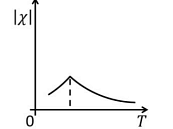
(P) Diamagnetic (2) 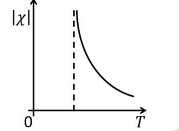
(Q) Paramagnetic (3) 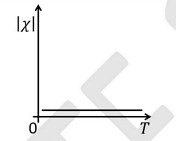
(R) Ferromagnetic (4) 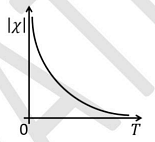
(S) Antiferromagnetic
Top GATE PH General Physics Questions
- Which one of the following is a dimensionless constant?
- Choose the most appropriate matching of the items in Column 1 with those in Column 2. \[ \begin{array}{|c|c|} \hline \textbf{Column 1} & \textbf{Column 2} \\ \hline (i)\ \text{PIN diode} & Q.\ \text{Radio frequency and microwave devices} \\ (ii)\ \text{Tunnel diode} & S.\ \text{Oscillator} \\ (iii)\ \text{Zener diode} & P.\ \text{Voltage regulation} \\ (iv)\ \text{Photo diode} & R.\ \text{Optoelectronic detection} \\ \hline \end{array} \]
- The atomic number of an atom is 6. What is the spectroscopic notation of its ground state, according to Hund’s rules?
The Hall experiment is carried out with a non-magnetic semiconductor. The current $I$ is along the X-axis and the magnetic field $B$ is along the Z-axis. Which one of the following is the CORRECT representation of the variation of the magnitude of the Hall resistivity $\rho_{xy}$ as a function of the magnetic field?

The figure schematically shows the M (magnetization) - H (magnetic field) plots for certain types of materials. Here M and H are plotted in the same scale and units. Which one of the following is the most appropriate combination?

Top GATE PH Questions
- If \( F_1(Q, q) = Qq \) is the generating function of a canonical transformation from \((p, q)\) to \((P, Q)\), then which one of the following relations is correct?
- When an unpolarized plane electromagnetic wave in a dielectric medium with refractive index \( n_1 \) is incident on a plane interface separating it from another dielectric medium with refractive index \( n_2 \) (where \( n_2 > n_1 \)), and the angle of incidence is \(\tan^{-1} \left( \frac{n_2}{n_1} \right) \), the following statement is true:
- The wavefunction of a particle in an infinite one-dimensional potential well at time \( t \) is
\[ \Psi(x, t) = \sqrt{\frac{2}{3}} e^{-iE_1 t/\hbar}\psi_1(x) + \frac{1}{\sqrt{6}} e^{i\pi/6} e^{-iE_2 t/\hbar} \psi_2(x) + \frac{1}{\sqrt{6}} e^{i\pi/4} e^{-iE_3 t/\hbar} \psi_3(x) \]where \(\psi_1\), \(\psi_2\), and \(\psi_3\) are the normalized ground state, the normalized first excited state, and the normalized second excited state, respectively. \(E_1\), \(E_2\), and \(E_3\) are the eigen-energies corresponding to \(\psi_1\), \(\psi_2\), and \(\psi_3\), respectively. The expectation value of energy of the particle in state \(\Psi(x,t)\) is - If a thermodynamical system is adiabatically isolated and experiences a change in volume under an externally applied constant pressure, then the thermodynamical potential minimized at equilibrium is the
- The mean distance between the two atoms of an HD molecule is \( r \), where H and D denote hydrogen and deuterium, respectively. The mass of the hydrogen atom is \( m_H \). The energy difference between the two lowest lying rotational states of HD in multiples of \(\frac{h^2}{m_H r^2}\) is: