$ \, if \, I_ n = \int^{\pi}_{ -\pi} \frac { \sin \, n \, x }{ ( 1 + \pi ^x ) \sin \, x } dx , \, n = 0 , 1 , 2 , .............., then $
- $ I_ n = I_{ n + 2 } $
- $ \displaystyle \sum^{10}_{ m = 1 } \, I _{ 2 m + 1 } = 10 \pi $
- $ \displaystyle \sum^{10}_{ m = 1 } \, I _{ 2 m } = 10 $
- $ I_ n = I_{ n + 1 } $

The Correct Option is C
Solution and Explanation
Given \(\, if \, I_ n = \int^{\pi}_{ -\pi} \frac { sin \, n \, x }{ ( 1 + \pi ^x ) \, sin \, x } dx ,...............(1)\)
Using \(\int^b_a \, f ( x ) \, dx = \int^b _a \, f ( b + a - x ) \, dx , we \, get\)
\(\, \, \, \, \, \, \, \, \, \, \, \, \, \, \, \, \, \, I_n = \int^{\pi}_ {-\pi } \frac { \pi^{x } \, sin \, n x}{ ( 1 + \pi^x ) sin \, x } \, dx ................(2)\)
On adding Eqs. (i) and (ii), we have
\(\, \, \, \, \, \, \, \, \, \, \, \, \, \, \, \, \, \, 2I_n = \int^{\pi}_ {-\pi } \frac { sin \, n x}{ sin \, x } \, dx = 2 \int^{\pi}_ 0 \frac { sin \, n x}{ sin \, x } \, dx\)
\(\, \, \, \, \, \, \, \, \, \, \, \, \, \, \, \, \, \, [ \because f ( x ) = \frac { sin \, n x}{ sin \, x } \, is \, an \, even \, function ]\)
\(\Rightarrow \, \, \, \, \, \, \, \, \,\) \(I_n = \int^\pi _ 0 \frac { sin \, nx }{ simn \, x } \, dx\)
\(Now , I_{ n + 2 } - I_n = \int^{\pi}_0 \frac { sin ( n - 2 ) \, x - sin \, nx }{ sin \, x } \, dx\)
\(\, \, \, \, \, \, \, \, \, \, \, \, \, \, \, \, \, \, = \int^\pi_0 \frac { 2 \, cos ( n + 1 ) \, x . sin \, x }{ sin \, x } \, dx\)
\(\, \, \, \, \, \, \, \, \, \, \, \, \, \, \, \, \, \, = 2 \int^\pi_0 cos ( n + 1 ) \, x \, dx = 2 \bigg [ \frac { sin ( n + 1 ) \, x }{ ( n + 1 ) } \bigg ]^{\pi}_0 = 0\)
\(\therefore \, I_{ n + 2 } = I_n \, \, \, \, \, \, \, \, \, \, \, \, \, \, \, \, \, \, \, \, \, \, \, \, \, \, \, \, \, \, \, \, \, \, \, \, ...................(3)\)
\(Since , \, \, \, \, \, \, \, \, \, \, \, \, \, \, I_n = \int^{\pi}_0 \frac {sin \, nx }{ sin \, x } \, dx\)
\(\Rightarrow\) \(\, \, \, \, \, \, \, \, \, \, \, \, \, \, \, \, I_1 = \pi \, and \, I_2 = 0\)
From E (iii) \(I_1 = I_3 = I_5 = .................= \pi\)
and \(\, \, \, \, \, \, \, \, \, \, \, \, \, \, \, \,\) \(I_2 = I_4 = I_6 = .................= 0\)
\(\Rightarrow\) \(\displaystyle \sum^{10} I_{2m + 1 } = 10 \pi \, and \, \displaystyle \sum^{10} I_{2m } = 0\)
\(\therefore\) Correct options are (A), (B), (C).
Top JEE Advanced Mathematics Questions
- In a $\triangle$ ABC w ith fixed base BC, the vertex A moves such that cos B + cos C = 4 $ sin^2 \frac{A}{2}$. If a, b and c denote th e lengths of th e sides of th e triangle opposite to the angles A, B and C respectively, then
- Let $P=[a_{ij}]$ be a $3\times3$ matrix and let $Q=[b_{ij}]$ where $b_{ij}=2^{i+j} a_{ij}$ for $1 \le i, j \le $.If the determinant of $P$ is $2$, then the determinant of the matrix $Q$ is
- For the equation $3x^2+px+3=0,p>0,$ if one of the root is square of the other, then p is equal to
- The equation $\sqrt{x+1}-\sqrt{x-1}=\sqrt{4x-1}$ has
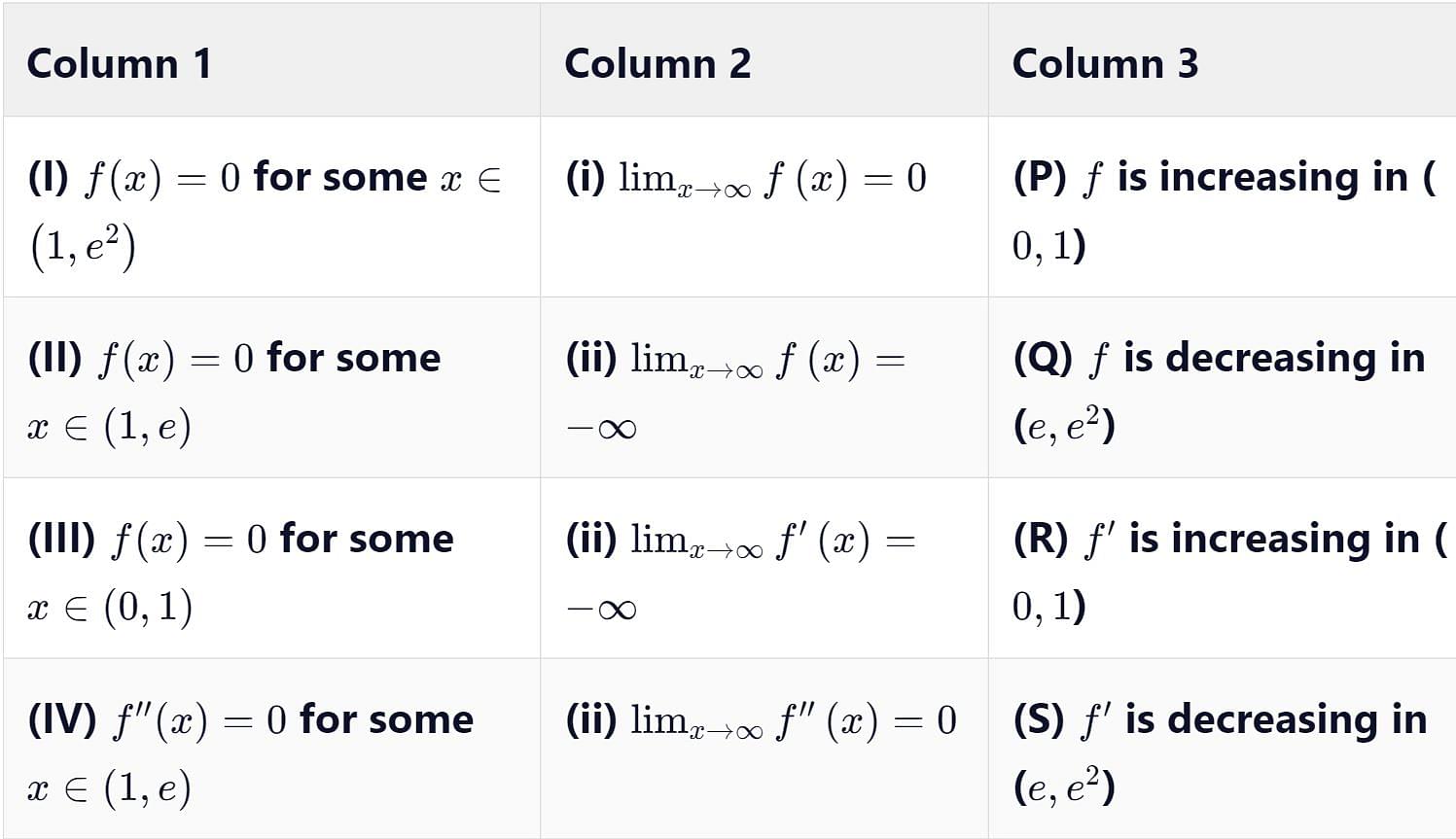
Let \(f(x)=x+log_{e}x−xlog_{e}x,\text{ }x∈(0,∞)\).
- Column 1 contains information about zeros of \(f(x)\), \(f'(x)\) and \(f''(x)\).
- Column 2 contains information about the limiting behavior of \(f(x)\), \(f'(x)\) and \(f''(x)\) at infinity.
- Column 3 contains information about increasing/decreasing nature of \(f(x)\) and \(f'(x)\).
Top JEE Advanced Integrals of Some Particular Functions Questions
- The value of the integral $ \int ^{\frac{\pi}{2}}_{-\frac{\pi}{2}} \bigg ( x^2 + \log \frac{\pi - x }{ \pi + x } \bigg ) \, \cos \, x \, dx $
- The value of $\int^{\pi}_{-\pi} \frac{ \cos^2 \, x }{ 1 + a^x } \, dx , a> 0 $ is
- $ lim_ { x \to \frac{\pi}{4}} \frac{ \int \limits_2^{sec^2 \, x} \, f \, (t) \, dt }{ x^2 - \frac{\pi^2}{ 16}} $ equals
- Let $S_n= \displaystyle \sum_{k=0}^n \frac{n}{n^2+kn+k^2} \, and \, T_n= \displaystyle \sum_{k=0}^{n-1} \frac{1}{n^2+kn+k^2} , \, for \, $ $n = 1 ,2 ,3 $,... Then,
- The area bounded by the curves y = f (x), the X-axis and the ordinates x = 1 and x = b is (b - 1 ) sin (3b + 4). Then, f (x) is equal to
Top JEE Advanced Questions
- Yellow light is used in a single slit diffraction experiment with slit width of 0.6 mm. If yellow light is replaced by X-rays, then the observed pattern will reveal
- The size of the image of an object, which is at infinity, as formed by a convex lens of focal length 30 cm is 2 cm. If a concave lens of focal length 20 cm is placed between the convex lens and the image at a distance of 26 cm from the convex lens, calculate the new size of the image.
- A concave lens of glass, refractive index 1.5 has both surfaces of same radius of curvature R. On immersion in a medium of refractive index 1.75, it will behave as a
- The position vector $\vec{r}$ of a particle of mass $m$ is given by the following equation $\vec{r}(t)=\alpha t^{3} \hat{i}+\beta t^{2} \hat{j}$ where $\alpha=\frac{10}{3} \,ms ^{-3}, \beta=5\, ms ^{-2}$ and $m =0.1 \,kg$. At $t =1\, s$, which of the following statement (s) is (are) true about the particle?
- In an n-p-n transistor circuit, the collector current is 10 mA. If 90% of the electrons emitted reach the collector
Concepts Used:
Integrals of Some Particular Functions
There are many important integration formulas which are applied to integrate many other standard integrals. In this article, we will take a look at the integrals of these particular functions and see how they are used in several other standard integrals.
Integrals of Some Particular Functions:
- ∫1/(x2 – a2) dx = (1/2a) log|(x – a)/(x + a)| + C
- ∫1/(a2 – x2) dx = (1/2a) log|(a + x)/(a – x)| + C
- ∫1/(x2 + a2) dx = (1/a) tan-1(x/a) + C
- ∫1/√(x2 – a2) dx = log|x + √(x2 – a2)| + C
- ∫1/√(a2 – x2) dx = sin-1(x/a) + C
- ∫1/√(x2 + a2) dx = log|x + √(x2 + a2)| + C
These are tabulated below along with the meaning of each part.
