Question:
Glycocalyx is associated with
Glycocalyx is associated with
Updated On: Jun 14, 2022
- nucleolus
- plasma membrane
- nucleus
- nucleosome
Show Solution

Verified By Collegedunia
The Correct Option is B
Solution and Explanation
Bacterial cells have a chemically complex cell envelope. The cell envelope consists of a tightly bound three-layered structure, i.e., the outermost glycocalyx followed by the cell wall and then the plasma membrane. The glycocalyx is made up of sugar and proteins.
Was this answer helpful?
0
0
Top JKCET Biology Questions
- In $C_{3}-$ plants, photosynthesis occurs in
- In Chlamydomonas the meiosis occurs in :
- In Mendel's experiments with garden pea, round seed shape (RR) was dominant over wrikled seed (rr), yellow cotyledon (YY) was dominant over green cotyledon (yy). What are the expected phenotypes in the $F_{2}$ generation of the cross R R Y Y- rryy?
- In plants, chlorosis is caused by the deficiency of
- In porogamy, pollen tube enters the ovule through the
View More Questions
Top JKCET Cell: the unit of life Questions
- Cilia are :
- Which is not properly paired?
- What is true about fluid mosaic model?
- Besides proteins ribosomes contain :
- Plasma membrane helps in :
View More Questions
Top JKCET Questions
- The coordinates of a moving particle at any time $t$ are given by $x=\alpha t^{3}$ and $y=\beta t^{3}$. The speed of the particle at time $t$ is given by
- The maximum range of a projectile is $ 100\,m $ . The maximum height reached by it is
- Solve $ {{\sin }^{-1}}\,2x+{{\cos }^{-1}}\,2x+2\,{{\tan }^{-1}}\,x=\pi $
- A wave has velocity $u$ in medium $P$ and velocity $ 2u $ in medium $Q$. If the wave is incident in medium $P$ at an angle $ 30^{\circ}, $ then the angle of refraction will be
- The working principle of rocket propulsion is conservation of
View More Questions
Concepts Used:
Cell: The Unit of Life
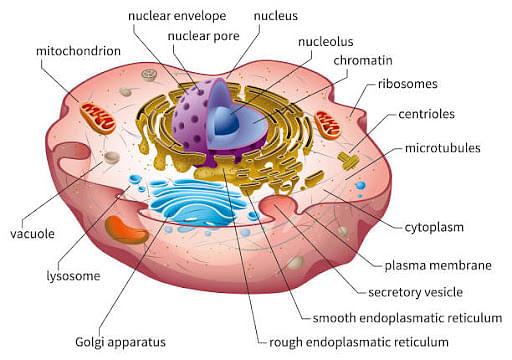
- A cell is derived as the functional and structural unit of life. Every cell is surrounded by a cell membrane that dissects the external and internal environments of the cell. The interior environment of a cell is called the cytoplasm.
- It carries cellular machinery and structural elements. The nucleus is present in the center of the cell, which includes all the hereditary information of an organism. Some of the molecules present in the cell are protein, carbohydrates, starch, and sugar.
Read More: Fundamental Unit of Life: Cell
Parts of Cell:
The different parts of a cell and their functions are as follows:
- Cell Membrane
- Cell Wall
- Nucleus
- Cytoplasm