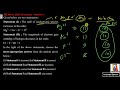
Given below are two statements:
Statement (I): The radius of isoelectronic species increases in the order:
\[
\text{Mg}^{2+} < \text{Na}^{+} < \text{F}^{-} < \text{O}^{2-}
\]
Statement (II): The magnitude of electron gain enthalpy of halogens decreases in the order:
\[
\text{Cl} > \text{F} > \text{Br} > \text{I}
\]
In light of the above statements, choose the most appropriate answer from the options given below:
Show Hint
For isoelectronic species, the size decreases as the nuclear charge increases. Electron gain enthalpy becomes more negative as the atomic size increases.
Statement I is incorrect but Statement II is correct.
Statement I is correct but Statement II is incorrect.
Both Statement I and Statement II are incorrect.
Show Solution
Verified By Collegedunia
The Correct Option isC
Solution and Explanation
The given problem involves evaluating two statements related to Chemistry, focusing on isoelectronic species and electron gain enthalpy trends.
Analysis of Statement (I):
Isoelectronic species have the same number of electrons but different nuclear charges. The radius of an isoelectronic series is influenced by the effective nuclear charge, which increases as protons increase. Consequently, size decreases as nuclear charge increases. For the series \(\text{Mg}^{2+}, \text{Na}^{+}, \text{F}^{-}, \text{O}^{2-}\), the order of increasing size is correct due to the varying nuclear charge affecting electron contraction:
Electron gain enthalpy refers to the energy change when an electron is added to a neutral atom. For halogens, due to increasing atomic size, electron-electron repulsion, and effective nuclear attraction, the usual order is \(\text{F} > \text{Cl} > \text{Br} > \text{I}\). However, despite fluorine's high electronegativity, chlorine has a more favorable electron gain enthalpy due to less electron repulsion faced at a larger atomic radius:
\[\text{Cl} > \text{F} > \text{Br} > \text{I} \]
Conclusion: Statement II is incorrect as it contrasts the actual trend.
Final Answer: Statement I is correct but Statement II is incorrect.