Given below are two statements: one is labelled as Assertion A and the other is labelled as Reason R Assertion A: In an Ellingham diagram, the oxidation of carbon to carbon monoxide shows a negative slope with respect to temperature Reason R: CO tends to get decomposed at higher temperature In the light of the above statements, choose the correct answer from the options given below
Show Hint
In an Ellingham diagram, a negative slope indicates that the reaction becomes more favorable at higher temperatures, while a positive slope indicates that the reaction becomes less favorable.
Both $A$ and $R$ are correct and $R$ is the correct explanation of $A$
Both $A$ and $R$ are correct but $R$ is NOT the correct explanation of $A$
Show Solution
Verified By Collegedunia
The Correct Option isA
Solution and Explanation
Assertion A is correct: In an Ellingham diagram, the oxidation of carbon to carbon monoxide does indeed show a negative slope, indicating that the reaction becomes more favorable as temperature increases.
Reason R is incorrect: While CO is a reducing agent, it does not tend to decompose at higher temperatures; rather, the decomposition of CO to C and \( \text{O}_2 \) is unfavorable at high temperatures, as shown by its position on the Ellingham diagram.
General Principles and Processes of Isolation of Elements
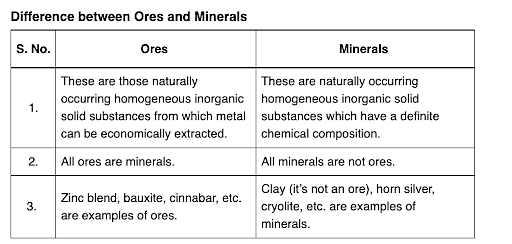
What are Ores and Minerals?
Minerals are the naturally occurring, homogeneous inorganic solid substances. They are having a definite chemical composition and crystalline structure, hardness and color. For example, copper pyrite, calamine, etc.
Impurities in an ore are called gauge. The removal of a gauge from the ore is called concentration ore.
Several steps are involved in the extraction of pure metal from ores. Major steps are as follows –