Question:
For the following reaction,
\[ 2\,\mathrm{Pb_3O_4(s)} \rightleftharpoons 6\,\mathrm{PbO(s)} + \mathrm{O_2(g)} \] The correct option showing the number of phases (P), number of components (C) and degrees of freedom (F) is:
For the following reaction,
\[ 2\,\mathrm{Pb_3O_4(s)} \rightleftharpoons 6\,\mathrm{PbO(s)} + \mathrm{O_2(g)} \] The correct option showing the number of phases (P), number of components (C) and degrees of freedom (F) is:
\[ 2\,\mathrm{Pb_3O_4(s)} \rightleftharpoons 6\,\mathrm{PbO(s)} + \mathrm{O_2(g)} \] The correct option showing the number of phases (P), number of components (C) and degrees of freedom (F) is:
Show Hint
Two distinct solids plus one gas give P = 3; three species tied by one reaction give C = 2; apply F = C - P + 2.
Updated On: Aug 10, 2026
- P = 3, C = 2, F = 1
- P = 3, C = 3, F = 2
- P = 2, C = 3, F = 3
- P = 2, C = 2, F = 2
Show Solution

Verified By Collegedunia
The Correct Option is A
Solution and Explanation
Step 1: Count the phases present at equilibrium.
The system has \(\mathrm{Pb_3O_4(s)}\) as one solid phase and \(\mathrm{PbO(s)}\) as a second, chemically distinct solid phase (they don't mix into a single solid solution), plus \(\mathrm{O_2(g)}\) as a single gas phase (all gases mix into one phase). So \(P=3\).
Step 2: Count the number of independent components.
There are 3 chemical species: \(\mathrm{Pb_3O_4}\), \(\mathrm{PbO}\), and \(\mathrm{O_2}\), related by exactly one chemical equilibrium (the reaction itself). So:
\[ C = (\text{species}) - (\text{independent reactions}) = 3-1=2 \]
There is no extra concentration constraint since the solids are separate pure phases, not a single mixed phase.
Step 3: Apply the Gibbs phase rule.
\[ F = C-P+2 \]
Substituting \(C=2\), \(P=3\):
\[ F = 2-3+2=1 \]
Step 4: Sanity-check the result physically.
With one degree of freedom, once temperature is fixed, the equilibrium dissociation pressure of \(\mathrm{O_2}\) over the \(\mathrm{Pb_3O_4/PbO}\) mixture is automatically fixed, exactly the expected behaviour for a univariant three-phase equilibrium, analogous to \(\mathrm{CaCO_3(s) \rightleftharpoons CaO(s)+CO_2(g)}\), also \(P=3,C=2,F=1\).
Final Answer:
\(P=3\), \(C=2\), \(F=1\), option (A). \[ \boxed{P=3,\ C=2,\ F=1} \]
The system has \(\mathrm{Pb_3O_4(s)}\) as one solid phase and \(\mathrm{PbO(s)}\) as a second, chemically distinct solid phase (they don't mix into a single solid solution), plus \(\mathrm{O_2(g)}\) as a single gas phase (all gases mix into one phase). So \(P=3\).
Step 2: Count the number of independent components.
There are 3 chemical species: \(\mathrm{Pb_3O_4}\), \(\mathrm{PbO}\), and \(\mathrm{O_2}\), related by exactly one chemical equilibrium (the reaction itself). So:
\[ C = (\text{species}) - (\text{independent reactions}) = 3-1=2 \]
There is no extra concentration constraint since the solids are separate pure phases, not a single mixed phase.
Step 3: Apply the Gibbs phase rule.
\[ F = C-P+2 \]
Substituting \(C=2\), \(P=3\):
\[ F = 2-3+2=1 \]
Step 4: Sanity-check the result physically.
With one degree of freedom, once temperature is fixed, the equilibrium dissociation pressure of \(\mathrm{O_2}\) over the \(\mathrm{Pb_3O_4/PbO}\) mixture is automatically fixed, exactly the expected behaviour for a univariant three-phase equilibrium, analogous to \(\mathrm{CaCO_3(s) \rightleftharpoons CaO(s)+CO_2(g)}\), also \(P=3,C=2,F=1\).
Final Answer:
\(P=3\), \(C=2\), \(F=1\), option (A). \[ \boxed{P=3,\ C=2,\ F=1} \]
Was this answer helpful?
0
0
Top GATE CY Physical Chemistry Questions

k1=2k2, find the initial concentration of A.- Critical micellar concentration of a surfactant is 0.008 M in water at 25 °C. If the aggregation number of the micelles is 80, the concentration of the micelles (in M) present in 0.088 M aqueous solution of the surfactant at 25 °C is
- The molecule XY2 is microwave active and its vibration-rotation spectrum shows only P and R transitions. In the correct structure,
- The correct statement(s) about 4D5/2 state of an atom is (are) :
- The correct statement(s) related to an ensemble is (are) :
View More Questions
Top GATE CY Phase rule Questions
- The following figure shows an experimental liquid-liquid phase diagram of phenol and water at the vapor pressure of the system. The total amount of phenol and water (in mol) present in the phenol-rich phase when 5 mol of water was shaken with 5 mol of phenol at 40 °C is _______.
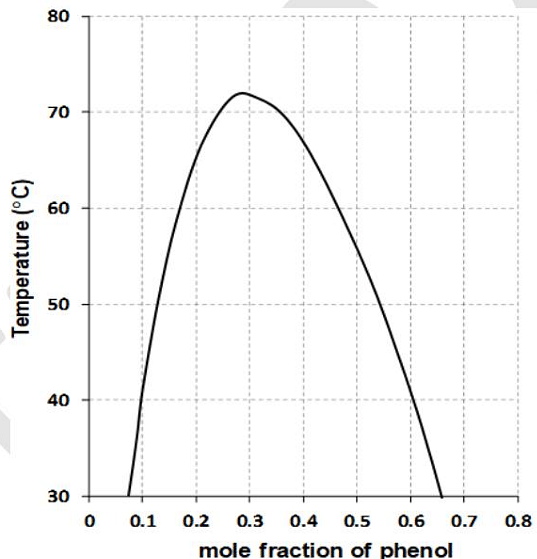
(rounded off to one decimal place) - The correct statement(s) about actinides is/are:
Top GATE CY Questions
- Ψ(x) = \(\sqrt{\frac{32}{L^3}}\)[sin(\(\frac{\pi x}{L}\)).cos(\(\frac{\pi x}{L}\)).sin(\(\frac{2\pi y}{L}\)).sin(\(\frac{\pi z}{L}\))]Find the value of E221: E111.
 what is the final product
- Which are optically active?
 intensity ratio of final product
- Which among the following is true?
View More Questions