For a prism of prism angle 𝜃 = 60°, the refractive indices of the left half and the right half are, respectively, 𝑛1 and 𝑛2 (𝑛2 ≥ 𝑛1) as shown in the figure. The angle of incidence 𝑖 is chosen such that the incident light rays will have minimum deviation if 𝑛1 = 𝑛2 = 𝑛 = 1.5. For the case of unequal refractive indices, 𝑛1 = 𝑛 and 𝑛2 = 𝑛 +∆𝑛 (where∆𝑛≪𝑛), the angle of emergence \(𝑒 =𝑖+∆𝑒\). Which of the following statement(s) is (are) correct?
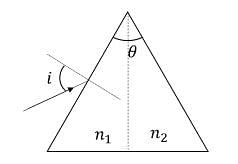
- The value of $\Delta e$ (in radians) is greater than that of $\Delta n$
- $\Delta e$ is proportional to $\Delta n$
- $\Delta e$ lies between $2.0$ and $3.0$ milliradians, if $\Delta n =2.8 \times 10^{-3}$
- $\Delta e$ lies between $1.0$ and $1.6$ milliradians, if $\Delta n =2.8 \times 10^{-3}$

The Correct Option is A, B, C
Solution and Explanation
Step 1: Given Information
We are given the following conditions:
- The prism has an angle of \( \theta = 60^\circ \).
- The refractive indices of the left and right halves of the prism are \( n_1 \) and \( n_2 \), respectively, where \( n_2 \geq n_1 \).
- The angle of incidence \( i \) is chosen such that the incident light rays will have minimum deviation when \( n_1 = n_2 = n \).
- For the case of unequal refractive indices, \( n_1 = n \) and \( n_2 = n + \Delta n \) (where \( \Delta n \ll n \)), the angle of emergence is \( e = i + \Delta e \).
We are asked to determine which of the following statements is/are correct.
Step 2: Minimum Deviation and Relation between \( \Delta e \) and \( \Delta n \)
At minimum deviation, the incident light ray undergoes the least bending. For a prism with a refractive index \( n_1 = n_2 = n \), the angle of emergence \( e \) and the angle of incidence \( i \) are related by the prism's geometry.
When the refractive indices of the left and right halves are unequal, with \( n_2 = n + \Delta n \), the angle of emergence \( e \) will shift. Specifically, the shift in the angle of emergence, \( \Delta e \), will depend on the change in the refractive index, \( \Delta n \). This change is proportional to \( \Delta n \). Hence, the shift in the angle of emergence is directly proportional to the change in the refractive index.
Therefore, statement (B) is correct: \( \Delta e \) is proportional to \( \Delta n \).
Step 3: Estimating \( \Delta e \) for \( \Delta n = 2.8 \times 10^{-3} \)
We are given that \( \Delta n = 2.8 \times 10^{-3} \). We need to estimate the value of \( \Delta e \), which lies between 2.0 and 3.0 milliradians. The value of \( \Delta e \) is small because \( \Delta n \) is small. The linear relationship between \( \Delta e \) and \( \Delta n \) means that if \( \Delta n = 2.8 \times 10^{-3} \), the value of \( \Delta e \) will indeed lie between 2.0 and 3.0 milliradians.
Therefore, statement (C) is correct: \( \Delta e \) lies between 2.0 and 3.0 milliradians if \( \Delta n = 2.8 \times 10^{-3} \).
Final Answer:
The correct options are:
- (B) \( \Delta e \) is proportional to \( \Delta n \)
- (C) \( \Delta e \) lies between 2.0 and 3.0 milliradians if \( \Delta n = 2.8 \times 10^{-3} \)
Top JEE Advanced Physics Questions
- Yellow light is used in a single slit diffraction experiment with slit width of 0.6 mm. If yellow light is replaced by X-rays, then the observed pattern will reveal
- The size of the image of an object, which is at infinity, as formed by a convex lens of focal length 30 cm is 2 cm. If a concave lens of focal length 20 cm is placed between the convex lens and the image at a distance of 26 cm from the convex lens, calculate the new size of the image.
- A concave lens of glass, refractive index 1.5 has both surfaces of same radius of curvature R. On immersion in a medium of refractive index 1.75, it will behave as a
- The position vector $\vec{r}$ of a particle of mass $m$ is given by the following equation $\vec{r}(t)=\alpha t^{3} \hat{i}+\beta t^{2} \hat{j}$ where $\alpha=\frac{10}{3} \,ms ^{-3}, \beta=5\, ms ^{-2}$ and $m =0.1 \,kg$. At $t =1\, s$, which of the following statement (s) is (are) true about the particle?
- In an n-p-n transistor circuit, the collector current is 10 mA. If 90% of the electrons emitted reach the collector
Top JEE Advanced Ray optics and optical instruments Questions
- A light beam is travelling from Region $I$ to Region $IV$ (Refer Figure). The refractive index in Regions $I, II, III$ and $IV$ are $n_0,\frac{n_0}{2},\frac{n_0}{6} \, \, and \, \, \frac{n_0}{8},$ respectively.The angle of incidence $\theta$ for which the beam just misses entering Region $IV$ is
- For an isosceles prism of angle $
- A ball is dropped from a height of $20\, m$ above the surface of water in a lake. The refractive index of water is$\frac{4}{3}$ A fish fish inside the lake, in the line of fall of the ball, is looking at the ball. At an instant, when the ball is 12.8 m above the water surface, the fish sees the speed of ball as ($Take g = 10\,m/s^2$)
- A bi-convex lens is formed with two thin plano-convex lenses as shown in the figure. Refractive index $n$ of the first lens is $1.5$ and that of the second lens is $1.2$. Both the curved surfaces are of the same radius of curvature $R\, = \,14\, cm$.For this bi-convex lens, for an object distance of $40\, cm$, the image distance will be
- A biconvex lens of focal length $15\, cm$ is in front of a plane mirror. The distance between the lens and the mirror is $10\,cm$. A small object is kept at a distance of $30\,cm$ from the lens. The final image is
Top JEE Advanced Questions
- Yellow light is used in a single slit diffraction experiment with slit width of 0.6 mm. If yellow light is replaced by X-rays, then the observed pattern will reveal
- The size of the image of an object, which is at infinity, as formed by a convex lens of focal length 30 cm is 2 cm. If a concave lens of focal length 20 cm is placed between the convex lens and the image at a distance of 26 cm from the convex lens, calculate the new size of the image.
- A concave lens of glass, refractive index 1.5 has both surfaces of same radius of curvature R. On immersion in a medium of refractive index 1.75, it will behave as a
- The position vector $\vec{r}$ of a particle of mass $m$ is given by the following equation $\vec{r}(t)=\alpha t^{3} \hat{i}+\beta t^{2} \hat{j}$ where $\alpha=\frac{10}{3} \,ms ^{-3}, \beta=5\, ms ^{-2}$ and $m =0.1 \,kg$. At $t =1\, s$, which of the following statement (s) is (are) true about the particle?
- In an n-p-n transistor circuit, the collector current is 10 mA. If 90% of the electrons emitted reach the collector