Question:
Following thyroid surgery, a patient developed hoarseness, weakness, decreased range of pitch or volume, and fatigue after extensive use of the voice. The nerve injured is:
Following thyroid surgery, a patient developed hoarseness, weakness, decreased range of pitch or volume, and fatigue after extensive use of the voice. The nerve injured is:
Show Hint
Think about which nerve controls vocal cord closure, not just pitch.
Updated On: Jul 16, 2026
- Transverse cutaneous nerve of the neck (C2 and C3)
- External branch of the superior laryngeal nerve
- Recurrent laryngeal nerve
- Cervical sympathetic plexus
Show Solution

Verified By Collegedunia
The Correct Option is C
Solution and Explanation
Step 1: Understanding the Question:
This question describes a patient who develops voice changes after thyroid surgery and asks which nerve is responsible. Thyroidectomy places several nerves at risk because they run close to the thyroid vessels and gland capsule, and different nerve injuries produce different patterns of voice change.
Step 2: Key Concept or Approach:
The recurrent laryngeal nerve (RLN) supplies every intrinsic muscle of the larynx except the cricothyroid and is chiefly responsible for vocal cord movement and glottic closure. It runs close to the inferior thyroid artery and the ligament of Berry, making it the nerve most commonly injured during thyroid surgery. When one RLN is injured, the corresponding vocal cord loses its adductor tone and sits in a paramedian position. The opposite cord tries to compensate by crossing the midline during phonation, but glottic closure stays incomplete. This produces a weak, breathy voice that tires quickly with use, drops in volume, and loses part of its normal pitch range because the patient can no longer generate firm, sustained glottic contact.
Step 3: Working Through the Options:
The transverse cutaneous nerve of the neck (C2, C3) is a purely sensory branch of the cervical plexus supplying skin over the anterior neck; injuring it causes numbness, not any change in voice. The external branch of the superior laryngeal nerve supplies only the cricothyroid muscle, which tenses the vocal cords for high-pitched sound; its injury causes a subtle, often overlooked loss of the upper singing range while the conversational voice usually stays close to normal, a milder pattern than the one described. The cervical sympathetic plexus has nothing to do with phonation; damage to it produces Horner's syndrome (ptosis, miosis, anhidrosis), not hoarseness. The recurrent laryngeal nerve fits the clinical picture because its injury directly impairs cord closure, giving hoarseness, a breathy and weak voice, reduced loudness, a narrowed pitch range, and easy vocal fatigue on prolonged use.
Step 4: Conclusion:
The nerve injured is the recurrent laryngeal nerve.
This question describes a patient who develops voice changes after thyroid surgery and asks which nerve is responsible. Thyroidectomy places several nerves at risk because they run close to the thyroid vessels and gland capsule, and different nerve injuries produce different patterns of voice change.
Step 2: Key Concept or Approach:
The recurrent laryngeal nerve (RLN) supplies every intrinsic muscle of the larynx except the cricothyroid and is chiefly responsible for vocal cord movement and glottic closure. It runs close to the inferior thyroid artery and the ligament of Berry, making it the nerve most commonly injured during thyroid surgery. When one RLN is injured, the corresponding vocal cord loses its adductor tone and sits in a paramedian position. The opposite cord tries to compensate by crossing the midline during phonation, but glottic closure stays incomplete. This produces a weak, breathy voice that tires quickly with use, drops in volume, and loses part of its normal pitch range because the patient can no longer generate firm, sustained glottic contact.
Step 3: Working Through the Options:
The transverse cutaneous nerve of the neck (C2, C3) is a purely sensory branch of the cervical plexus supplying skin over the anterior neck; injuring it causes numbness, not any change in voice. The external branch of the superior laryngeal nerve supplies only the cricothyroid muscle, which tenses the vocal cords for high-pitched sound; its injury causes a subtle, often overlooked loss of the upper singing range while the conversational voice usually stays close to normal, a milder pattern than the one described. The cervical sympathetic plexus has nothing to do with phonation; damage to it produces Horner's syndrome (ptosis, miosis, anhidrosis), not hoarseness. The recurrent laryngeal nerve fits the clinical picture because its injury directly impairs cord closure, giving hoarseness, a breathy and weak voice, reduced loudness, a narrowed pitch range, and easy vocal fatigue on prolonged use.
Step 4: Conclusion:
The nerve injured is the recurrent laryngeal nerve.
Was this answer helpful?
0
0
Top NEET PG Surgery Questions
- A 55-year-old male presented with verrucous carcinoma around the glans of the penis. Examination reveals that the inguinal lymph nodes are not enlarged. What is the appropriate management for this patient?
- Identify the procedure being performed in the image given below.
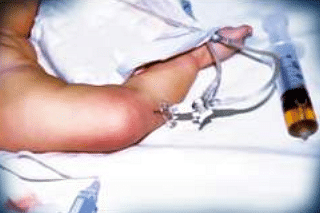
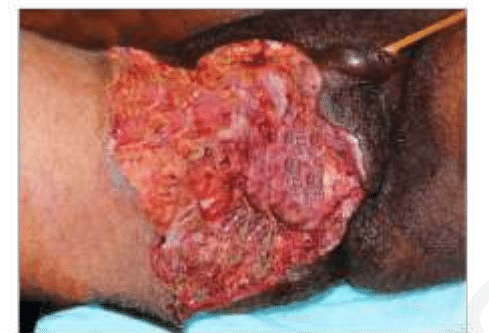
- A diabetic patient presents with sudden-onset perineal pain. On examination, foul-smelling discharge, and necrotic tissue as seen in the image is noted. Which of the following is true about the given condition?
- Which of the following is the most common complication following ligation of the first vessel during abdominoperineal resection for rectal carcinoma?(APR Abdominoperineal resection)
- A patient presents to the clinic with the lesion given in the image. He had a traumatic injury to the chest one year ago. What is the most likely diagnosis?
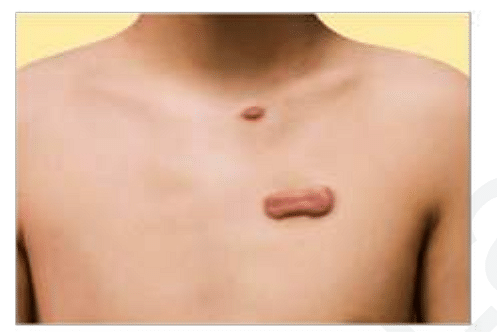
View More Questions
Top NEET PG Questions
- A patient hailing from Delhi presents with fever, arthralgia, and extensive petechial rash for 3 days. Lab investigations revealed a hemoglobin of 9 g/ dL, a white blood cell count of 9000 cells/mm3, a platelet count of 20000 cells/mm3, and a prolonged bleeding time. The clotting time was normal. What is the most likely diagnosis?
- Which of the following statements is true about Trichomonas vaginalis?
- A lady from West Rajasthan presented with an ulcer surrounded by erythema on the right leg. Microscopy of the biopsy from the edge of the ulcer showed organisms with dark staining nuclei and kinetoplast. What is the most likely causative agent?
- A child presents with a fever and a rash. Urine examination showed cells with owl's eye appearance. What is the most likely diagnosis?
- Infection with Clonorchis sinensis is associated with an increased risk of__?
View More Questions