Question:
Following a full term normal delivery (FTND), a woman develops postpartum hemorrhage after 2 days. Activated partial thromboplastin time (APTT) is raised, factor VIII is 10% of the normal value, while prothrombin time (PT) and thrombin time (TT) are normal. What is the likely diagnosis?
Following a full term normal delivery (FTND), a woman develops postpartum hemorrhage after 2 days. Activated partial thromboplastin time (APTT) is raised, factor VIII is 10% of the normal value, while prothrombin time (PT) and thrombin time (TT) are normal. What is the likely diagnosis?
Show Hint
Isolated raised APTT with low factor VIII, normal PT and TT, and no bleeding history before delivery points to an acquired factor VIII inhibitor, not a hereditary defect or DIC.
Updated On: Jul 8, 2026
- Acquired factor VIII deficiency
- Hereditary factor VIII deficiency
- DIC
- Antiphospholipid syndrome
Show Solution

Verified By Collegedunia
The Correct Option is A
Solution and Explanation
Step 1: Understanding the Question.
A woman bleeds two days after a normal delivery. Her APTT is long, her factor VIII activity is only 10% of normal, but her PT and TT are both normal. We need the diagnosis that fits this exact lab pattern.
Step 2: Key Concept or Approach.
APTT tests the intrinsic pathway, factors VIII, IX, XI, and XII, plus the common pathway. PT tests the extrinsic pathway, factor VII, plus the common pathway. TT tests only the last step, fibrinogen turning into fibrin.
A long APTT with a normal PT and a normal TT means the defect sits only in the intrinsic-pathway factors, VIII, IX, XI, or XII, and not in fibrinogen or the extrinsic pathway.
Step 3: Detailed Explanation.
Her factor VIII is measured directly and is only 10% of normal, so factor VIII is the specific factor at fault, matching the isolated APTT rise.
Hereditary factor VIII deficiency (hemophilia A) is X-linked and present from birth, so a woman with this disease would almost always have a bleeding history since childhood, such as bleeding after minor cuts, dental work, or an earlier delivery. A first bleed only now, after an otherwise normal delivery, does not fit a lifelong hereditary defect.
A new antibody that appears after delivery and attacks factor VIII, called acquired hemophilia A, is a recognized rare postpartum complication. The antibody neutralizes circulating factor VIII, so its activity drops even though the person was never a hemophiliac before. Since only factor VIII is knocked down, APTT rises while PT and TT, which do not depend on factor VIII, stay normal. This matches the case exactly.
DIC would consume clotting factors from both pathways, so PT would also rise, fibrinogen would fall and lengthen TT, and platelets would usually drop too. Here PT and TT are both normal, so DIC does not fit.
Antiphospholipid syndrome, through the lupus anticoagulant, can make the APTT look long in the test tube because the antibody interferes with the phospholipid used in the assay, but the true factor VIII level stays normal and the clinical problem this syndrome causes is clotting, not bleeding. A real drop of factor VIII to 10% does not match this diagnosis.
Step 4: Final Answer.
An isolated long APTT, a true fall in factor VIII, normal PT and TT, and a fresh onset after delivery point to an acquired inhibitor against factor VIII.
\[ \boxed{\text{Acquired factor VIII deficiency}} \]
A woman bleeds two days after a normal delivery. Her APTT is long, her factor VIII activity is only 10% of normal, but her PT and TT are both normal. We need the diagnosis that fits this exact lab pattern.
Step 2: Key Concept or Approach.
APTT tests the intrinsic pathway, factors VIII, IX, XI, and XII, plus the common pathway. PT tests the extrinsic pathway, factor VII, plus the common pathway. TT tests only the last step, fibrinogen turning into fibrin.
A long APTT with a normal PT and a normal TT means the defect sits only in the intrinsic-pathway factors, VIII, IX, XI, or XII, and not in fibrinogen or the extrinsic pathway.
Step 3: Detailed Explanation.
Her factor VIII is measured directly and is only 10% of normal, so factor VIII is the specific factor at fault, matching the isolated APTT rise.
Hereditary factor VIII deficiency (hemophilia A) is X-linked and present from birth, so a woman with this disease would almost always have a bleeding history since childhood, such as bleeding after minor cuts, dental work, or an earlier delivery. A first bleed only now, after an otherwise normal delivery, does not fit a lifelong hereditary defect.
A new antibody that appears after delivery and attacks factor VIII, called acquired hemophilia A, is a recognized rare postpartum complication. The antibody neutralizes circulating factor VIII, so its activity drops even though the person was never a hemophiliac before. Since only factor VIII is knocked down, APTT rises while PT and TT, which do not depend on factor VIII, stay normal. This matches the case exactly.
DIC would consume clotting factors from both pathways, so PT would also rise, fibrinogen would fall and lengthen TT, and platelets would usually drop too. Here PT and TT are both normal, so DIC does not fit.
Antiphospholipid syndrome, through the lupus anticoagulant, can make the APTT look long in the test tube because the antibody interferes with the phospholipid used in the assay, but the true factor VIII level stays normal and the clinical problem this syndrome causes is clotting, not bleeding. A real drop of factor VIII to 10% does not match this diagnosis.
Step 4: Final Answer.
An isolated long APTT, a true fall in factor VIII, normal PT and TT, and a fresh onset after delivery point to an acquired inhibitor against factor VIII.
\[ \boxed{\text{Acquired factor VIII deficiency}} \]
Was this answer helpful?
0
0
Top NEET PG Gynaecology and Obstetrics Questions
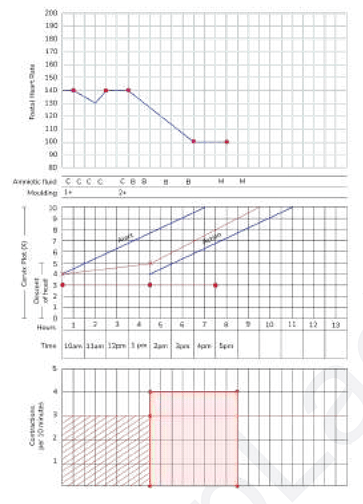
- A partogram of a woman who is in labor is shown below. Oxytocin infusion is already given. How will you manage the condition?
- A woman presents to you at 36 weeks of gestation with complaints of breathlessness and excessive abdominal distension. Fetal movements are normal. On examination, fetal parts are not easily felt and fetal heartbeat is heard but it is muffled. Her symphysis fundal height is 41 cm. Her abdomen is tense but not tender. What is the most likely diagonosis?
- For which of the following procedures in the given OT list, can you preferably do a hysteroscopy ?
- A primigravida presents to you with anemia early in her pregnancy. She is 7 weeks pregnant as seen on ultrasound. Her hemoglobin level is 9 g/dL. When should the iron supplements be started for her?
- A 23-year-old woman accompanied by her mother-in-law comes to the infertility clinic. She has been having regular intercourse for 6 months but is not able to conceive. What is the next best step?
View More Questions
Top NEET PG Questions
- A patient hailing from Delhi presents with fever, arthralgia, and extensive petechial rash for 3 days. Lab investigations revealed a hemoglobin of 9 g/ dL, a white blood cell count of 9000 cells/mm3, a platelet count of 20000 cells/mm3, and a prolonged bleeding time. The clotting time was normal. What is the most likely diagnosis?
- Which of the following statements is true about Trichomonas vaginalis?
- A lady from West Rajasthan presented with an ulcer surrounded by erythema on the right leg. Microscopy of the biopsy from the edge of the ulcer showed organisms with dark staining nuclei and kinetoplast. What is the most likely causative agent?
- A child presents with a fever and a rash. Urine examination showed cells with owl's eye appearance. What is the most likely diagnosis?
- Infection with Clonorchis sinensis is associated with an increased risk of__?
View More Questions