Find the values of other five trigonometric functions if \(cos\,x=-\frac{1}{2},\) x lies in third quadrant.

Solution and Explanation
\(cos\,x=-\frac{1}{2}\)
\(∴sec\,x=\frac{1}{cos\,x}=\frac{1}{(-\frac{1}{2})}=-2\)
\(sin^2x+cos^2\,x=1\)
\(⇒sin^2+cos^2\,x=1\)
\(⇒sin^2x=1-(-\frac{1}{2})^2\)
\(⇒sin^2x=1-\frac{1}{4}=\frac{3}{4}\)
\(sin^2x=±\frac{±√3}{2}\)
Since x lies in the 3rd quadrant, the value of sin x will be negative.
\(∴sin\,x=-\frac{√3}{2}\)
\(cosecx=\frac{1}{sin\,x}=\frac{1}{-\frac{√3}{2}}=-\frac{2}{√3}\)
\(tan\,x=\frac{sin\,x}{cos \,x}=\frac{-\frac{√3}{2}}{-\frac{1}{2}}=√3\)
\(cot\,x=\frac{1}{tan\,x}=\frac{1}{√3}\)
Top CBSE Class XI Mathematics Questions
- A coin is tossed twice, what is the probability that atleast one tail occurs?
- The relation f is defined by
\(f(x) = \begin{cases} x^2, & \quad 0≤x≤3\\ 3x, & \quad 3≤x≤10 \end{cases}\)
The relation g is defined by
\(g(x) = \begin{cases} x^2, & \quad 0≤x≤2\\ 3x, & \quad 2≤x≤10 \end{cases}\)
Show that f is a function and g is not a function. - Let \(f={(x,\frac {x^2}{1+x^2}):x∈R}\) be a function from R into R. Determine the range of f.
- How many 4-letter code can be formed using the first 10 letters of the English alphabet, if no letter can be repeated?
- In how many of the distinct permutations of the letters in MISSISSIPPI do the four I's not come together?
Top CBSE Class XI Questions
- The total number of protons in $ 10\,g$ of calcium carbonate is $ (N_{0}=6.023\times 10^{23})$ :
- Justify giving reactions that among halogens, fluorine is the best oxidant and among hydrohalic compounds, hydroiodic acid is the best reductant.
- An oxygen cylinder of volume 30 litre has an initial gauge pressure of 15 atm and a temperature of 27 °C. After some oxygen is withdrawn from the cylinder, the gauge pressure drops to 11 atm and its temperature drops to 17 °C. Estimate the mass of oxygen taken out of the cylinder (R = 8.31 J mol–1 K–1, molecular mass of O2 = 32 u).
- Estimate the total number of air molecules (inclusive of oxygen, nitrogen, water vapour and other constituents) in a room of capacity 25.0 m3 at a temperature of 27 °C and 1 atm pressure.
- An air bubble of volume 1.0 cm3 rises from the bottom of a lake 40 m deep at a temperature of 12 °C. To what volume does it grow when it reaches the surface, which is at a temperature of 35 °C ?
Concepts Used:
Trigonometric Functions
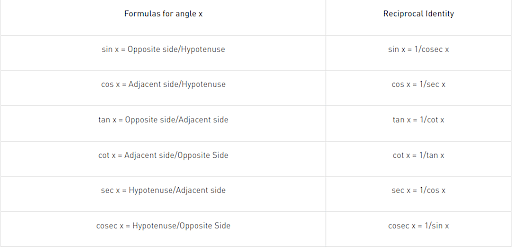
The relationship between the sides and angles of a right-angle triangle is described by trigonometry functions, sometimes known as circular functions. These trigonometric functions derive the relationship between the angles and sides of a triangle. In trigonometry, there are three primary functions of sine (sin), cosine (cos), tangent (tan). The other three main functions can be derived from the primary functions as cotangent (cot), secant (sec), and cosecant (cosec).
Six Basic Trigonometric Functions:
- Sine Function: The ratio between the length of the opposite side of the triangle to the length of the hypotenuse of the triangle.
sin x = a/h
- Cosine Function: The ratio between the length of the adjacent side of the triangle to the length of the hypotenuse of the triangle.
cos x = b/h
- Tangent Function: The ratio between the length of the opposite side of the triangle to the adjacent side length.
tan x = a/b
Tan x can also be represented as sin x/cos x
- Secant Function: The reciprocal of the cosine function.
sec x = 1/cosx = h/b
- Cosecant Function: The reciprocal of the sine function.
cosec x = 1/sinx = h/a
- Cotangent Function: The reciprocal of the tangent function.
cot x = 1/tan x = b/a
Formulas of Trigonometric Functions: