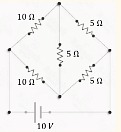
Find potential difference across bulb as shown in the figure.
Show Hint
When dealing with circuits, always use Ohm's law and the power formula to relate the current, voltage, and resistance. In this case, the potential difference across the bulb is found using the current and the resistance of the bulb.
Step 1: Analyzing the circuit.
In the given circuit, we have two resistors: one with resistance \( R_1 = 200 \, \Omega \) and the other with \( R_2 = 400 \, \Omega \). The bulb, represented by a 100W, 200V specification, is connected across the 400Ω resistor. There is also a 100V power supply.
Step 2: Applying power and voltage relationship.
The power rating of the bulb is given by:
\[
P = \frac{V^2}{R}
\]
where \( P = 100 \, \text{W} \) and \( V = 200 \, \text{V} \). Therefore, we can calculate the resistance \( R \) of the bulb as:
\[
R_{\text{bulb}} = \frac{V^2}{P} = \frac{(200)^2}{100} = 400 \, \Omega
\]
Step 3: Total resistance in the circuit.
The total resistance in the circuit is the sum of the resistances of the two resistors and the bulb:
\[
R_{\text{total}} = R_1 + R_2 + R_{\text{bulb}} = 200 + 400 + 400 = 1000 \, \Omega
\]
Step 4: Calculating the current.
Now, using Ohm’s law, we can calculate the current \( I \) in the circuit:
\[
I = \frac{V_{\text{total}}}{R_{\text{total}}} = \frac{100}{1000} = 0.1 \, \text{A}
\]
Step 5: Finding the potential difference across the bulb.
Now, the potential difference across the bulb can be found using Ohm’s law:
\[
V_{\text{bulb}} = I \times R_{\text{bulb}} = 0.1 \times 400 = 50 \, \text{V}
\]