Explain the mechanism of the cleaning action of soaps.
Explain the mechanism of the cleaning action of soaps.

Solution and Explanation
Cleansing action of soaps: The dirt present on clothes is organic in nature and insoluble in water. Therefore, it cannot be removed by only washing with water. When soap is dissolved in water, its hydrophobic ends attach themselves to the dirt and remove it from the cloth. Then, the molecules of soap arrange themselves in micelle formation and trap the dirt at the center of the cluster. These micelles remain suspended in the water. Hence, the dust particles are easily rinsed away by water.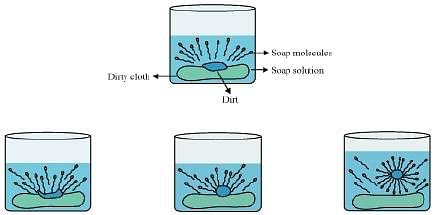
Top CBSE X Science Questions
- More than three million carbon compounds have been discovered in the field of chemistry. The diversity of these compounds is due to the capacity of carbon atoms for bonding with one another as well as with other atoms. Most of the carbon compounds are poor conductors of electricity and have low melting and boiling points.
- Human digestive system is a tube running from mouth to anus. Its main function is to breakdown complex molecules present in the food which cannot be absorbed as such into smaller molecules. These molecules are absorbed across the walls of the tube and the absorbed food reaches each and every cell of the body where it is utilised for obtaining energy.
- A student has three convex lenses A, B, and C of different focal lengths. He wants to observe the images formed by these lenses on a screen by placing a candle flame at different distances as given in the following table:
Case No. Lens Focal Length Object Distance 1 \(A\) 50 cm 25 cm 2 B 20 cm 60 cm 3 C 15 cm 30 cm - Consider the unbalanced chemical equations of the chemical reactions listed below:
- \(\text{CaO} + \text{H}_2\text{O} \rightarrow \text{Ca(OH)}_2\)
- \(\text{Pb(NO}_3\text{)}_2 \rightarrow \text{PbO} + \text{NO}_2 + \text{O}_2\)
- \(\text{CuSO}_4 + \text{Fe} \rightarrow \text{FeSO}_4 + \text{Cu}\)
- \(\text{Na}_2\text{SO}_4 + \text{BaCl}_2 \rightarrow \text{BaSO}_4 + \text{NaCl}\)
- The maintenance functions of every living organism on the earth keeps going on even when they are not doing anything particular. The processes which together perform the job of maintenance of life are known as life processes. These processes are nutrition, respiration, transportation and excretion.
Top CBSE X Chemical Properties Of Carbon Compounds Questions
- More than three million carbon compounds have been discovered in the field of chemistry. The diversity of these compounds is due to the capacity of carbon atoms for bonding with one another as well as with other atoms. Most of the carbon compounds are poor conductors of electricity and have low melting and boiling points.
Ethane, with the molecular formula C2H6 has
Butanone is a four-carbon compound with the functional group
While cooking, if the bottom of the vessel is getting blackened on the outside, it means that
Explain the nature of the covalent bond using the bond formation in CH3Cl.
Top CBSE X Questions
- Read the following source carefully and answer the questions that follow:
Print Comes to India
From 1780, James Augustus Hickey began to edit the Bengal Gazette, a weekly maga zine that described itself as ‘a commercial paper open to all, but influenced by none’. So it was private English enterprise, proud of its independence from colonial influence, that began English printing in India. Hickey published a lot of advertisements, including those that related to the import and sale of slaves. But he also published a lot of gossip about the Company’s senior officials in India. Enraged by this, Governor-General War ren Hastings persecuted Hickey, and encouraged the publication of officially sanctioned newspapers that could counter the flow of information that damaged the image of the colonial government. By the close of the eighteenth century, a number of newspapers and journals appeared in print. There were Indians, too, who began to publish Indian news papers. The first to appear was the weekly Bengal Gazette, brought out by Gangadhar Bhattacharya, who was close to Raja Rammohan Roy. - Read the following source carefully and answer the questions that follow:
Loans from Cooperatives
Besides banks, the other major source of cheap credit in rural areas are the cooperative societies (or cooperatives). Members of a cooperative pool their resources for coopera tion in certain areas. There are several types of cooperatives possible such as farmers cooperatives, weavers cooperatives, industrial workers cooperatives, etc. Krishak Coop erative functions in a village not very far away from Sonpur. It has 2300 farmers as members. It accepts deposits from its members. With these deposits as collateral, the Cooperative has obtained a large loan from the bank. These funds are used to provide loans to members. Once these loans are repaid, another round of lending can take place. Krishak Cooperative provides loans for the purchase of agricultural implements, loans for cultivation and agricultural trade, fishery loans, loans for construction of houses and for a variety of other expenses. - More than three million carbon compounds have been discovered in the field of chemistry. The diversity of these compounds is due to the capacity of carbon atoms for bonding with one another as well as with other atoms. Most of the carbon compounds are poor conductors of electricity and have low melting and boiling points.
- Human digestive system is a tube running from mouth to anus. Its main function is to breakdown complex molecules present in the food which cannot be absorbed as such into smaller molecules. These molecules are absorbed across the walls of the tube and the absorbed food reaches each and every cell of the body where it is utilised for obtaining energy.
- A student has three convex lenses A, B, and C of different focal lengths. He wants to observe the images formed by these lenses on a screen by placing a candle flame at different distances as given in the following table:
Case No. Lens Focal Length Object Distance 1 \(A\) 50 cm 25 cm 2 B 20 cm 60 cm 3 C 15 cm 30 cm
Concepts Used:
Allotropes of Carbon
The existence of a chemical element in one or more physical forms happening in the same physical state is called Allotropes or allotropy. Allotropes may show different physical or chemical states turning on the atom arrangement or the number of existent atoms. While carbon and sulfur is the common element presenting allotropy. Carbon can make further allotropes due to its five-membered valency.
Read More: Allotropes of Carbon
Allotropes of Carbon:
Carbon is part of a p-block element.
- The atomic number of carbon = 6
- It belongs to group 14.
- It makes up about 18.5% of the human body by mass.
Carbon has only two types of allotropes, such as;
- Crystalline
- Amorphous
The crystalline form of carbon consists of allotropes like;
- Diamond
- Graphite
- Fullerenes
The amorphous form of carbon consists of allotropes like;
- Coal
- Coke
- Wood charcoal
- Animal charcoal
- Lampblack
- Gas carbon