Question:
Continuity of cytoplasm from cell to cell is maintained through
Continuity of cytoplasm from cell to cell is maintained through
Updated On: Jun 21, 2022
- pit canals present in primary walls
- plasmodesmata
- plasmalemma
- middle lamella.
Show Solution

Verified By Collegedunia
The Correct Option is B
Solution and Explanation
Plasmodesrnata (singular- plasmodesma; Tangl, 1879; Strasburger, 1901) are cytoplasmic bridges between adjacent plant cells which develop in the minute pores of their walls. They form a protoplasmic continuum called symplast. Cell wall and intercellular spaces form a non-living component of the plant body called apoplast. A plasmodesma is 40-50 nm i diameter. It may be simple or branched.
Was this answer helpful?
0
0
Top COMEDK UGET Biology Questions
- A 10 years old patient is found to have the following clinical features: slanting eyes with epicanthic fold of the eyelid, hypertelorism, dysplastic ears, mongoloid face and protruding tongue. The above mentioned features are associated with which syndrome?
- Which of the following is not necessary for obtaining protoplasts for somatic hybridisation
- Which of the following is the correct date of publication of the, book entitled 'Speciee Plantarum" authored by Carolus Linnaeus? This date is starting point date for modern plant nomenclature.
- The two, more distantly related phyla among the following are
- Which one of the following families has features like bisexual, pentamerous, gamopetalous corolla with epipetalous stamens, sagittate anthers, subapocarpous ovary and a pair of follicles as their diagnostic characters?
View More Questions
Top COMEDK UGET Cell: the unit of life Questions
- Which of the following sequence is correct for the origin of lysosome?
- Lampbrush chromosomes are
- Fluid mosaic model of plasma membrane was proposed by
- Larger subunit of the ribosome helps in producing
- Which is characteristic feature of plant cell
View More Questions
Top COMEDK UGET Questions
- If the line px + qy = 0 coincides with one of the lines given by $ax^2 + 2hxy + by^2 = 0$, then
- A long hollow copper pipe carries a current. The magnetic field producted will be
- An ammeter reads 0 to 10 A. It has negligible resistance.To convert this into voltmeter to read upto 250 V, resistance to be used is
- Force of attraction or repulsion between two current carrying wires separated by a distance r is proportional to
- When a material is placed in a magnetic field B, a magnetic moment proportional tc B but in a direction opposite to B is induced. The material is
View More Questions
Concepts Used:
Cell: The Unit of Life
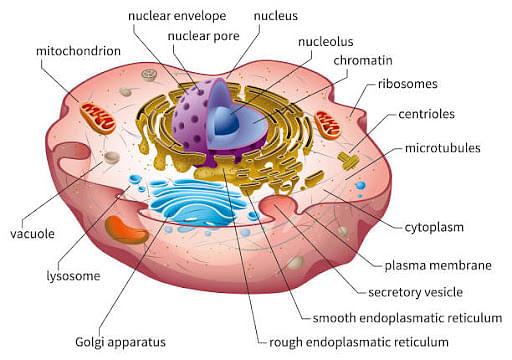
- A cell is derived as the functional and structural unit of life. Every cell is surrounded by a cell membrane that dissects the external and internal environments of the cell. The interior environment of a cell is called the cytoplasm.
- It carries cellular machinery and structural elements. The nucleus is present in the center of the cell, which includes all the hereditary information of an organism. Some of the molecules present in the cell are protein, carbohydrates, starch, and sugar.
Read More: Fundamental Unit of Life: Cell
Parts of Cell:
The different parts of a cell and their functions are as follows:
- Cell Membrane
- Cell Wall
- Nucleus
- Cytoplasm