Question:
Consider two particles with angular momenta \(j_1 = 2\hbar\) and \(j_2 = \hbar/2\). If the expression
\[ |j=\tfrac52, m=\tfrac32\rangle = c_1|j_1=2,m_1=1\rangle|j_2=\tfrac12,m_2=\tfrac12\rangle + c_2|j_1=2,m_1=2\rangle|j_2=\tfrac12,m_2=-\tfrac12\rangle \]gives an eigenstate of the total angular momentum of the two particles, using standard notation, which of the following is true?
(Hint: \(\hat J_{\pm}|j,m\rangle = \sqrt{j(j+1)-m(m\pm1)}\,|j,m\pm1\rangle\))
Consider two particles with angular momenta \(j_1 = 2\hbar\) and \(j_2 = \hbar/2\). If the expression
\[ |j=\tfrac52, m=\tfrac32\rangle = c_1|j_1=2,m_1=1\rangle|j_2=\tfrac12,m_2=\tfrac12\rangle + c_2|j_1=2,m_1=2\rangle|j_2=\tfrac12,m_2=-\tfrac12\rangle \]gives an eigenstate of the total angular momentum of the two particles, using standard notation, which of the following is true?
(Hint: \(\hat J_{\pm}|j,m\rangle = \sqrt{j(j+1)-m(m\pm1)}\,|j,m\pm1\rangle\))
\[ |j=\tfrac52, m=\tfrac32\rangle = c_1|j_1=2,m_1=1\rangle|j_2=\tfrac12,m_2=\tfrac12\rangle + c_2|j_1=2,m_1=2\rangle|j_2=\tfrac12,m_2=-\tfrac12\rangle \]gives an eigenstate of the total angular momentum of the two particles, using standard notation, which of the following is true?
(Hint: \(\hat J_{\pm}|j,m\rangle = \sqrt{j(j+1)-m(m\pm1)}\,|j,m\pm1\rangle\))
Show Hint
Start from the top state \(|j=5/2,m=5/2\rangle\), which is just the simple product state, then apply the lowering operator to both sides and match coefficients.
Updated On: Aug 17, 2026
- \(c_1 = \dfrac{2}{\sqrt5},\quad c_2 = \dfrac{1}{\sqrt5}\)
- \(c_1 = \dfrac{1}{\sqrt5},\quad c_2 = \dfrac{2}{\sqrt5}\)
- \(c_1 = \dfrac{1}{\sqrt2},\quad c_2 = \dfrac{1}{\sqrt2}\)
- \(c_1 = 0,\quad c_2 = 1\)
Show Solution

Verified By Collegedunia
The Correct Option is A
Solution and Explanation
Step 1: Start from the fully stretched top state.
For \(j_1=2\) and \(j_2=\tfrac12\), the largest possible total is \(j=j_1+j_2=\tfrac52\), and its top state is simply the product of both particles at their own maximum \(m\):
\[ \left|\tfrac52,\tfrac52\right\rangle = |j_1=2,m_1=2\rangle\,|j_2=\tfrac12,m_2=\tfrac12\rangle \]
This is true because there is only one way to combine \(m_1\) and \(m_2\) to reach the maximum \(m=\tfrac52\), so no mixing coefficient is needed here.
Step 2: Lower the total state by one step using the hint formula.
Apply the total lowering operator \(\hat J_- = \hat J_{1-}+\hat J_{2-}\) to \(\left|\tfrac52,\tfrac52\right\rangle\). On the left side, using the hint with \(j=\tfrac52,m=\tfrac52\):
\[ \hat J_-\left|\tfrac52,\tfrac52\right\rangle = \sqrt{\tfrac52\cdot\tfrac72 - \tfrac52\cdot\tfrac32}\,\left|\tfrac52,\tfrac32\right\rangle = \sqrt{\tfrac{35}{4}-\tfrac{15}{4}}\,\left|\tfrac52,\tfrac32\right\rangle = \sqrt5\,\left|\tfrac52,\tfrac32\right\rangle \]
Step 3: Apply the same lowering operator to the product state.
On the right side, \(\hat J_{1-}\) acts only on the \(j_1=2\) part and \(\hat J_{2-}\) only on the \(j_2=\tfrac12\) part. Using the hint for each:
\[ \hat J_{1-}|2,2\rangle = \sqrt{2\cdot3-2\cdot1}\,|2,1\rangle = \sqrt{6-2}\,|2,1\rangle = 2|2,1\rangle \]
\[ \hat J_{2-}\left|\tfrac12,\tfrac12\right\rangle = \sqrt{\tfrac12\cdot\tfrac32-\tfrac12\cdot(-\tfrac12)}\left|\tfrac12,-\tfrac12\right\rangle = \sqrt{\tfrac34+\tfrac14}\left|\tfrac12,-\tfrac12\right\rangle = 1\cdot\left|\tfrac12,-\tfrac12\right\rangle \]
So
\[ \hat J_-\Big(|2,2\rangle\left|\tfrac12,\tfrac12\right\rangle\Big) = 2\,|2,1\rangle\left|\tfrac12,\tfrac12\right\rangle + 1\cdot|2,2\rangle\left|\tfrac12,-\tfrac12\right\rangle \]
Step 4: Match the two sides and normalise.
Both sides describe the same physical state, so
\[ \sqrt5\left|\tfrac52,\tfrac32\right\rangle = 2\,|2,1\rangle\left|\tfrac12,\tfrac12\right\rangle + |2,2\rangle\left|\tfrac12,-\tfrac12\right\rangle \]
Dividing through by \(\sqrt5\):
\[ \left|\tfrac52,\tfrac32\right\rangle = \frac{2}{\sqrt5}\,|2,1\rangle\left|\tfrac12,\tfrac12\right\rangle + \frac{1}{\sqrt5}\,|2,2\rangle\left|\tfrac12,-\tfrac12\right\rangle \]
Step 5: Read off the coefficients.
Comparing term by term with the expression given in the question, \(c_1 = \dfrac{2}{\sqrt5}\) (the coefficient of \(|2,1\rangle|\tfrac12,\tfrac12\rangle\)) and \(c_2 = \dfrac{1}{\sqrt5}\) (the coefficient of \(|2,2\rangle|\tfrac12,-\tfrac12\rangle\)).
Step 6: Why the other options are wrong.
Option (B) simply swaps \(c_1\) and \(c_2\), which would be the answer only if the labeling of the two basis kets were reversed. Option (C) treats the two terms as equally weighted, ignoring that lowering \(m_1\) from \(2\) to \(1\) and lowering \(m_2\) from \(\tfrac12\) to \(-\tfrac12\) do not carry equal weight here. Option (D) would mean the state is just the unmixed product state, which is only true for the top state \(m=\tfrac52\), not for \(m=\tfrac32\).
Final Answer:
\(c_1=\dfrac{2}{\sqrt5}\) and \(c_2=\dfrac{1}{\sqrt5}\), option (A).\[ \boxed{c_1=\tfrac{2}{\sqrt5},\ c_2=\tfrac{1}{\sqrt5}} \]
For \(j_1=2\) and \(j_2=\tfrac12\), the largest possible total is \(j=j_1+j_2=\tfrac52\), and its top state is simply the product of both particles at their own maximum \(m\):
\[ \left|\tfrac52,\tfrac52\right\rangle = |j_1=2,m_1=2\rangle\,|j_2=\tfrac12,m_2=\tfrac12\rangle \]
This is true because there is only one way to combine \(m_1\) and \(m_2\) to reach the maximum \(m=\tfrac52\), so no mixing coefficient is needed here.
Step 2: Lower the total state by one step using the hint formula.
Apply the total lowering operator \(\hat J_- = \hat J_{1-}+\hat J_{2-}\) to \(\left|\tfrac52,\tfrac52\right\rangle\). On the left side, using the hint with \(j=\tfrac52,m=\tfrac52\):
\[ \hat J_-\left|\tfrac52,\tfrac52\right\rangle = \sqrt{\tfrac52\cdot\tfrac72 - \tfrac52\cdot\tfrac32}\,\left|\tfrac52,\tfrac32\right\rangle = \sqrt{\tfrac{35}{4}-\tfrac{15}{4}}\,\left|\tfrac52,\tfrac32\right\rangle = \sqrt5\,\left|\tfrac52,\tfrac32\right\rangle \]
Step 3: Apply the same lowering operator to the product state.
On the right side, \(\hat J_{1-}\) acts only on the \(j_1=2\) part and \(\hat J_{2-}\) only on the \(j_2=\tfrac12\) part. Using the hint for each:
\[ \hat J_{1-}|2,2\rangle = \sqrt{2\cdot3-2\cdot1}\,|2,1\rangle = \sqrt{6-2}\,|2,1\rangle = 2|2,1\rangle \]
\[ \hat J_{2-}\left|\tfrac12,\tfrac12\right\rangle = \sqrt{\tfrac12\cdot\tfrac32-\tfrac12\cdot(-\tfrac12)}\left|\tfrac12,-\tfrac12\right\rangle = \sqrt{\tfrac34+\tfrac14}\left|\tfrac12,-\tfrac12\right\rangle = 1\cdot\left|\tfrac12,-\tfrac12\right\rangle \]
So
\[ \hat J_-\Big(|2,2\rangle\left|\tfrac12,\tfrac12\right\rangle\Big) = 2\,|2,1\rangle\left|\tfrac12,\tfrac12\right\rangle + 1\cdot|2,2\rangle\left|\tfrac12,-\tfrac12\right\rangle \]
Step 4: Match the two sides and normalise.
Both sides describe the same physical state, so
\[ \sqrt5\left|\tfrac52,\tfrac32\right\rangle = 2\,|2,1\rangle\left|\tfrac12,\tfrac12\right\rangle + |2,2\rangle\left|\tfrac12,-\tfrac12\right\rangle \]
Dividing through by \(\sqrt5\):
\[ \left|\tfrac52,\tfrac32\right\rangle = \frac{2}{\sqrt5}\,|2,1\rangle\left|\tfrac12,\tfrac12\right\rangle + \frac{1}{\sqrt5}\,|2,2\rangle\left|\tfrac12,-\tfrac12\right\rangle \]
Step 5: Read off the coefficients.
Comparing term by term with the expression given in the question, \(c_1 = \dfrac{2}{\sqrt5}\) (the coefficient of \(|2,1\rangle|\tfrac12,\tfrac12\rangle\)) and \(c_2 = \dfrac{1}{\sqrt5}\) (the coefficient of \(|2,2\rangle|\tfrac12,-\tfrac12\rangle\)).
Step 6: Why the other options are wrong.
Option (B) simply swaps \(c_1\) and \(c_2\), which would be the answer only if the labeling of the two basis kets were reversed. Option (C) treats the two terms as equally weighted, ignoring that lowering \(m_1\) from \(2\) to \(1\) and lowering \(m_2\) from \(\tfrac12\) to \(-\tfrac12\) do not carry equal weight here. Option (D) would mean the state is just the unmixed product state, which is only true for the top state \(m=\tfrac52\), not for \(m=\tfrac32\).
Final Answer:
\(c_1=\dfrac{2}{\sqrt5}\) and \(c_2=\dfrac{1}{\sqrt5}\), option (A).\[ \boxed{c_1=\tfrac{2}{\sqrt5},\ c_2=\tfrac{1}{\sqrt5}} \]
Was this answer helpful?
0
0
Top GATE PH Physics Questions
- An infinite one-dimensional lattice extends along the x-axis. At each lattice site, there exists an ion with spin 1/2. The spin can point either in the +z or -z direction only. Let \( S_P \), \( S_F \), and \( S_A \) denote the entropies of paramagnetic, ferromagnetic, and antiferromagnetic configurations, respectively. Which of the following relations is/are true?
- Two point charges of charge \( +q \) each are placed a distance \( 2d \) apart. A grounded solid conducting sphere of radius \( a \) is placed midway between them. Assume \( a^2 \ll d^2 \). Which of the following statements is/are true?
- A particle of mass $m$ is moving in the potential
\[ V(x) = \begin{cases} V_0 + \frac{1}{2} m \omega_{0P}^2 x^2 & \quad \text{if } x > 0 \\ \infty & \quad \text{if } x \leq 0 \end{cases} \]
Figures P, Q, R, and S show different combinations of the values of $ \omega_0 $ and $ V_0 $. - Decays of mesons and baryons can be categorized as weak, strong and electromagnetic decays depending upon the interactions involved in the processes. Which of the following option is/are true?
- The temperature \( T \) dependence of magnetic susceptibility \( \chi \) (Column I) of certain magnetic materials (Column II) are given below. Which of the following options is/are correct?
Column I Column II (1) 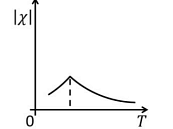
(P) Diamagnetic (2) 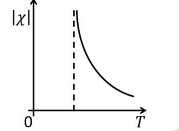
(Q) Paramagnetic (3) 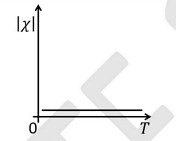
(R) Ferromagnetic (4) 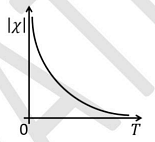
(S) Antiferromagnetic
View More Questions
Top GATE PH Quantum Mechanics Questions
- A particle of mass \( m \) is in a potential \( V(x) = \frac{1}{2} m \omega^2 x^2 \) for \( x > 0 \), and \( V(x) = \infty \) for \( x \leq 0 \), where \( \omega \) is the angular frequency. The ratio of the energies corresponding to the lowest energy level to the next higher level is:
- A particle is scattered from a potential \( V_{\vec{r}} = g \delta^3(\vec{r}) \), where \( g \) is a positive constant. Using the first Born approximation, the angular \((\theta, \phi)\) dependence of the differential scattering cross section \( \frac{d\sigma}{d\Omega} \) is:
- Which of the following option(s) is/are correct for photons?
Two projectile protons \( P_1 \) and \( P_2 \), both with spin up (along the \( +z \)-direction), are scattered from another fixed target proton \( T \) with spin up at rest in the \( xy \)-plane, as shown in the figure. They scatter one at a time. The nuclear interaction potential between both the projectiles and the target proton is \( \hat{\lambda} \vec{L} \cdot \vec{S} \), where \( \vec{L} \) is the orbital angular momentum of the system with respect to the target, \( \vec{S} \) is the spin angular momentum of the system, and \( \lambda \) is a negative constant in appropriate units. Which one of the following is correct?

- Let \( |m\rangle \) and \( |n\rangle \) denote the energy eigenstates of a one-dimensional simple harmonic oscillator. The position and momentum operators are \( \hat{X} \) and \( \hat{P} \), respectively. The matrix element \( \langle m | \hat{P}\hat{X} | n \rangle \) is non-zero when:
View More Questions
Top GATE PH Questions
- If \( F_1(Q, q) = Qq \) is the generating function of a canonical transformation from \((p, q)\) to \((P, Q)\), then which one of the following relations is correct?
- When an unpolarized plane electromagnetic wave in a dielectric medium with refractive index \( n_1 \) is incident on a plane interface separating it from another dielectric medium with refractive index \( n_2 \) (where \( n_2 > n_1 \)), and the angle of incidence is \(\tan^{-1} \left( \frac{n_2}{n_1} \right) \), the following statement is true:
- The wavefunction of a particle in an infinite one-dimensional potential well at time \( t \) is
\[ \Psi(x, t) = \sqrt{\frac{2}{3}} e^{-iE_1 t/\hbar}\psi_1(x) + \frac{1}{\sqrt{6}} e^{i\pi/6} e^{-iE_2 t/\hbar} \psi_2(x) + \frac{1}{\sqrt{6}} e^{i\pi/4} e^{-iE_3 t/\hbar} \psi_3(x) \]where \(\psi_1\), \(\psi_2\), and \(\psi_3\) are the normalized ground state, the normalized first excited state, and the normalized second excited state, respectively. \(E_1\), \(E_2\), and \(E_3\) are the eigen-energies corresponding to \(\psi_1\), \(\psi_2\), and \(\psi_3\), respectively. The expectation value of energy of the particle in state \(\Psi(x,t)\) is - If a thermodynamical system is adiabatically isolated and experiences a change in volume under an externally applied constant pressure, then the thermodynamical potential minimized at equilibrium is the
- The mean distance between the two atoms of an HD molecule is \( r \), where H and D denote hydrogen and deuterium, respectively. The mass of the hydrogen atom is \( m_H \). The energy difference between the two lowest lying rotational states of HD in multiples of \(\frac{h^2}{m_H r^2}\) is:
View More Questions