Question:
Consider the given pairs of complex ions. The correct pair(s) in which each complex ion exhibits three spin-allowed \(d\text{-}d\) transitions (excluding those arising due to distortions) is(are)
Consider the given pairs of complex ions. The correct pair(s) in which each complex ion exhibits three spin-allowed \(d\text{-}d\) transitions (excluding those arising due to distortions) is(are)
Show Hint
Work out the d-electron count of each ion; only d2, d3, d7, d8 (any geometry, high spin) give three spin-allowed d-d bands, high-spin d5 gives none.
Updated On: Aug 10, 2026
- \(\mathrm{[V(H_2O)_6]^{3+}}\) and \(\mathrm{[Ni(H_2O)_6]^{2+}}\)
- \(\mathrm{[Cr(H_2O)_6]^{3+}}\) and \(\mathrm{[NiCl_4]^{2-}}\)
- \(\mathrm{[Ti(H_2O)_6]^{3+}}\) and \(\mathrm{[Mn(H_2O)_6]^{2+}}\)
- \(\mathrm{[FeF_6]^{3-}}\) and \(\mathrm{[FeCl_4]^{2-}}\)
Show Solution

Verified By Collegedunia
The Correct Option is A, B
Solution and Explanation
Step 1: Recall which free-ion terms give three spin-allowed d-d bands.
For an octahedral (or tetrahedral) field, the number of spin-allowed d-d transitions is fixed by the ground free-ion term (Orgel/Tanabe-Sugano diagrams). Ions with a \(d^2\), \(d^3\), \(d^7\) or \(d^8\) configuration have an \(F\)-derived ground term that correlates with THREE excited terms of the same spin multiplicity in the field, so they show three spin-allowed bands (in either octahedral or tetrahedral geometry, high-spin). Ions with \(d^1\), high-spin \(d^4\), high-spin \(d^6\) or \(d^9\) (a \(D\) ground term) show only ONE spin-allowed transition (which can look split due to Jahn-Teller distortion, but that is excluded by the question). High-spin \(d^5\) (\(^6S\) ground term, e.g. \(\mathrm{Mn^{2+}}\), \(\mathrm{Fe^{3+}}\)) has NO spin-allowed d-d transition at all, since every excited state has a different (lower) spin multiplicity.
Step 2: Work out the d-electron count of every ion in every option.
\(\mathrm{V^{3+}}: d^2\); \(\mathrm{Ni^{2+}}: d^8\); \(\mathrm{Cr^{3+}}: d^3\); \(\mathrm{Ti^{3+}}: d^1\); \(\mathrm{Mn^{2+}}: d^5\) (high spin); \(\mathrm{Fe^{3+}}: d^5\) (high spin with weak-field \(\mathrm{F^-}\)); \(\mathrm{Fe^{2+}}: d^6\) (high spin, tetrahedral).
Step 3: Check option (A).
\(\mathrm{[V(H_2O)_6]^{3+}}\) is octahedral \(d^2\) (\(^3F\) ground term): three spin-allowed transitions (\(^3T_{1g}\to\,^3T_{2g}\), \(^3T_{1g}(F)\to\,^3T_{1g}(P)\), \(^3T_{1g}\to\,^3A_{2g}\)). \(\mathrm{[Ni(H_2O)_6]^{2+}}\) is octahedral \(d^8\) (\(^3F\) ground term, the textbook example): also three spin-allowed transitions (\(^3A_{2g}\to\,^3T_{2g}\), \(^3T_{1g}(F)\), \(^3T_{1g}(P)\)). Both ions in (A) show three bands, so (A) is correct.
Step 4: Check option (B).
\(\mathrm{[Cr(H_2O)_6]^{3+}}\) is octahedral \(d^3\) (\(^4F\) ground term): three spin-allowed transitions, exactly the well known chromium(III) three-band spectrum. \(\mathrm{[NiCl_4]^{2-}}\) is TETRAHEDRAL \(d^8\); the \(F\)-term correlation diagram gives three spin-allowed transitions for \(d^8\) in tetrahedral geometry too (this is the classic textbook comparison spectrum to octahedral \(\mathrm{Ni^{2+}}\)). So both ions in (B) show three bands, and (B) is correct.
Step 5: Check option (C).
\(\mathrm{[Ti(H_2O)_6]^{3+}}\) is octahedral \(d^1\): only ONE spin-allowed transition (\(^2T_{2g}\to\,^2E_g\); the shoulder sometimes seen is a Jahn-Teller distortion effect, excluded here). \(\mathrm{[Mn(H_2O)_6]^{2+}}\) is high-spin \(d^5\) (\(^6A_{1g}\) ground term): NO spin-allowed transitions at all (this is why \(\mathrm{Mn^{2+}}\) solutions are very pale). Neither ion shows three bands, so (C) is wrong.
Step 6: Check option (D).
\(\mathrm{[FeF_6]^{3-}}\) is high-spin \(\mathrm{Fe^{3+}}\), \(d^5\) (\(\mathrm{F^-}\) is weak field): like \(\mathrm{Mn^{2+}}\), it has NO spin-allowed transitions. \(\mathrm{[FeCl_4]^{2-}}\) is tetrahedral high-spin \(\mathrm{Fe^{2+}}\), \(d^6\): this belongs to the \(D\)-term (\(d^1,d^4,d^6,d^9\)) family, giving only ONE spin-allowed transition. Neither shows three bands, so (D) is wrong.
Final Answer:
Both members show three spin-allowed \(d\text{-}d\) transitions only in \[ \boxed{\text{(A) and (B)}} \] (all four ions there are \(d^2, d^8, d^3, d^8\) respectively).
For an octahedral (or tetrahedral) field, the number of spin-allowed d-d transitions is fixed by the ground free-ion term (Orgel/Tanabe-Sugano diagrams). Ions with a \(d^2\), \(d^3\), \(d^7\) or \(d^8\) configuration have an \(F\)-derived ground term that correlates with THREE excited terms of the same spin multiplicity in the field, so they show three spin-allowed bands (in either octahedral or tetrahedral geometry, high-spin). Ions with \(d^1\), high-spin \(d^4\), high-spin \(d^6\) or \(d^9\) (a \(D\) ground term) show only ONE spin-allowed transition (which can look split due to Jahn-Teller distortion, but that is excluded by the question). High-spin \(d^5\) (\(^6S\) ground term, e.g. \(\mathrm{Mn^{2+}}\), \(\mathrm{Fe^{3+}}\)) has NO spin-allowed d-d transition at all, since every excited state has a different (lower) spin multiplicity.
Step 2: Work out the d-electron count of every ion in every option.
\(\mathrm{V^{3+}}: d^2\); \(\mathrm{Ni^{2+}}: d^8\); \(\mathrm{Cr^{3+}}: d^3\); \(\mathrm{Ti^{3+}}: d^1\); \(\mathrm{Mn^{2+}}: d^5\) (high spin); \(\mathrm{Fe^{3+}}: d^5\) (high spin with weak-field \(\mathrm{F^-}\)); \(\mathrm{Fe^{2+}}: d^6\) (high spin, tetrahedral).
Step 3: Check option (A).
\(\mathrm{[V(H_2O)_6]^{3+}}\) is octahedral \(d^2\) (\(^3F\) ground term): three spin-allowed transitions (\(^3T_{1g}\to\,^3T_{2g}\), \(^3T_{1g}(F)\to\,^3T_{1g}(P)\), \(^3T_{1g}\to\,^3A_{2g}\)). \(\mathrm{[Ni(H_2O)_6]^{2+}}\) is octahedral \(d^8\) (\(^3F\) ground term, the textbook example): also three spin-allowed transitions (\(^3A_{2g}\to\,^3T_{2g}\), \(^3T_{1g}(F)\), \(^3T_{1g}(P)\)). Both ions in (A) show three bands, so (A) is correct.
Step 4: Check option (B).
\(\mathrm{[Cr(H_2O)_6]^{3+}}\) is octahedral \(d^3\) (\(^4F\) ground term): three spin-allowed transitions, exactly the well known chromium(III) three-band spectrum. \(\mathrm{[NiCl_4]^{2-}}\) is TETRAHEDRAL \(d^8\); the \(F\)-term correlation diagram gives three spin-allowed transitions for \(d^8\) in tetrahedral geometry too (this is the classic textbook comparison spectrum to octahedral \(\mathrm{Ni^{2+}}\)). So both ions in (B) show three bands, and (B) is correct.
Step 5: Check option (C).
\(\mathrm{[Ti(H_2O)_6]^{3+}}\) is octahedral \(d^1\): only ONE spin-allowed transition (\(^2T_{2g}\to\,^2E_g\); the shoulder sometimes seen is a Jahn-Teller distortion effect, excluded here). \(\mathrm{[Mn(H_2O)_6]^{2+}}\) is high-spin \(d^5\) (\(^6A_{1g}\) ground term): NO spin-allowed transitions at all (this is why \(\mathrm{Mn^{2+}}\) solutions are very pale). Neither ion shows three bands, so (C) is wrong.
Step 6: Check option (D).
\(\mathrm{[FeF_6]^{3-}}\) is high-spin \(\mathrm{Fe^{3+}}\), \(d^5\) (\(\mathrm{F^-}\) is weak field): like \(\mathrm{Mn^{2+}}\), it has NO spin-allowed transitions. \(\mathrm{[FeCl_4]^{2-}}\) is tetrahedral high-spin \(\mathrm{Fe^{2+}}\), \(d^6\): this belongs to the \(D\)-term (\(d^1,d^4,d^6,d^9\)) family, giving only ONE spin-allowed transition. Neither shows three bands, so (D) is wrong.
Final Answer:
Both members show three spin-allowed \(d\text{-}d\) transitions only in \[ \boxed{\text{(A) and (B)}} \] (all four ions there are \(d^2, d^8, d^3, d^8\) respectively).
Was this answer helpful?
0
0
Top GATE CY Inorganic Chemistry Questions
- Which are optically active?
- Among the following, the compound with the lowest CO stretching frequency is
- The ground state of [Cr(H2O)6]2+ is
- The reaction of XeF2 with HN(SO2F)2 at 273 K in CF2Cl2 solvent yields
- The major product in the given reaction sequence is Q. The mass spectrum of Q shows
([M] = molecular ion peak)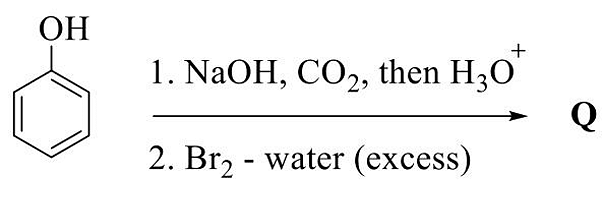
View More Questions
Top GATE CY Coordination chemistry Questions
- Which are optically active?
- Among the following, the compound with the lowest CO stretching frequency is
- The ground state of [Cr(H2O)6]2+ is
- The complex(es) with distorted octahedral structure is (are)
- The heptacity of allyl and Cp and the ligation mode of NO in the thermodynamically stable complexes
[(ηx-allyl)Ru(CO)2(NO)] and [(ηy-Cp)Ru(CO)2(NO)],
respectively, are
(The heptacity of allyl and Cp are denoted by ηx and ηy, respectively.)
View More Questions
Top GATE CY Questions
- Ψ(x) = \(\sqrt{\frac{32}{L^3}}\)[sin(\(\frac{\pi x}{L}\)).cos(\(\frac{\pi x}{L}\)).sin(\(\frac{2\pi y}{L}\)).sin(\(\frac{\pi z}{L}\))]Find the value of E221: E111.
 what is the final product
- Which are optically active?
 intensity ratio of final product
- Which among the following is true?
View More Questions