Question:
Consider the function
\[
f:(0,\infty)\to(-\infty,\infty)
\]
given by
\[
f(x)=\sqrt{x}\log_e(x)-x+1
\]
Then which one of the following statements is TRUE?
Consider the function
\[
f:(0,\infty)\to(-\infty,\infty)
\]
given by
\[
f(x)=\sqrt{x}\log_e(x)-x+1
\]
Then which one of the following statements is TRUE?
Show Hint
If:
\[
f'(x)
\]
changes from positive to negative at a point, then the function has a local maximum there.
Updated On: Aug 18, 2026
- The derivative of the function \(f\) is decreasing in the interval \((0,1)\)
- The function \(f\) has a local maximum at some point \(a \in (0,\infty)\)
- The function \(f\) has a local minimum at some point \(b \in (0,\infty)\)
- The function \(f\) has neither a point of local maximum nor a point of local minimum in \((0,\infty)\)
Show Solution

Verified By Collegedunia
The Correct Option is D
Solution and Explanation
Step 1: Differentiate the function.
Given: \[ f(x)=\sqrt{x}\ln x-x+1 \] Differentiate: \[ f'(x) = \frac1{2\sqrt{x}}\ln x + \sqrt{x}\cdot\frac1x -1 \] \[ = \frac{\ln x}{2\sqrt{x}} +\frac1{\sqrt{x}} -1 \] \[ = \frac{\ln x+2}{2\sqrt{x}}-1 \]
Step 2: Find critical points.
Set: \[ f'(x)=0 \] \[ \frac{\ln x+2}{2\sqrt{x}}=1 \] \[ \ln x+2=2\sqrt{x} \] Let: \[ t=\sqrt{x} \] Then: \[ 2\ln t+2=2t \] \[ \ln t+1=t \] Consider: \[ g(t)=\ln t+1-t \] \[ g'(t)=\frac1t-1 \] Thus: \[ g'(t)=0 \quad\text{at}\quad t=1 \] Also: \[ g''(t)=-\frac1{t^2}<0 \] Hence: \[ t=1 \] gives maximum value. Now: \[ g(1)=0 \] Therefore: \[ t=1 \] is the only solution. Hence: \[ x=1 \]
Step 3: Use second derivative test.
Differentiate: \[ f'(x)=\frac{\ln x+2}{2\sqrt{x}}-1 \] \[ f''(x) = \frac{-\ln x}{4x^{3/2}} \] At: \[ x=1 \] \[ f''(1)=0 \] Check sign of: \[ f'(x) \] For: \[ x<1 \] \[ f'(x)>0 \] For: \[ x>1 \] \[ f'(x)<0 \] Thus function increases before: \[ x=1 \] and decreases after: \[ x=1 \] Hence: \[ x=1 \] is a local maximum point. Therefore: \[ \boxed{\mathrm{(B)\ is\ correct}} \]
Step 4: Check option (A).
In: \[ (0,1) \] \[ f''(x)=\frac{-\ln x}{4x^{3/2}} \] Since: \[ \ln x<0 \] \[ -\ln x>0 \] Thus: \[ f''(x)>0 \] Hence: \[ f'(x) \] is increasing, not decreasing. Therefore: \[ \boxed{\mathrm{(A)\ is\ incorrect}} \]
Step 5: Identify the correct option.
Therefore: \[ \boxed{\mathrm{(B)}} \]
Given: \[ f(x)=\sqrt{x}\ln x-x+1 \] Differentiate: \[ f'(x) = \frac1{2\sqrt{x}}\ln x + \sqrt{x}\cdot\frac1x -1 \] \[ = \frac{\ln x}{2\sqrt{x}} +\frac1{\sqrt{x}} -1 \] \[ = \frac{\ln x+2}{2\sqrt{x}}-1 \]
Step 2: Find critical points.
Set: \[ f'(x)=0 \] \[ \frac{\ln x+2}{2\sqrt{x}}=1 \] \[ \ln x+2=2\sqrt{x} \] Let: \[ t=\sqrt{x} \] Then: \[ 2\ln t+2=2t \] \[ \ln t+1=t \] Consider: \[ g(t)=\ln t+1-t \] \[ g'(t)=\frac1t-1 \] Thus: \[ g'(t)=0 \quad\text{at}\quad t=1 \] Also: \[ g''(t)=-\frac1{t^2}<0 \] Hence: \[ t=1 \] gives maximum value. Now: \[ g(1)=0 \] Therefore: \[ t=1 \] is the only solution. Hence: \[ x=1 \]
Step 3: Use second derivative test.
Differentiate: \[ f'(x)=\frac{\ln x+2}{2\sqrt{x}}-1 \] \[ f''(x) = \frac{-\ln x}{4x^{3/2}} \] At: \[ x=1 \] \[ f''(1)=0 \] Check sign of: \[ f'(x) \] For: \[ x<1 \] \[ f'(x)>0 \] For: \[ x>1 \] \[ f'(x)<0 \] Thus function increases before: \[ x=1 \] and decreases after: \[ x=1 \] Hence: \[ x=1 \] is a local maximum point. Therefore: \[ \boxed{\mathrm{(B)\ is\ correct}} \]
Step 4: Check option (A).
In: \[ (0,1) \] \[ f''(x)=\frac{-\ln x}{4x^{3/2}} \] Since: \[ \ln x<0 \] \[ -\ln x>0 \] Thus: \[ f''(x)>0 \] Hence: \[ f'(x) \] is increasing, not decreasing. Therefore: \[ \boxed{\mathrm{(A)\ is\ incorrect}} \]
Step 5: Identify the correct option.
Therefore: \[ \boxed{\mathrm{(B)}} \]
Was this answer helpful?
0
0
Top JEE Advanced Mathematics Questions
- In a $\triangle$ ABC w ith fixed base BC, the vertex A moves such that cos B + cos C = 4 $ sin^2 \frac{A}{2}$. If a, b and c denote th e lengths of th e sides of th e triangle opposite to the angles A, B and C respectively, then
- Let $P=[a_{ij}]$ be a $3\times3$ matrix and let $Q=[b_{ij}]$ where $b_{ij}=2^{i+j} a_{ij}$ for $1 \le i, j \le $.If the determinant of $P$ is $2$, then the determinant of the matrix $Q$ is
- For the equation $3x^2+px+3=0,p>0,$ if one of the root is square of the other, then p is equal to
- The equation $\sqrt{x+1}-\sqrt{x-1}=\sqrt{4x-1}$ has
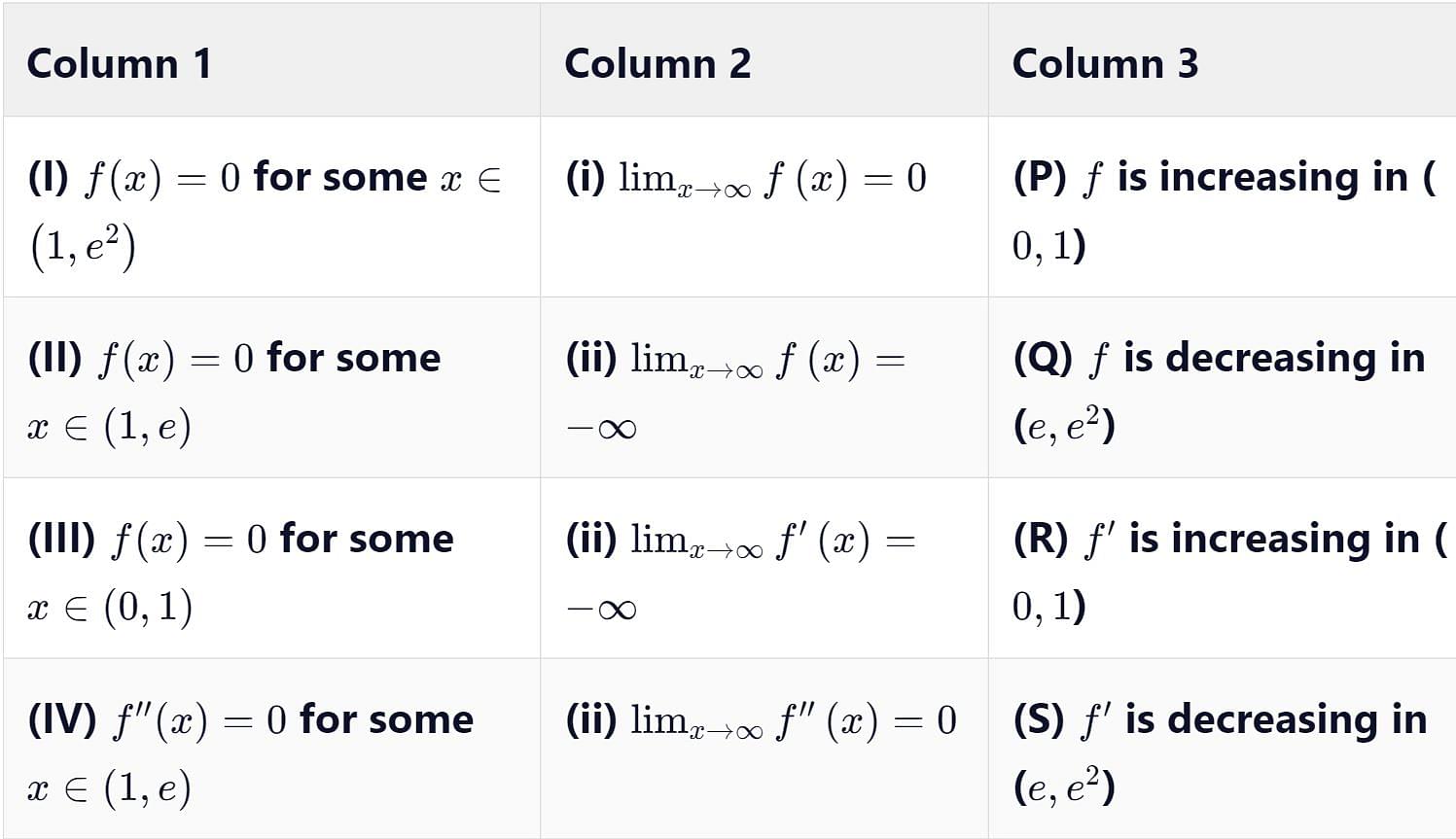
Let \(f(x)=x+log_{e}x−xlog_{e}x,\text{ }x∈(0,∞)\).
- Column 1 contains information about zeros of \(f(x)\), \(f'(x)\) and \(f''(x)\).
- Column 2 contains information about the limiting behavior of \(f(x)\), \(f'(x)\) and \(f''(x)\) at infinity.
- Column 3 contains information about increasing/decreasing nature of \(f(x)\) and \(f'(x)\).
View More Questions
Top JEE Advanced Application of derivatives Questions
Let \(f(x)=x+log_{e}x−xlog_{e}x,\text{ }x∈(0,∞)\).
- Column 1 contains information about zeros of \(f(x)\), \(f'(x)\) and \(f''(x)\).
- Column 2 contains information about the limiting behavior of \(f(x)\), \(f'(x)\) and \(f''(x)\) at infinity.
- Column 3 contains information about increasing/decreasing nature of \(f(x)\) and \(f'(x)\).
- If '' > 0$ for all $
- If $f: R \rightarrow R$ is a differentiable function such that $f'(x)>2 f(x)$ for all $x \in R$, and $f(0)=1$, then
- f(x) is cubic polynomial with f(2) = 18 and f(1) = -1. Also f(x) has local maxima at x = -1 and f '(x) has local minima at x = 0, then
- For all $x\,\in\,(0,1)$
View More Questions
Top JEE Advanced Questions
- Yellow light is used in a single slit diffraction experiment with slit width of 0.6 mm. If yellow light is replaced by X-rays, then the observed pattern will reveal
- The size of the image of an object, which is at infinity, as formed by a convex lens of focal length 30 cm is 2 cm. If a concave lens of focal length 20 cm is placed between the convex lens and the image at a distance of 26 cm from the convex lens, calculate the new size of the image.
- A concave lens of glass, refractive index 1.5 has both surfaces of same radius of curvature R. On immersion in a medium of refractive index 1.75, it will behave as a
- The position vector $\vec{r}$ of a particle of mass $m$ is given by the following equation $\vec{r}(t)=\alpha t^{3} \hat{i}+\beta t^{2} \hat{j}$ where $\alpha=\frac{10}{3} \,ms ^{-3}, \beta=5\, ms ^{-2}$ and $m =0.1 \,kg$. At $t =1\, s$, which of the following statement (s) is (are) true about the particle?
- In an n-p-n transistor circuit, the collector current is 10 mA. If 90% of the electrons emitted reach the collector
View More Questions