Consider the figure given below, where M is a metal and L is a monodentate ligand. The \(\sigma\)-bonding ligand group orbital (LGO) having same symmetry with \(d_{z^2}\) orbital of M in the octahedral coordination geometry is:
Show Hint
The \(d_{z^2}\) orbital has large lobes on \(\pm z\) and a small negative torus in the \(xy\)-plane; weight the axial \(\sigma\)'s twice and the four equatorial \(\sigma\)'s with an opposite sign, then normalize.
Step 1: Set up the geometry from the figure.
Six identical \(\sigma\)-donor ligands sit on an octahedron centred at M. From the figure, \(\sigma_1\) and \(\sigma_2\) lie on the \(z\)-axis (one at \(+z\), one at \(-z\)), while \(\sigma_3,\sigma_4,\sigma_5,\sigma_6\) lie in the equatorial \(xy\)-plane.
Step 2: Recall the shape of the \(d_{z^2}\) orbital.
The \(d_{z^2}\) orbital has two large lobes pointing along \(+z\) and \(-z\), and a small negative torus in the \(xy\)-plane. It transforms as the \(e_g\) irreducible representation in \(O_h\) symmetry (the same representation as \(d_{x^2-y^2}\)), so the matching LGO overlaps constructively with the axial lobes and, with a smaller weight, with the equatorial ligands.
Step 3: Build the LGO by projection.
Projecting onto the \(z^2\) component of \(e_g\) gives twice the weight to the two axial \(\sigma\) orbitals and equal, opposite-sign, half-weight to the four equatorial \(\sigma\) orbitals:
\[ \psi(d_{z^2}) \propto 2\sigma_1 + 2\sigma_2 - \sigma_3 - \sigma_4 - \sigma_5 - \sigma_6 \]
Step 4: Normalize.
The sum of squares of the coefficients is \(2^2+2^2+1^2+1^2+1^2+1^2=4+4+1+1+1+1=12\), so the normalization constant is \(\dfrac{1}{\sqrt{12}}\):
\[ \psi(d_{z^2}) = \frac{1}{\sqrt{12}}\left(2\sigma_1+2\sigma_2-\sigma_3-\sigma_4-\sigma_5-\sigma_6\right) \]
Step 5: Eliminate the wrong options.
Option (B) mixes signs unevenly on the equatorial terms, the wrong pattern for this combination. Option (C) uses \(\dfrac{1}{\sqrt{6}}\) with equal unit weight on axial and equatorial terms, undercounting the axial contribution. Option (D), \(\dfrac{1}{\sqrt{6}}(\sigma_1+\ldots+\sigma_6)\), is the fully symmetric \(a_{1g}\) LGO, matching \(s\), not \(d_{z^2}\).
Final Answer:
The \(\sigma\)-LGO matching \(d_{z^2}\) is option (A).
\[ \boxed{\dfrac{1}{\sqrt{12}}\left(2\sigma_1+2\sigma_2-\sigma_3-\sigma_4-\sigma_5-\sigma_6\right)} \]


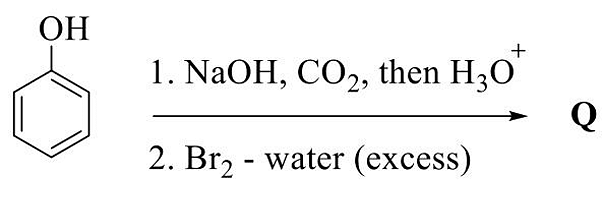
 what is the final product
 intensity ratio of final product