Question:
Consider a data consisting of 10 observations
\[
x_1, x_2, \dots, x_{10},
\]
whose mean is \(5\) and variance is \(7\).
If the mean and the variance of the first 8 observations
\[
x_1, x_2, \dots, x_8
\]
are \(4\) and \(3.5\), respectively, and
\[
x_9<x_{10},
\]
then the value of
\[
3x_9 + 2x_{10}
\]
is:
Consider a data consisting of 10 observations
\[
x_1, x_2, \dots, x_{10},
\]
whose mean is \(5\) and variance is \(7\).
If the mean and the variance of the first 8 observations
\[
x_1, x_2, \dots, x_8
\]
are \(4\) and \(3.5\), respectively, and
\[
x_9<x_{10},
\]
then the value of
\[
3x_9 + 2x_{10}
\]
is:
Show Hint
Try shifting all the observations by the overall mean first. This makes the total sum zero and removes the mean-squared term when converting variance into sum of squares, keeping the numbers smaller and less error-prone. Once you know the sum and sum of squares of the two missing observations, write them as the average of the pair plus or minus a single unknown difference rather than setting up a full quadratic equation.
Updated On: Aug 17, 2026
Show Solution

Verified By Collegedunia
Correct Answer: 44
Approach Solution - 1
Step 1: Understanding the Question:
We are given statistical parameters for a set of 10 observations and a subset of 8 observations. We need to find the values of the remaining two observations, $x_9$ and $x_{10}$, and calculate a linear combination of them.
Step 2: Key Formula or Approach:
• Sum of observations: $\sum x_i = n \bar{x}$.
• Sum of squares of observations: $\sum x_i^2 = n(\sigma^2 + \bar{x}^2)$.
Step 3: Detailed Explanation:
• For $n=10$, $\bar{x}=5, \sigma^2=7 \implies \sum_{i=1}^{10} x_i = 10 \times 5 = 50$.
$\sum_{i=1}^{10} x_i^2 = 10(7 + 5^2) = 10(32) = 320$.
• For the first 8 observations, $\bar{x}_1=4, \sigma_1^2=3.5 \implies \sum_{i=1}^8 x_i = 8 \times 4 = 32$.
$\sum_{i=1}^8 x_i^2 = 8(3.5 + 4^2) = 8(19.5) = 156$.
• Now, find equations for $x_9$ and $x_{10}$:
$x_9 + x_{10} = \sum_{1}^{10} x_i - \sum_{1}^8 x_i = 50 - 32 = 18$.
$x_9^2 + x_{10}^2 = \sum_{1}^{10} x_i^2 - \sum_{1}^8 x_i^2 = 320 - 156 = 164$.
• Use the identity $(x_9 + x_{10})^2 - 2x_9x_{10} = x_9^2 + x_{10}^2$:
$18^2 - 2x_9x_{10} = 164 \implies 324 - 164 = 2x_9x_{10} \implies x_9x_{10} = 80$.
• $x_9$ and $x_{10}$ are roots of $t^2 - 18t + 80 = 0 \implies (t-10)(t-8) = 0$.
• Since $x_9 < x_{10}$, we have $x_9 = 8$ and $x_{10} = 10$.
• Value $= 3(8) + 2(10) = 24 + 20 = 44$.
Step 4: Final Answer:
The value of $3x_9 + 2x_{10}$ is 44.
We are given statistical parameters for a set of 10 observations and a subset of 8 observations. We need to find the values of the remaining two observations, $x_9$ and $x_{10}$, and calculate a linear combination of them.
Step 2: Key Formula or Approach:
• Sum of observations: $\sum x_i = n \bar{x}$.
• Sum of squares of observations: $\sum x_i^2 = n(\sigma^2 + \bar{x}^2)$.
Step 3: Detailed Explanation:
• For $n=10$, $\bar{x}=5, \sigma^2=7 \implies \sum_{i=1}^{10} x_i = 10 \times 5 = 50$.
$\sum_{i=1}^{10} x_i^2 = 10(7 + 5^2) = 10(32) = 320$.
• For the first 8 observations, $\bar{x}_1=4, \sigma_1^2=3.5 \implies \sum_{i=1}^8 x_i = 8 \times 4 = 32$.
$\sum_{i=1}^8 x_i^2 = 8(3.5 + 4^2) = 8(19.5) = 156$.
• Now, find equations for $x_9$ and $x_{10}$:
$x_9 + x_{10} = \sum_{1}^{10} x_i - \sum_{1}^8 x_i = 50 - 32 = 18$.
$x_9^2 + x_{10}^2 = \sum_{1}^{10} x_i^2 - \sum_{1}^8 x_i^2 = 320 - 156 = 164$.
• Use the identity $(x_9 + x_{10})^2 - 2x_9x_{10} = x_9^2 + x_{10}^2$:
$18^2 - 2x_9x_{10} = 164 \implies 324 - 164 = 2x_9x_{10} \implies x_9x_{10} = 80$.
• $x_9$ and $x_{10}$ are roots of $t^2 - 18t + 80 = 0 \implies (t-10)(t-8) = 0$.
• Since $x_9 < x_{10}$, we have $x_9 = 8$ and $x_{10} = 10$.
• Value $= 3(8) + 2(10) = 24 + 20 = 44$.
Step 4: Final Answer:
The value of $3x_9 + 2x_{10}$ is 44.
Was this answer helpful?
0
0
Show Solution
Verified By Collegedunia
Approach Solution -2
Concept:
Step 1: Shift every observation by the overall mean.
Let $y_i=x_i-5$ for $i=1,2,\ldots,10$.
Step 2: Use the shift to simplify the full data set.
Mean of $y$ (all $10$ values) $=5-5=0$. Variance is unaffected by a shift, so variance of $y=7$.
Since the mean of $y$ is $0$: $\sum_{i=1}^{10}y_i=10(0)=0$, and $\sum_{i=1}^{10}y_i^2=10(7)=70$ (the mean-squared term vanishes because the mean is $0$).
Step 3: Apply the same shift to the first $8$ observations.
Mean of $y$ for the first $8=4-5=-1$. Variance of $y$ for the first $8=3.5$ (shift-invariant).
$\sum_{i=1}^{8}y_i=8(-1)=-8$
$\sum_{i=1}^{8}y_i^2=8\left(3.5+(-1)^2\right)=8(4.5)=36$
Step 4: Subtract to isolate the last two shifted observations.
$y_9+y_{10}=0-(-8)=8$
$y_9^2+y_{10}^2=70-36=34$
Step 5: Write $y_9,y_{10}$ as their average plus or minus a deviation, and solve.
Average of the pair: $m=\dfrac{y_9+y_{10}}{2}=4$. Let $y_9=m-d$ and $y_{10}=m+d$, with $d>0$ since $x_9<x_{10}$ (a shift does not change the order).
$y_9^2+y_{10}^2=(m-d)^2+(m+d)^2=2m^2+2d^2=34$
$2(16)+2d^2=34$
$2d^2=2 \Rightarrow d^2=1 \Rightarrow d=1$
So $y_9=4-1=3$ and $y_{10}=4+1=5$.
Step 6: Shift back to the original observations and compute the required value.
$x_9=y_9+5=8$ and $x_{10}=y_{10}+5=10$
$3x_9+2x_{10}=3(8)+2(10)=24+20=44$
Final Answer: $44$
- Variance does not change when every observation in a data set is shifted by the same constant, since it depends only on how spread out the values are, not on their position. Shifting all values by the overall mean makes the mean of the shifted values zero, which removes the mean-squared term from the sum-of-squares formula for that set.
- Once the sum and sum of squares of exactly two unknown numbers are known, writing them as their average plus or minus a single deviation variable solves for them directly, without forming and factoring a quadratic equation.
Step 1: Shift every observation by the overall mean.
Let $y_i=x_i-5$ for $i=1,2,\ldots,10$.
Step 2: Use the shift to simplify the full data set.
Mean of $y$ (all $10$ values) $=5-5=0$. Variance is unaffected by a shift, so variance of $y=7$.
Since the mean of $y$ is $0$: $\sum_{i=1}^{10}y_i=10(0)=0$, and $\sum_{i=1}^{10}y_i^2=10(7)=70$ (the mean-squared term vanishes because the mean is $0$).
Step 3: Apply the same shift to the first $8$ observations.
Mean of $y$ for the first $8=4-5=-1$. Variance of $y$ for the first $8=3.5$ (shift-invariant).
$\sum_{i=1}^{8}y_i=8(-1)=-8$
$\sum_{i=1}^{8}y_i^2=8\left(3.5+(-1)^2\right)=8(4.5)=36$
Step 4: Subtract to isolate the last two shifted observations.
$y_9+y_{10}=0-(-8)=8$
$y_9^2+y_{10}^2=70-36=34$
Step 5: Write $y_9,y_{10}$ as their average plus or minus a deviation, and solve.
Average of the pair: $m=\dfrac{y_9+y_{10}}{2}=4$. Let $y_9=m-d$ and $y_{10}=m+d$, with $d>0$ since $x_9<x_{10}$ (a shift does not change the order).
$y_9^2+y_{10}^2=(m-d)^2+(m+d)^2=2m^2+2d^2=34$
$2(16)+2d^2=34$
$2d^2=2 \Rightarrow d^2=1 \Rightarrow d=1$
So $y_9=4-1=3$ and $y_{10}=4+1=5$.
Step 6: Shift back to the original observations and compute the required value.
$x_9=y_9+5=8$ and $x_{10}=y_{10}+5=10$
$3x_9+2x_{10}=3(8)+2(10)=24+20=44$
Final Answer: $44$
Was this answer helpful?
0
0
Top JEE Advanced Mathematics Questions
- In a $\triangle$ ABC w ith fixed base BC, the vertex A moves such that cos B + cos C = 4 $ sin^2 \frac{A}{2}$. If a, b and c denote th e lengths of th e sides of th e triangle opposite to the angles A, B and C respectively, then
- Let $P=[a_{ij}]$ be a $3\times3$ matrix and let $Q=[b_{ij}]$ where $b_{ij}=2^{i+j} a_{ij}$ for $1 \le i, j \le $.If the determinant of $P$ is $2$, then the determinant of the matrix $Q$ is
- For the equation $3x^2+px+3=0,p>0,$ if one of the root is square of the other, then p is equal to
- The equation $\sqrt{x+1}-\sqrt{x-1}=\sqrt{4x-1}$ has
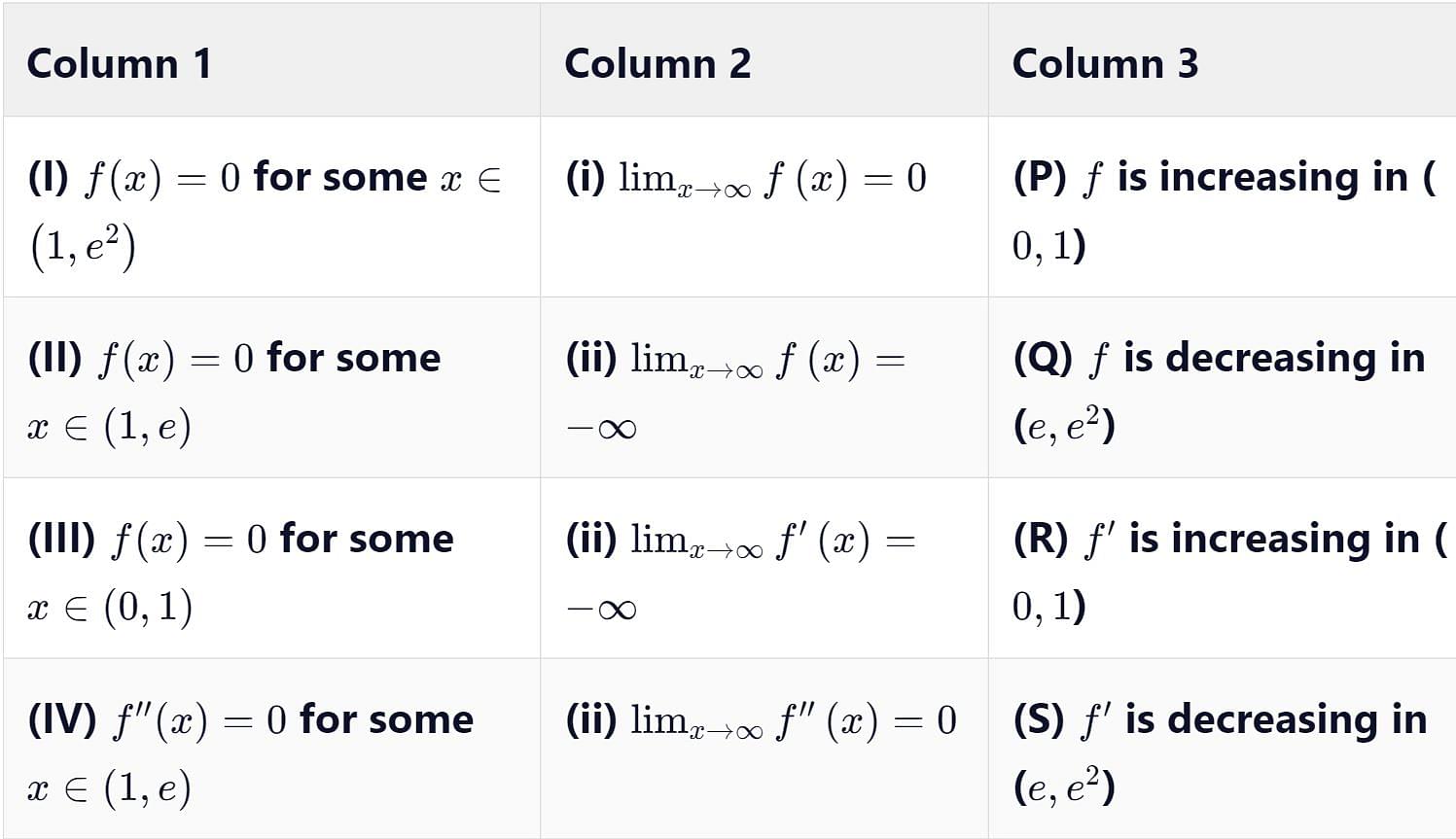
Let \(f(x)=x+log_{e}x−xlog_{e}x,\text{ }x∈(0,∞)\).
- Column 1 contains information about zeros of \(f(x)\), \(f'(x)\) and \(f''(x)\).
- Column 2 contains information about the limiting behavior of \(f(x)\), \(f'(x)\) and \(f''(x)\) at infinity.
- Column 3 contains information about increasing/decreasing nature of \(f(x)\) and \(f'(x)\).
View More Questions
Top JEE Advanced Questions
- Yellow light is used in a single slit diffraction experiment with slit width of 0.6 mm. If yellow light is replaced by X-rays, then the observed pattern will reveal
- The size of the image of an object, which is at infinity, as formed by a convex lens of focal length 30 cm is 2 cm. If a concave lens of focal length 20 cm is placed between the convex lens and the image at a distance of 26 cm from the convex lens, calculate the new size of the image.
- A concave lens of glass, refractive index 1.5 has both surfaces of same radius of curvature R. On immersion in a medium of refractive index 1.75, it will behave as a
- The position vector $\vec{r}$ of a particle of mass $m$ is given by the following equation $\vec{r}(t)=\alpha t^{3} \hat{i}+\beta t^{2} \hat{j}$ where $\alpha=\frac{10}{3} \,ms ^{-3}, \beta=5\, ms ^{-2}$ and $m =0.1 \,kg$. At $t =1\, s$, which of the following statement (s) is (are) true about the particle?
- In an n-p-n transistor circuit, the collector current is 10 mA. If 90% of the electrons emitted reach the collector
View More Questions