Question:
Chymotrypsin selectively cleaves a peptide at the carboxyl side of the amino acids having an aryl sidechain. The tripeptide(s) formed on hydrolysis of the peptide, \(\mathrm{Val\text{-}Phe\text{-}Leu\text{-}Met\text{-}Tyr\text{-}Pro\text{-}Gly\text{-}Trp\text{-}Cys}\), with chymotrypsin is(are)
Chymotrypsin selectively cleaves a peptide at the carboxyl side of the amino acids having an aryl sidechain. The tripeptide(s) formed on hydrolysis of the peptide, \(\mathrm{Val\text{-}Phe\text{-}Leu\text{-}Met\text{-}Tyr\text{-}Pro\text{-}Gly\text{-}Trp\text{-}Cys}\), with chymotrypsin is(are)
Show Hint
Cut the chain right after every Phe, Tyr and Trp, then read off whatever three-residue piece falls between two consecutive cuts.
Updated On: Aug 10, 2026
- Leu-Met-Tyr
- Phe-Leu-Met
- Pro-Gly-Trp
- Tyr-Pro-Gly
Show Solution

Verified By Collegedunia
The Correct Option is A, C
Solution and Explanation
Step 1: Identify the amino acids with an aryl (aromatic) sidechain.
Of the standard amino acids, only \(\mathrm{Phe}\) (phenylalanine), \(\mathrm{Tyr}\) (tyrosine) and \(\mathrm{Trp}\) (tryptophan) carry an aromatic (aryl) sidechain. Chymotrypsin cleaves the peptide bond on the carboxyl (C-terminal) side of each of these three residues, wherever they occur in the chain.
Step 2: Number the residues in the given peptide.
\[ \underset{1}{\mathrm{Val}}\text{-}\underset{2}{\mathrm{Phe}}\text{-}\underset{3}{\mathrm{Leu}}\text{-}\underset{4}{\mathrm{Met}}\text{-}\underset{5}{\mathrm{Tyr}}\text{-}\underset{6}{\mathrm{Pro}}\text{-}\underset{7}{\mathrm{Gly}}\text{-}\underset{8}{\mathrm{Trp}}\text{-}\underset{9}{\mathrm{Cys}} \]
The aromatic residues are at positions 2 (\(\mathrm{Phe}\)), 5 (\(\mathrm{Tyr}\)) and 8 (\(\mathrm{Trp}\)).
Step 3: Mark the cleavage sites.
Chymotrypsin cuts the bond just after each aromatic residue, i.e. between residues 2-3, between residues 5-6, and between residues 8-9. This breaks the nine-residue chain into four fragments.
Step 4: List the fragments.
\[ \underbrace{\mathrm{Val\text{-}Phe}}_{1\text{-}2}\ \ \underbrace{\mathrm{Leu\text{-}Met\text{-}Tyr}}_{3\text{-}5}\ \ \underbrace{\mathrm{Pro\text{-}Gly\text{-}Trp}}_{6\text{-}8}\ \ \underbrace{\mathrm{Cys}}_{9} \]
This gives one dipeptide (Val-Phe), two tripeptides (Leu-Met-Tyr and Pro-Gly-Trp), and one free amino acid (Cys).
Step 5: Check why (B) and (D) are wrong.
(B) Phe-Leu-Met is not a fragment because the cut after \(\mathrm{Phe}\)(2) separates \(\mathrm{Phe}\) from \(\mathrm{Leu}\); they end up in DIFFERENT fragments (Val-Phe and Leu-Met-Tyr), so "Phe-Leu-Met" is never generated as one piece.
(D) Tyr-Pro-Gly is not a fragment for the same reason: the cut after \(\mathrm{Tyr}\)(5) puts \(\mathrm{Tyr}\) in the fragment ending at position 5, while \(\mathrm{Pro}\) and \(\mathrm{Gly}\) start the NEXT fragment (positions 6-8), so \(\mathrm{Tyr}\) is never in the same piece as \(\mathrm{Pro}\text{-}\mathrm{Gly}\).
Final Answer:
The tripeptides formed are \[ \boxed{\text{Leu-Met-Tyr (A) and Pro-Gly-Trp (C)}} \]
Of the standard amino acids, only \(\mathrm{Phe}\) (phenylalanine), \(\mathrm{Tyr}\) (tyrosine) and \(\mathrm{Trp}\) (tryptophan) carry an aromatic (aryl) sidechain. Chymotrypsin cleaves the peptide bond on the carboxyl (C-terminal) side of each of these three residues, wherever they occur in the chain.
Step 2: Number the residues in the given peptide.
\[ \underset{1}{\mathrm{Val}}\text{-}\underset{2}{\mathrm{Phe}}\text{-}\underset{3}{\mathrm{Leu}}\text{-}\underset{4}{\mathrm{Met}}\text{-}\underset{5}{\mathrm{Tyr}}\text{-}\underset{6}{\mathrm{Pro}}\text{-}\underset{7}{\mathrm{Gly}}\text{-}\underset{8}{\mathrm{Trp}}\text{-}\underset{9}{\mathrm{Cys}} \]
The aromatic residues are at positions 2 (\(\mathrm{Phe}\)), 5 (\(\mathrm{Tyr}\)) and 8 (\(\mathrm{Trp}\)).
Step 3: Mark the cleavage sites.
Chymotrypsin cuts the bond just after each aromatic residue, i.e. between residues 2-3, between residues 5-6, and between residues 8-9. This breaks the nine-residue chain into four fragments.
Step 4: List the fragments.
\[ \underbrace{\mathrm{Val\text{-}Phe}}_{1\text{-}2}\ \ \underbrace{\mathrm{Leu\text{-}Met\text{-}Tyr}}_{3\text{-}5}\ \ \underbrace{\mathrm{Pro\text{-}Gly\text{-}Trp}}_{6\text{-}8}\ \ \underbrace{\mathrm{Cys}}_{9} \]
This gives one dipeptide (Val-Phe), two tripeptides (Leu-Met-Tyr and Pro-Gly-Trp), and one free amino acid (Cys).
Step 5: Check why (B) and (D) are wrong.
(B) Phe-Leu-Met is not a fragment because the cut after \(\mathrm{Phe}\)(2) separates \(\mathrm{Phe}\) from \(\mathrm{Leu}\); they end up in DIFFERENT fragments (Val-Phe and Leu-Met-Tyr), so "Phe-Leu-Met" is never generated as one piece.
(D) Tyr-Pro-Gly is not a fragment for the same reason: the cut after \(\mathrm{Tyr}\)(5) puts \(\mathrm{Tyr}\) in the fragment ending at position 5, while \(\mathrm{Pro}\) and \(\mathrm{Gly}\) start the NEXT fragment (positions 6-8), so \(\mathrm{Tyr}\) is never in the same piece as \(\mathrm{Pro}\text{-}\mathrm{Gly}\).
Final Answer:
The tripeptides formed are \[ \boxed{\text{Leu-Met-Tyr (A) and Pro-Gly-Trp (C)}} \]
Was this answer helpful?
0
0
Top GATE CY Organic Chemistry Questions
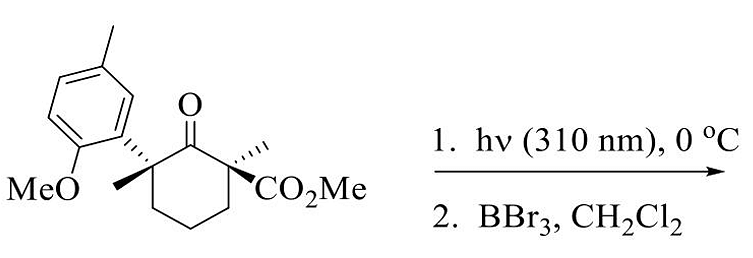
- The major product in the following reaction sequence is
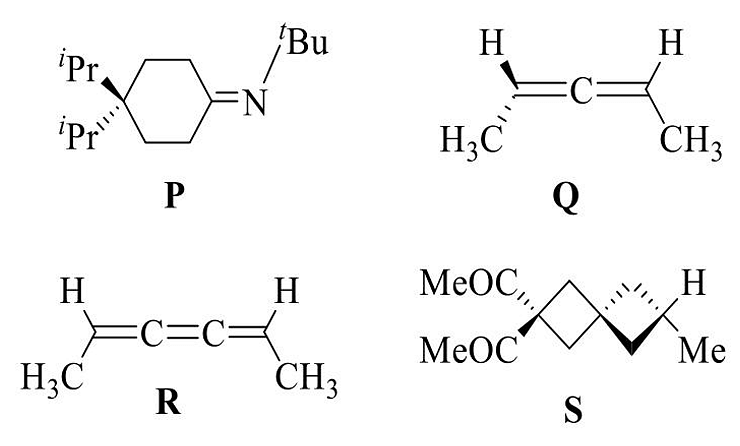
- Among the following, the chiral compound is
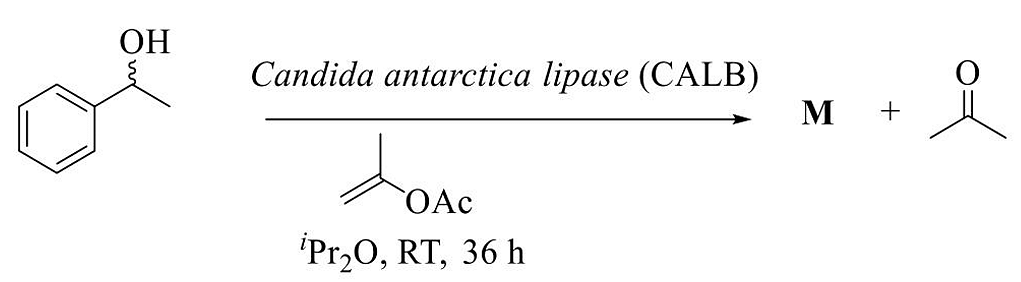
- The product M in the following reaction is
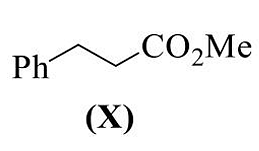
- The reaction(s) that yield(s) X as the major product is (are)
- The reaction(s) that yield(s) 2-methylquinoline as the major product is (are)
View More Questions
Top GATE CY Questions
- Ψ(x) = \(\sqrt{\frac{32}{L^3}}\)[sin(\(\frac{\pi x}{L}\)).cos(\(\frac{\pi x}{L}\)).sin(\(\frac{2\pi y}{L}\)).sin(\(\frac{\pi z}{L}\))]Find the value of E221: E111.
 what is the final product
- Which are optically active?
 intensity ratio of final product
- Which among the following is true?
View More Questions