Question:
Assertion (A): Splenectomised patients are at increased risk of septicaemia.
Reason (R): Splenectomised patients frequently have an increase in white cell and platelet counts.
Assertion (A): Splenectomised patients are at increased risk of septicaemia.
Reason (R): Splenectomised patients frequently have an increase in white cell and platelet counts.
Show Hint
The infection risk comes from loss of splenic filtering, not from the rise in blood counts.
Updated On: Jul 7, 2026
- Both A and R are true and R is the correct explanation of A
- Both A and R are true but R is NOT the correct explanation of A
- A is true but R is false
- A is false but R is true
Show Solution

Verified By Collegedunia
The Correct Option is B
Solution and Explanation
Step 1: Understanding the Assertion and Reason:
The assertion states that patients who have had their spleen removed face a higher risk of septicaemia (blood infection). The reason offered is that these patients often show a rise in white cell and platelet counts after the operation. We need to check if both statements are true, and if the reason genuinely explains the assertion.
Step 2: Evaluating the Assertion.
The spleen filters blood and clears encapsulated bacteria such as pneumococcus, meningococcus, and Haemophilus influenzae. It also helps the body make certain antibodies. Without a spleen, these organisms are cleared poorly, so splenectomised patients face a real and well known increased risk of severe infection and septicaemia, sometimes called overwhelming post splenectomy infection. So the assertion is true.
Step 3: Evaluating the Reason.
After splenectomy, the platelet count and white cell count do commonly rise for some weeks, since the spleen normally removes some old platelets and white cells from circulation, and this removal stops once the spleen is gone. So the reason, taken as a stand alone fact, is also true.
Step 4: Checking whether the reason explains the assertion.
The higher infection risk after splenectomy comes from the loss of the spleen's filtering and antibody producing role against encapsulated bacteria, not from the rise in blood cell counts. A higher platelet or white cell count does not, by itself, cause septicaemia. So although both statements are true, the reason does not correctly explain why the assertion is true.
Step 5: Final Answer:
Both A and R are true, but R is not the correct explanation of A.
The assertion states that patients who have had their spleen removed face a higher risk of septicaemia (blood infection). The reason offered is that these patients often show a rise in white cell and platelet counts after the operation. We need to check if both statements are true, and if the reason genuinely explains the assertion.
Step 2: Evaluating the Assertion.
The spleen filters blood and clears encapsulated bacteria such as pneumococcus, meningococcus, and Haemophilus influenzae. It also helps the body make certain antibodies. Without a spleen, these organisms are cleared poorly, so splenectomised patients face a real and well known increased risk of severe infection and septicaemia, sometimes called overwhelming post splenectomy infection. So the assertion is true.
Step 3: Evaluating the Reason.
After splenectomy, the platelet count and white cell count do commonly rise for some weeks, since the spleen normally removes some old platelets and white cells from circulation, and this removal stops once the spleen is gone. So the reason, taken as a stand alone fact, is also true.
Step 4: Checking whether the reason explains the assertion.
The higher infection risk after splenectomy comes from the loss of the spleen's filtering and antibody producing role against encapsulated bacteria, not from the rise in blood cell counts. A higher platelet or white cell count does not, by itself, cause septicaemia. So although both statements are true, the reason does not correctly explain why the assertion is true.
Step 5: Final Answer:
Both A and R are true, but R is not the correct explanation of A.
Was this answer helpful?
0
0
Top NEET PG Surgery Questions
- A 55-year-old male presented with verrucous carcinoma around the glans of the penis. Examination reveals that the inguinal lymph nodes are not enlarged. What is the appropriate management for this patient?
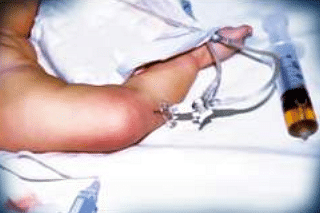
- Identify the procedure being performed in the image given below.
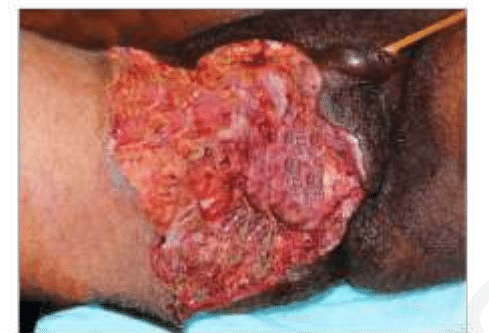
- A diabetic patient presents with sudden-onset perineal pain. On examination, foul-smelling discharge, and necrotic tissue as seen in the image is noted. Which of the following is true about the given condition?
- Which of the following is the most common complication following ligation of the first vessel during abdominoperineal resection for rectal carcinoma?(APR Abdominoperineal resection)
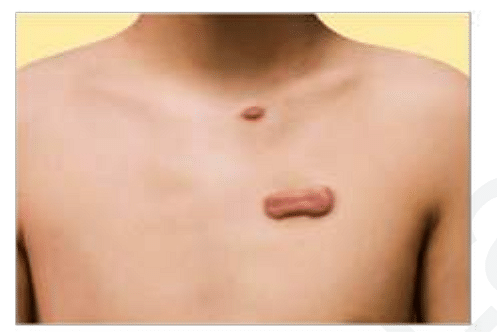
- A patient presents to the clinic with the lesion given in the image. He had a traumatic injury to the chest one year ago. What is the most likely diagnosis?
View More Questions
Top NEET PG Spleen and Splenectomy Complications Questions
Top NEET PG Questions
- A patient hailing from Delhi presents with fever, arthralgia, and extensive petechial rash for 3 days. Lab investigations revealed a hemoglobin of 9 g/ dL, a white blood cell count of 9000 cells/mm3, a platelet count of 20000 cells/mm3, and a prolonged bleeding time. The clotting time was normal. What is the most likely diagnosis?
- Which of the following statements is true about Trichomonas vaginalis?
- A lady from West Rajasthan presented with an ulcer surrounded by erythema on the right leg. Microscopy of the biopsy from the edge of the ulcer showed organisms with dark staining nuclei and kinetoplast. What is the most likely causative agent?
- A child presents with a fever and a rash. Urine examination showed cells with owl's eye appearance. What is the most likely diagnosis?
- Infection with Clonorchis sinensis is associated with an increased risk of__?
View More Questions