Question:
An electric dipole of dipole moment \(\vec{P}\) is placed in the uniform electric field \(\vec{E}\). Then which of the following statements are correct?
Statement I: The torque on the dipole is \(\vec{P} \times \vec{E}\)
Statement II: The potential energy of the dipole is \(-\vec{P} \cdot \vec{E}\)
Statement III: The net force on the dipole is non zero
An electric dipole of dipole moment \(\vec{P}\) is placed in the uniform electric field \(\vec{E}\). Then which of the following statements are correct?
Statement I: The torque on the dipole is \(\vec{P} \times \vec{E}\)
Statement II: The potential energy of the dipole is \(-\vec{P} \cdot \vec{E}\)
Statement III: The net force on the dipole is non zero
Statement I: The torque on the dipole is \(\vec{P} \times \vec{E}\)
Statement II: The potential energy of the dipole is \(-\vec{P} \cdot \vec{E}\)
Statement III: The net force on the dipole is non zero
Show Hint
If the electric field were non-uniform, then both a net torque and a net force would act on the dipole. Always check if the field is described as "uniform" or "non-uniform" in the problem statement.
Updated On: Apr 29, 2026
- I, II and III
- I and II only
- II and III only
- I and III only
Show Solution

Verified By Collegedunia
The Correct Option is B
Solution and Explanation
Step 1: Understanding the Question:
The question asks to evaluate three fundamental properties of an electric dipole when it is situated within a uniform external electric field.
Step 3: Detailed Explanation:
Statement I: The torque (\( \vec{\tau} \)) on a dipole in an external field is given by the cross product of the dipole moment and the field.
\( \vec{\tau} = \vec{P} \times \vec{E} \). Magnitude \( \tau = PE \sin\theta \).
This statement is correct.
Statement II: The electrostatic potential energy (\( U \)) of a dipole is the work done in bringing it from infinity (or a reference orientation of \( 90^{\circ} \)).
\( U = -PE \cos\theta = -\vec{P} \cdot \vec{E} \).
This statement is correct.
Statement III: In a uniform electric field, the force on the positive charge (\( +qE \)) and the force on the negative charge (\( -qE \)) are equal in magnitude and opposite in direction.
Net force \( \vec{F}_{net} = +q\vec{E} + (-q\vec{E}) = 0 \).
Therefore, the net force is zero.
Statement III says the net force is "non zero", so it is incorrect.
Step 4: Final Answer:
Only Statements I and II are correct. Hence, option (2) is the right answer.
The question asks to evaluate three fundamental properties of an electric dipole when it is situated within a uniform external electric field.
Step 3: Detailed Explanation:
Statement I: The torque (\( \vec{\tau} \)) on a dipole in an external field is given by the cross product of the dipole moment and the field.
\( \vec{\tau} = \vec{P} \times \vec{E} \). Magnitude \( \tau = PE \sin\theta \).
This statement is correct.
Statement II: The electrostatic potential energy (\( U \)) of a dipole is the work done in bringing it from infinity (or a reference orientation of \( 90^{\circ} \)).
\( U = -PE \cos\theta = -\vec{P} \cdot \vec{E} \).
This statement is correct.
Statement III: In a uniform electric field, the force on the positive charge (\( +qE \)) and the force on the negative charge (\( -qE \)) are equal in magnitude and opposite in direction.
Net force \( \vec{F}_{net} = +q\vec{E} + (-q\vec{E}) = 0 \).
Therefore, the net force is zero.
Statement III says the net force is "non zero", so it is incorrect.
Step 4: Final Answer:
Only Statements I and II are correct. Hence, option (2) is the right answer.
Was this answer helpful?
2
0
Top KCET Physics Questions
- The magnetic Lorentz force experienced by a charge q, entering a magnetic field B with a velocity v is
- ABCD is a square loop made of an uniform conducting wire. The current enters the loop at A and leaves at D. The magnetic field is
- A milliammeter of range 10 mA has a coil of resistance $1\Omega$. To use it as a voltmeter of range 10 V, the resistance that must be connected in series with it is
- The magnetic fields at two points on the axis of a circular coil at distance of 0.05 m and 0.2 m from the centre are in the ratio 8 :1 . The radius of the coil is
- The relative permeability is represented by $\mu_r$ and the susceptibility by $\varkappa$ for a magnetic substance. Then for a paramagnetic substance
View More Questions
Top KCET Electrostatics Questions
- A positively charged glass rod is brought near uncharged metal sphere, which is mounted on an insulated stand. If the glass rod is removed, the net charge on the metal sphere is
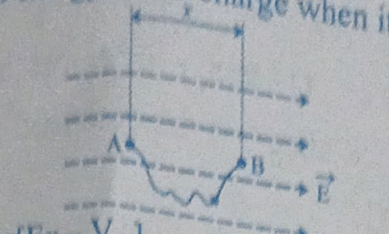
- A uniform electric field vector \(\vec{E}\) exists along horizontal direction as shown. The electric potential at A is VA . A small point charge q is slowly taken from A to B along the curved path as shown. The potential energy of the charge when it is at point B is
- Under electrostatic condition of a charged conductor, which among the following statements is true?
- A 2 – gram object, located in a region of uniform electric field \(\vec{E}=(300\ N\ C^{-1})\hat{i}\) carries a charge Q. The object released from rest at x = 0 , has a kinetic energy of 0.12 J at x = 0.5 m. Then Q is
- A cube of side 1 cm contains 100 molecules each having an induced dipole moment of \( 0.2 \times 10^{-16} \, \text{C} \cdot \text{m} \) in an external electric field of \( 4 \times 10^4 \, \text{N/C} \). The electric susceptibility of the materials is ___
View More Questions
Top KCET Questions
- Which of the following is not true for oxidation?
- If $a, b$ and $c \in N$ which one of the following is not true ?
- When $50\, cm ^{3}$ of $0.2\, N$ $H_{2} SO _{4}$ is mixed with $50 cm ^{3}$ of $1 N\, KOH$, the heat liberated is :
- If $a | (b + c)$ and $a| (b-c)$ where $a,b,c \in \, N $ then
- Which of the following is NOT a pair of functional isomers?
View More Questions