Question:
An adult presented with hematemesis and upper abdominal pain. Endoscopy revealed a growth at the pyloric antrum of the stomach. CT scan showed growth involving the pyloric antrum without infiltration or invasion into surrounding structures and no evidence of distant metastasis. At laparotomy the neoplastic growth was observed to involve the posterior wall of the stomach and the pancreas, extending 6 cm up to the tail of the pancreas. What will be the most appropriate surgical management?
An adult presented with hematemesis and upper abdominal pain. Endoscopy revealed a growth at the pyloric antrum of the stomach. CT scan showed growth involving the pyloric antrum without infiltration or invasion into surrounding structures and no evidence of distant metastasis. At laparotomy the neoplastic growth was observed to involve the posterior wall of the stomach and the pancreas, extending 6 cm up to the tail of the pancreas. What will be the most appropriate surgical management?
Show Hint
Resectable cancer invading a neighbour means en bloc removal of both, no more than needed.
Updated On: Jun 24, 2026
- Closure of the abdomen
- Antrectomy and vagotomy
- Partial gastrectomy and distal pancreatectomy
- Partial gastrectomy, distal pancreatectomy and splenectomy
Show Solution

Verified By Collegedunia
The Correct Option is C
Solution and Explanation
Step 1: This is a gastric carcinoma of the antrum that, at laparotomy, is found to directly invade an adjacent organ (the pancreas, up to the tail). There is no distant metastasis. Direct invasion of a contiguous organ is a T4b lesion, not a contraindication to surgery, provided an en bloc resection can clear it.
Step 2: The principle for locally advanced gastric cancer invading a neighbouring organ is en bloc resection: remove the involved stomach together with the directly invaded organ in one specimen to achieve R0 margins. Here that means partial (subtotal) gastrectomy plus distal pancreatectomy to take the tumour and the invaded pancreatic body and tail together.
Step 3: Closure of the abdomen (option A) is wrong because there is no unresectable distant disease or peritoneal spread; the lesion is resectable.
Step 4: Antrectomy and vagotomy (option B) is an operation for peptic ulcer disease, not for an invasive cancer, and it would leave the pancreatic disease behind.
Step 5: Adding splenectomy (option D) is not automatically required just because a distal pancreatectomy is done. Splenectomy is added only if the spleen or splenic hilum nodes are involved; here the disease stops at the pancreatic tail without stated splenic involvement, so routine splenectomy is overtreatment in this stem.
Conclusion: The correct answer is C. Partial gastrectomy and distal pancreatectomy.
Step 2: The principle for locally advanced gastric cancer invading a neighbouring organ is en bloc resection: remove the involved stomach together with the directly invaded organ in one specimen to achieve R0 margins. Here that means partial (subtotal) gastrectomy plus distal pancreatectomy to take the tumour and the invaded pancreatic body and tail together.
Step 3: Closure of the abdomen (option A) is wrong because there is no unresectable distant disease or peritoneal spread; the lesion is resectable.
Step 4: Antrectomy and vagotomy (option B) is an operation for peptic ulcer disease, not for an invasive cancer, and it would leave the pancreatic disease behind.
Step 5: Adding splenectomy (option D) is not automatically required just because a distal pancreatectomy is done. Splenectomy is added only if the spleen or splenic hilum nodes are involved; here the disease stops at the pancreatic tail without stated splenic involvement, so routine splenectomy is overtreatment in this stem.
Conclusion: The correct answer is C. Partial gastrectomy and distal pancreatectomy.
Was this answer helpful?
0
0
Top NEET PG Surgery Questions
- A 55-year-old male presented with verrucous carcinoma around the glans of the penis. Examination reveals that the inguinal lymph nodes are not enlarged. What is the appropriate management for this patient?
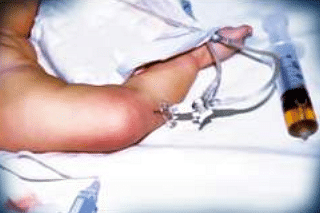
- Identify the procedure being performed in the image given below.
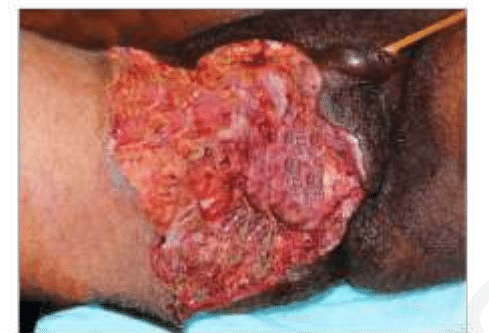
- A diabetic patient presents with sudden-onset perineal pain. On examination, foul-smelling discharge, and necrotic tissue as seen in the image is noted. Which of the following is true about the given condition?
- Which of the following is the most common complication following ligation of the first vessel during abdominoperineal resection for rectal carcinoma?(APR Abdominoperineal resection)
- A patient presents to the clinic with the lesion given in the image. He had a traumatic injury to the chest one year ago. What is the most likely diagnosis?
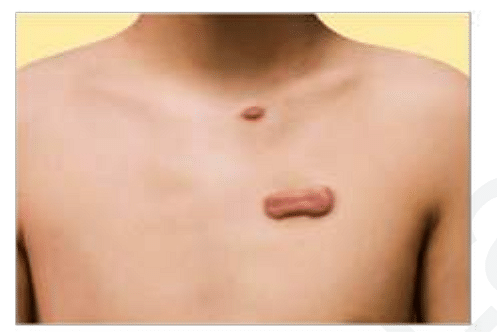
View More Questions
Top NEET PG Questions
- A patient hailing from Delhi presents with fever, arthralgia, and extensive petechial rash for 3 days. Lab investigations revealed a hemoglobin of 9 g/ dL, a white blood cell count of 9000 cells/mm3, a platelet count of 20000 cells/mm3, and a prolonged bleeding time. The clotting time was normal. What is the most likely diagnosis?
- Which of the following statements is true about Trichomonas vaginalis?
- A lady from West Rajasthan presented with an ulcer surrounded by erythema on the right leg. Microscopy of the biopsy from the edge of the ulcer showed organisms with dark staining nuclei and kinetoplast. What is the most likely causative agent?
- A child presents with a fever and a rash. Urine examination showed cells with owl's eye appearance. What is the most likely diagnosis?
- Infection with Clonorchis sinensis is associated with an increased risk of__?
View More Questions