Question:
All of the following swellings are transilluminant, EXCEPT:
All of the following swellings are transilluminant, EXCEPT:
Show Hint
Think about which of these four swellings is a solid mass rather than a fluid-filled sac.
Updated On: Jul 16, 2026
- Meningocoele
- Hydrocoele
- Thyroglossal cyst
- Lipoma
Show Solution

Verified By Collegedunia
The Correct Option is D
Solution and Explanation
Step 1: Understanding the Question:
The question is asking which of four surgical swellings does NOT light up when a torch is held against it in a dark room, that is, which one fails the transillumination test.
Step 2: Key Concept or Approach:
Transillumination is a bedside clinical test used to separate cystic, fluid- or gas-filled swellings from solid ones. Light passes through a swelling that contains clear fluid or a thin translucent wall, producing a visible glow around the torch. A solid mass simply blocks the light, so it does not transilluminate.
Step 3: Working Through the Options:
Meningocoele is a sac herniating through a spinal or cranial defect that contains clear cerebrospinal fluid, so it transilluminates well. Hydrocoele is a collection of clear serous fluid around the testis within the tunica vaginalis and is the classic example of a brilliantly transilluminant swelling. Thyroglossal cyst is a thin-walled midline cystic swelling containing clear mucoid fluid, and it also transilluminates. Lipoma, in contrast, is a solid encapsulated mass of mature fat cells with no fluid cavity, so light cannot pass through it and it stays dark on testing.
Step 4: Conclusion:
Because it is a solid fatty tumour rather than a fluid-filled sac, Lipoma is the swelling that does not transilluminate, making it the correct answer.
The question is asking which of four surgical swellings does NOT light up when a torch is held against it in a dark room, that is, which one fails the transillumination test.
Step 2: Key Concept or Approach:
Transillumination is a bedside clinical test used to separate cystic, fluid- or gas-filled swellings from solid ones. Light passes through a swelling that contains clear fluid or a thin translucent wall, producing a visible glow around the torch. A solid mass simply blocks the light, so it does not transilluminate.
Step 3: Working Through the Options:
Meningocoele is a sac herniating through a spinal or cranial defect that contains clear cerebrospinal fluid, so it transilluminates well. Hydrocoele is a collection of clear serous fluid around the testis within the tunica vaginalis and is the classic example of a brilliantly transilluminant swelling. Thyroglossal cyst is a thin-walled midline cystic swelling containing clear mucoid fluid, and it also transilluminates. Lipoma, in contrast, is a solid encapsulated mass of mature fat cells with no fluid cavity, so light cannot pass through it and it stays dark on testing.
Step 4: Conclusion:
Because it is a solid fatty tumour rather than a fluid-filled sac, Lipoma is the swelling that does not transilluminate, making it the correct answer.
Was this answer helpful?
0
0
Top NEET PG Surgery Questions
- A 55-year-old male presented with verrucous carcinoma around the glans of the penis. Examination reveals that the inguinal lymph nodes are not enlarged. What is the appropriate management for this patient?
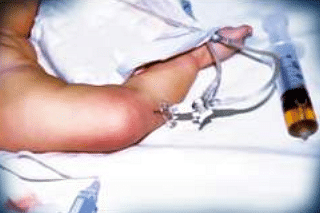
- Identify the procedure being performed in the image given below.
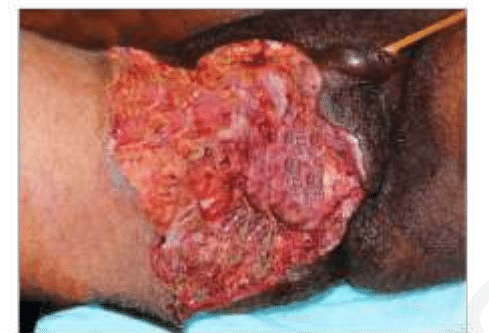
- A diabetic patient presents with sudden-onset perineal pain. On examination, foul-smelling discharge, and necrotic tissue as seen in the image is noted. Which of the following is true about the given condition?
- Which of the following is the most common complication following ligation of the first vessel during abdominoperineal resection for rectal carcinoma?(APR Abdominoperineal resection)
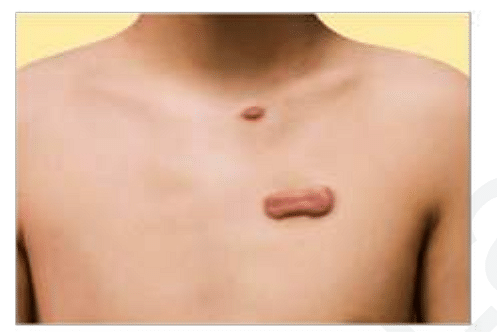
- A patient presents to the clinic with the lesion given in the image. He had a traumatic injury to the chest one year ago. What is the most likely diagnosis?
View More Questions
Top NEET PG Questions
- A patient hailing from Delhi presents with fever, arthralgia, and extensive petechial rash for 3 days. Lab investigations revealed a hemoglobin of 9 g/ dL, a white blood cell count of 9000 cells/mm3, a platelet count of 20000 cells/mm3, and a prolonged bleeding time. The clotting time was normal. What is the most likely diagnosis?
- Which of the following statements is true about Trichomonas vaginalis?
- A lady from West Rajasthan presented with an ulcer surrounded by erythema on the right leg. Microscopy of the biopsy from the edge of the ulcer showed organisms with dark staining nuclei and kinetoplast. What is the most likely causative agent?
- A child presents with a fever and a rash. Urine examination showed cells with owl's eye appearance. What is the most likely diagnosis?
- Infection with Clonorchis sinensis is associated with an increased risk of__?
View More Questions