Question:
After total thyroidectomy, the surgeon is unable to extubate and the patient shows cyanosis and respiratory distress. What is the cause of inability to extubate?
After total thyroidectomy, the surgeon is unable to extubate and the patient shows cyanosis and respiratory distress. What is the cause of inability to extubate?
Show Hint
Bilateral vocal cord paralysis after thyroid surgery causes both cords to adduct to midline, obstructing the airway.
Updated On: Jun 23, 2026
- Bilateral recurrent laryngeal nerve palsy
- Unilateral recurrent laryngeal nerve palsy
- Hemorrhage
- Supra laryngeal nerve palsy
Show Solution

Verified By Collegedunia
The Correct Option is A
Solution and Explanation
Step 1: Identify the clinical scenario. The patient is immediately post-total thyroidectomy and cannot be extubated, with cyanosis and respiratory distress. This indicates acute airway obstruction at the level of the larynx.
Step 2: Understand the anatomy. The recurrent laryngeal nerve (RLN) supplies all intrinsic muscles of the larynx except the cricothyroid. These muscles include the posterior cricoarytenoid (the only abductor of the vocal cords) and the lateral cricoarytenoid and thyroarytenoid (adductors).
Step 3: Analyze the effect of nerve injuries. Unilateral RLN palsy: the paralyzed cord lies in the paramedian position. The other cord compensates, so airway is usually adequate -- hoarseness is the main complaint. Bilateral RLN palsy: both cords lie in the paramedian or median position causing near-total glottic closure, resulting in stridor, respiratory distress, cyanosis, and inability to extubate. Superior laryngeal nerve injury causes loss of pitch and anesthesia of the supraglottis -- does not cause airway obstruction severe enough to prevent extubation.
Conclusion: Bilateral RLN palsy leads to bilateral vocal cord adduction resulting in inability to extubate, respiratory distress, and cyanosis.
Step 2: Understand the anatomy. The recurrent laryngeal nerve (RLN) supplies all intrinsic muscles of the larynx except the cricothyroid. These muscles include the posterior cricoarytenoid (the only abductor of the vocal cords) and the lateral cricoarytenoid and thyroarytenoid (adductors).
Step 3: Analyze the effect of nerve injuries. Unilateral RLN palsy: the paralyzed cord lies in the paramedian position. The other cord compensates, so airway is usually adequate -- hoarseness is the main complaint. Bilateral RLN palsy: both cords lie in the paramedian or median position causing near-total glottic closure, resulting in stridor, respiratory distress, cyanosis, and inability to extubate. Superior laryngeal nerve injury causes loss of pitch and anesthesia of the supraglottis -- does not cause airway obstruction severe enough to prevent extubation.
Conclusion: Bilateral RLN palsy leads to bilateral vocal cord adduction resulting in inability to extubate, respiratory distress, and cyanosis.
Was this answer helpful?
0
0
Top NEET PG Surgery Questions
- A 55-year-old male presented with verrucous carcinoma around the glans of the penis. Examination reveals that the inguinal lymph nodes are not enlarged. What is the appropriate management for this patient?
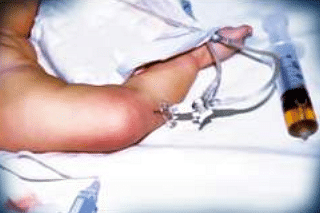
- Identify the procedure being performed in the image given below.
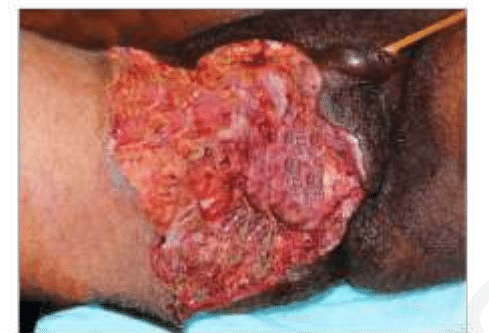
- A diabetic patient presents with sudden-onset perineal pain. On examination, foul-smelling discharge, and necrotic tissue as seen in the image is noted. Which of the following is true about the given condition?
- Which of the following is the most common complication following ligation of the first vessel during abdominoperineal resection for rectal carcinoma?(APR Abdominoperineal resection)
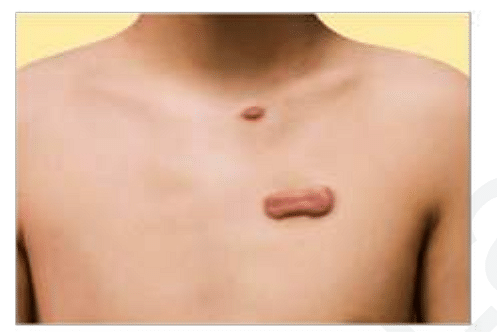
- A patient presents to the clinic with the lesion given in the image. He had a traumatic injury to the chest one year ago. What is the most likely diagnosis?
View More Questions
Top NEET PG Plastic Surgery Questions
- A patient presents to the clinic with the lesion given in the image. He had a traumatic injury to the chest one year ago. What is the most likely diagnosis?
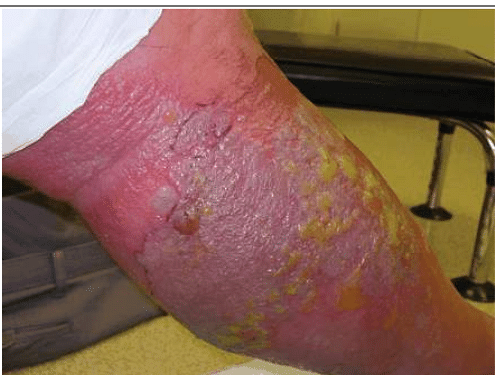
- Which of the following is false about the given condition?
- Identify the given condition
- Instrument used for ligation of pedicles in thyroid surgery is:
- A 60-year-old male patient has antral carcinoma which is spreading to the head of the pancreas and multiple small metastases to the right lobe of the liver. What will be the best treatment?
Top NEET PG Questions
- A patient hailing from Delhi presents with fever, arthralgia, and extensive petechial rash for 3 days. Lab investigations revealed a hemoglobin of 9 g/ dL, a white blood cell count of 9000 cells/mm3, a platelet count of 20000 cells/mm3, and a prolonged bleeding time. The clotting time was normal. What is the most likely diagnosis?
- Which of the following statements is true about Trichomonas vaginalis?
- A lady from West Rajasthan presented with an ulcer surrounded by erythema on the right leg. Microscopy of the biopsy from the edge of the ulcer showed organisms with dark staining nuclei and kinetoplast. What is the most likely causative agent?
- A child presents with a fever and a rash. Urine examination showed cells with owl's eye appearance. What is the most likely diagnosis?
- Infection with Clonorchis sinensis is associated with an increased risk of__?
View More Questions