Question:
According to molecular orbital theory, the correct ground state electronic configuration for \(\mathrm{[Co(NH_3)_6]^{3+}}\) ion is
According to molecular orbital theory, the correct ground state electronic configuration for \(\mathrm{[Co(NH_3)_6]^{3+}}\) ion is
Show Hint
For a sigma-only ligand set, the MO energy order is \(a_{1g} < t_{1u} < e_g\) (bonding) \(< t_{2g}\) (non-bonding) \(< e_g^{*}\) (antibonding); fill 12 ligand electrons into the bonding set, then place \(\mathrm{Co(III)}\)'s 6 \(d\) electrons in the low-spin \(t_{2g}^{6}\) configuration, since \(\mathrm{[Co(NH_3)_6]^{3+}}\) is diamagnetic.
Updated On: Aug 10, 2026
- \(a_{1g}^{2}\ t_{1u}^{6}\ e_g^{4}\ t_{2g}^{6}\ e_g^{*0}\)
- \(a_{1g}^{2}\ t_{1u}^{6}\ t_{2g}^{6}\ e_g^{4}\ e_g^{*0}\)
- \(t_{1u}^{6}\ a_{1g}^{2}\ e_g^{4}\ t_{2g}^{6}\ e_g^{*0}\)
- \(a_{1g}^{2}\ t_{1u}^{6}\ e_g^{4}\ t_{2g}^{4}\ e_g^{*2}\)
Show Solution

Verified By Collegedunia
The Correct Option is A
Solution and Explanation
Step 1: Set up the octahedral MO picture for a sigma-only ligand set.
\(\mathrm{NH_3}\) is a pure \(\sigma\)-donor with no \(\pi\)-donor or \(\pi\)-acceptor orbitals of the right symmetry to interact strongly with the metal \(d\) orbitals. In the standard octahedral MO diagram built from six \(\sigma\)-donor ligands, the metal's \(s, p_x, p_y, p_z\), and the two \(e_g\)-symmetry \(d\) orbitals (\(d_{z^2}, d_{x^2-y^2}\)) combine with the six ligand \(\sigma\) symmetry-adapted combinations to give bonding molecular orbitals of symmetry \(a_{1g}\) (from \(s\)), \(t_{1u}\) (from the three \(p\) orbitals), and \(e_g\) (from the two matching \(d\) orbitals), together with matching antibonding \(a_{1g}^{*}, t_{1u}^{*}, e_g^{*}\) orbitals. The remaining three metal \(d\) orbitals (\(d_{xy}, d_{xz}, d_{yz}\), symmetry \(t_{2g}\)) have no matching \(\sigma\)-symmetry combination on the ligands, so they stay essentially non-bonding, sitting in energy between the bonding \(e_g\) set and the antibonding \(e_g^{*}\) set.
The energy order from lowest to highest is therefore: \(a_{1g} < t_{1u} < e_g\) (all bonding) \(< t_{2g}\) (non-bonding) \(< e_g^{*}\) (antibonding).
Step 2: Fill the bonding orbitals with the ligand electrons.
Each of the six \(\mathrm{NH_3}\) ligands donates one lone pair (2 electrons) to the complex, giving \(6 \times 2 = 12\) electrons total from the ligands. These 12 electrons exactly fill the three bonding molecular orbitals: \(a_{1g}^{2}\ t_{1u}^{6}\ e_g^{4}\) (\(2 + 6 + 4 = 12\)).
Step 3: Place the metal's \(d\) electrons in \(t_{2g}\) and \(e_g^{*}\).
\(\mathrm{Co}\) in \(\mathrm{[Co(NH_3)_6]^{3+}}\) is \(\mathrm{Co(III)}\), a \(d^6\) ion. These six \(d\) electrons occupy the remaining, higher-energy orbitals, the non-bonding \(t_{2g}\) set first, then the antibonding \(e_g^{*}\) set. \(\mathrm{NH_3}\) is a reasonably strong-field ligand, and \(\mathrm{[Co(NH_3)_6]^{3+}}\) is a well known diamagnetic, low-spin complex, so all six \(d\) electrons pair up in the lower-energy, non-bonding \(t_{2g}\) orbitals before any electron occupies the higher-energy, antibonding \(e_g^{*}\) orbitals. This gives \(t_{2g}^{6}\ e_g^{*0}\).
Step 4: Assemble the full configuration.
Putting the bonding-orbital and metal-\(d\)-orbital electrons together in the correct energy order gives: \(a_{1g}^{2}\ t_{1u}^{6}\ e_g^{4}\ t_{2g}^{6}\ e_g^{*0}\).
Why the other options are wrong:
Option (B) lists the orbitals as \(a_{1g}^{2}\ t_{1u}^{6}\ t_{2g}^{6}\ e_g^{4}\ e_g^{*0}\), placing the non-bonding \(t_{2g}\) set below the bonding \(e_g\) set. That is the wrong energy order, the bonding \(e_g\), filled by ligand electrons, always lies below the non-bonding, purely metal-centered \(t_{2g}\) set.
Option (C) lists \(t_{1u}\) before \(a_{1g}\), reversing the correct order of the two lowest bonding orbitals; \(a_{1g}\), from the metal \(s\) orbital, lies below \(t_{1u}\), from the metal \(p\) orbitals, in the standard octahedral MO diagram.
Option (D), \(a_{1g}^{2}\ t_{1u}^{6}\ e_g^{4}\ t_{2g}^{4}\ e_g^{*2}\), keeps the correct orbital order but places only 4 of the 6 metal \(d\) electrons in \(t_{2g}\) and promotes 2 electrons into the antibonding \(e_g^{*}\) set, the high-spin \(d^6\) pattern. \(\mathrm{[Co(NH_3)_6]^{3+}}\) is experimentally diamagnetic and low-spin, so this weak-field-style population is not correct for this complex.
Final Answer:
\[ \boxed{a_{1g}^{2}\ t_{1u}^{6}\ e_g^{4}\ t_{2g}^{6}\ e_g^{*0}} \]
\(\mathrm{NH_3}\) is a pure \(\sigma\)-donor with no \(\pi\)-donor or \(\pi\)-acceptor orbitals of the right symmetry to interact strongly with the metal \(d\) orbitals. In the standard octahedral MO diagram built from six \(\sigma\)-donor ligands, the metal's \(s, p_x, p_y, p_z\), and the two \(e_g\)-symmetry \(d\) orbitals (\(d_{z^2}, d_{x^2-y^2}\)) combine with the six ligand \(\sigma\) symmetry-adapted combinations to give bonding molecular orbitals of symmetry \(a_{1g}\) (from \(s\)), \(t_{1u}\) (from the three \(p\) orbitals), and \(e_g\) (from the two matching \(d\) orbitals), together with matching antibonding \(a_{1g}^{*}, t_{1u}^{*}, e_g^{*}\) orbitals. The remaining three metal \(d\) orbitals (\(d_{xy}, d_{xz}, d_{yz}\), symmetry \(t_{2g}\)) have no matching \(\sigma\)-symmetry combination on the ligands, so they stay essentially non-bonding, sitting in energy between the bonding \(e_g\) set and the antibonding \(e_g^{*}\) set.
The energy order from lowest to highest is therefore: \(a_{1g} < t_{1u} < e_g\) (all bonding) \(< t_{2g}\) (non-bonding) \(< e_g^{*}\) (antibonding).
Step 2: Fill the bonding orbitals with the ligand electrons.
Each of the six \(\mathrm{NH_3}\) ligands donates one lone pair (2 electrons) to the complex, giving \(6 \times 2 = 12\) electrons total from the ligands. These 12 electrons exactly fill the three bonding molecular orbitals: \(a_{1g}^{2}\ t_{1u}^{6}\ e_g^{4}\) (\(2 + 6 + 4 = 12\)).
Step 3: Place the metal's \(d\) electrons in \(t_{2g}\) and \(e_g^{*}\).
\(\mathrm{Co}\) in \(\mathrm{[Co(NH_3)_6]^{3+}}\) is \(\mathrm{Co(III)}\), a \(d^6\) ion. These six \(d\) electrons occupy the remaining, higher-energy orbitals, the non-bonding \(t_{2g}\) set first, then the antibonding \(e_g^{*}\) set. \(\mathrm{NH_3}\) is a reasonably strong-field ligand, and \(\mathrm{[Co(NH_3)_6]^{3+}}\) is a well known diamagnetic, low-spin complex, so all six \(d\) electrons pair up in the lower-energy, non-bonding \(t_{2g}\) orbitals before any electron occupies the higher-energy, antibonding \(e_g^{*}\) orbitals. This gives \(t_{2g}^{6}\ e_g^{*0}\).
Step 4: Assemble the full configuration.
Putting the bonding-orbital and metal-\(d\)-orbital electrons together in the correct energy order gives: \(a_{1g}^{2}\ t_{1u}^{6}\ e_g^{4}\ t_{2g}^{6}\ e_g^{*0}\).
Why the other options are wrong:
Option (B) lists the orbitals as \(a_{1g}^{2}\ t_{1u}^{6}\ t_{2g}^{6}\ e_g^{4}\ e_g^{*0}\), placing the non-bonding \(t_{2g}\) set below the bonding \(e_g\) set. That is the wrong energy order, the bonding \(e_g\), filled by ligand electrons, always lies below the non-bonding, purely metal-centered \(t_{2g}\) set.
Option (C) lists \(t_{1u}\) before \(a_{1g}\), reversing the correct order of the two lowest bonding orbitals; \(a_{1g}\), from the metal \(s\) orbital, lies below \(t_{1u}\), from the metal \(p\) orbitals, in the standard octahedral MO diagram.
Option (D), \(a_{1g}^{2}\ t_{1u}^{6}\ e_g^{4}\ t_{2g}^{4}\ e_g^{*2}\), keeps the correct orbital order but places only 4 of the 6 metal \(d\) electrons in \(t_{2g}\) and promotes 2 electrons into the antibonding \(e_g^{*}\) set, the high-spin \(d^6\) pattern. \(\mathrm{[Co(NH_3)_6]^{3+}}\) is experimentally diamagnetic and low-spin, so this weak-field-style population is not correct for this complex.
Final Answer:
\[ \boxed{a_{1g}^{2}\ t_{1u}^{6}\ e_g^{4}\ t_{2g}^{6}\ e_g^{*0}} \]
Was this answer helpful?
0
0
Top GATE CY Inorganic Chemistry Questions
- Which are optically active?
- Among the following, the compound with the lowest CO stretching frequency is
- The ground state of [Cr(H2O)6]2+ is
- The reaction of XeF2 with HN(SO2F)2 at 273 K in CF2Cl2 solvent yields
- The major product in the given reaction sequence is Q. The mass spectrum of Q shows
([M] = molecular ion peak)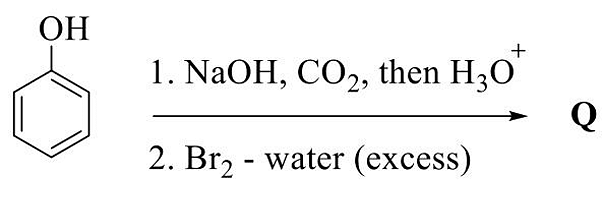
View More Questions
Top GATE CY Coordination chemistry Questions
- Which are optically active?
- Among the following, the compound with the lowest CO stretching frequency is
- The ground state of [Cr(H2O)6]2+ is
- The complex(es) with distorted octahedral structure is (are)
- The heptacity of allyl and Cp and the ligation mode of NO in the thermodynamically stable complexes
[(ηx-allyl)Ru(CO)2(NO)] and [(ηy-Cp)Ru(CO)2(NO)],
respectively, are
(The heptacity of allyl and Cp are denoted by ηx and ηy, respectively.)
View More Questions
Top GATE CY Questions
- Ψ(x) = \(\sqrt{\frac{32}{L^3}}\)[sin(\(\frac{\pi x}{L}\)).cos(\(\frac{\pi x}{L}\)).sin(\(\frac{2\pi y}{L}\)).sin(\(\frac{\pi z}{L}\))]Find the value of E221: E111.
 what is the final product
- Which are optically active?
 intensity ratio of final product
- Which among the following is true?
View More Questions