Question:
A young woman develops left sided pneumothorax following blunt injury to the chest. The most appropriate site to insert a chest tube would be
A young woman develops left sided pneumothorax following blunt injury to the chest. The most appropriate site to insert a chest tube would be
Show Hint
Think about the "triangle of safety" used for tube thoracostomy.
Updated On: Jul 16, 2026
- 2nd intercostal space in mid clavicular line
- 2nd intercostal space in anterior axillary line
- 5th intercostal space in anterior axillary line
- 5th intercostal space in posterior axillary line
Show Solution

Verified By Collegedunia
The Correct Option is C
Solution and Explanation
Step 1: Understanding the Question:
The question describes a young woman with blunt chest trauma who develops a left-sided pneumothorax, and asks for the correct anatomical landmark to place a chest tube (tube thoracostomy).
Step 2: Key Concept or Approach:
Chest tube insertion for pneumothorax or haemothorax is always done through the "triangle of safety" — a region bordered by the lateral edge of pectoralis major anteriorly, the lateral edge of latissimus dorsi posteriorly, and a horizontal line at the level of the nipple, roughly the 5th intercostal space, with its apex below the axilla. Entering here keeps the tube above the diaphragm and away from the heart, great vessels, and the internal mammary artery, while staying clear of major muscle and neurovascular structures.
Step 3: Working Through the Options:
The 2nd intercostal space in the mid-clavicular line is the site used for emergency needle decompression of a tension pneumothorax, not for a formal chest tube — a needle here buys time, but a tube placed at this level sits close to major vessels near the sternum and heals poorly. The 2nd intercostal space in the anterior axillary line is not a recognised chest tube landmark either; it is too high, again near the axillary vessels and outside the safe triangle. The 5th intercostal space in the anterior axillary line falls squarely within the triangle of safety, over relatively thin muscle, above the diaphragm and lateral to the heart — this is the correct and standard site. The 5th intercostal space in the posterior axillary line is too far back: a patient lying supine cannot comfortably rest on a tube placed there, it is prone to kinking or being compressed under the patient's own weight, and this approach risks injury to the long thoracic nerve running along the chest wall.
Step 4: Conclusion:
The correct answer is the 5th intercostal space in the anterior axillary line.
The question describes a young woman with blunt chest trauma who develops a left-sided pneumothorax, and asks for the correct anatomical landmark to place a chest tube (tube thoracostomy).
Step 2: Key Concept or Approach:
Chest tube insertion for pneumothorax or haemothorax is always done through the "triangle of safety" — a region bordered by the lateral edge of pectoralis major anteriorly, the lateral edge of latissimus dorsi posteriorly, and a horizontal line at the level of the nipple, roughly the 5th intercostal space, with its apex below the axilla. Entering here keeps the tube above the diaphragm and away from the heart, great vessels, and the internal mammary artery, while staying clear of major muscle and neurovascular structures.
Step 3: Working Through the Options:
The 2nd intercostal space in the mid-clavicular line is the site used for emergency needle decompression of a tension pneumothorax, not for a formal chest tube — a needle here buys time, but a tube placed at this level sits close to major vessels near the sternum and heals poorly. The 2nd intercostal space in the anterior axillary line is not a recognised chest tube landmark either; it is too high, again near the axillary vessels and outside the safe triangle. The 5th intercostal space in the anterior axillary line falls squarely within the triangle of safety, over relatively thin muscle, above the diaphragm and lateral to the heart — this is the correct and standard site. The 5th intercostal space in the posterior axillary line is too far back: a patient lying supine cannot comfortably rest on a tube placed there, it is prone to kinking or being compressed under the patient's own weight, and this approach risks injury to the long thoracic nerve running along the chest wall.
Step 4: Conclusion:
The correct answer is the 5th intercostal space in the anterior axillary line.
Was this answer helpful?
0
0
Top NEET PG Surgery Questions
- A 55-year-old male presented with verrucous carcinoma around the glans of the penis. Examination reveals that the inguinal lymph nodes are not enlarged. What is the appropriate management for this patient?
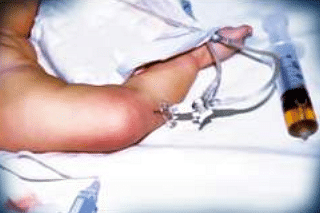
- Identify the procedure being performed in the image given below.
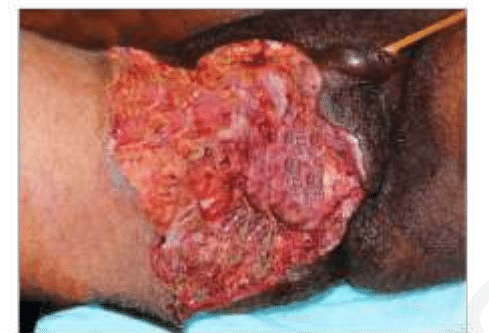
- A diabetic patient presents with sudden-onset perineal pain. On examination, foul-smelling discharge, and necrotic tissue as seen in the image is noted. Which of the following is true about the given condition?
- Which of the following is the most common complication following ligation of the first vessel during abdominoperineal resection for rectal carcinoma?(APR Abdominoperineal resection)
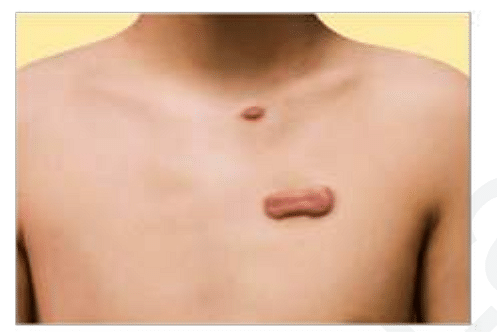
- A patient presents to the clinic with the lesion given in the image. He had a traumatic injury to the chest one year ago. What is the most likely diagnosis?
View More Questions
Top NEET PG Questions
- A patient hailing from Delhi presents with fever, arthralgia, and extensive petechial rash for 3 days. Lab investigations revealed a hemoglobin of 9 g/ dL, a white blood cell count of 9000 cells/mm3, a platelet count of 20000 cells/mm3, and a prolonged bleeding time. The clotting time was normal. What is the most likely diagnosis?
- Which of the following statements is true about Trichomonas vaginalis?
- A lady from West Rajasthan presented with an ulcer surrounded by erythema on the right leg. Microscopy of the biopsy from the edge of the ulcer showed organisms with dark staining nuclei and kinetoplast. What is the most likely causative agent?
- A child presents with a fever and a rash. Urine examination showed cells with owl's eye appearance. What is the most likely diagnosis?
- Infection with Clonorchis sinensis is associated with an increased risk of__?
View More Questions