Question:
A young motorist suffered injuries in a major road traffic accident. He was diagnosed to have a fracture of the left humerus. He also had fractures of multiple ribs anteriorly on both sides. On examination, the blood pressure was 80/60 mm Hg, and the heart rate was 140/minute. The patient was agitated, restless, and tachypneic. Jugular veins were distended. Air entry was adequate in both lung fields. Heart sounds were barely audible. Femoral pulses were weakly palpable but no pulsation could be felt distally. On a priority basis, the immediate intervention would be:
A young motorist suffered injuries in a major road traffic accident. He was diagnosed to have a fracture of the left humerus. He also had fractures of multiple ribs anteriorly on both sides. On examination, the blood pressure was 80/60 mm Hg, and the heart rate was 140/minute. The patient was agitated, restless, and tachypneic. Jugular veins were distended. Air entry was adequate in both lung fields. Heart sounds were barely audible. Femoral pulses were weakly palpable but no pulsation could be felt distally. On a priority basis, the immediate intervention would be:
Show Hint
Hypotension with distended neck veins and muffled heart sounds after chest trauma is Beck's triad; treat the tamponade first with urgent pericardiocentesis.
Updated On: Jul 8, 2026
- Rapid blood transfusion
- Urgent pericardial tap
- Intercostal drainage on both sides
- Fixation of left femur and repair of femoral artery
Show Solution

Verified By Collegedunia
The Correct Option is B
Solution and Explanation
Step 1: Pull out the three key signs together.
This patient has low blood pressure, distended neck veins, and heart sounds that are barely audible. These three findings together make up Beck's triad, which points straight to cardiac tamponade, that is, blood or fluid compressing the heart from outside after chest trauma.
Step 2: Use the jugular veins to separate this from blood loss shock.
In plain hypovolemic shock from heavy bleeding, the neck veins are flat because the circulating blood volume is low. Here the neck veins are distended, which rules against simple blood loss as the main problem and points instead to something blocking blood from returning to and filling the heart properly, which is tamponade.
Step 3: Note that the lungs are not the problem.
Air entry is adequate on both sides, so a tension pneumothorax or a large hemothorax needing chest tubes is unlikely to be the main threat here, even though the ribs are fractured.
Step 4: Recognize that this needs an emergency procedure right away.
Cardiac tamponade after blunt or penetrating chest trauma is rapidly fatal if the fluid around the heart is not drained. An urgent pericardial tap (pericardiocentesis) relieves the pressure on the heart immediately and is the life saving priority here.
Step 5: Rule out rapid blood transfusion as the first move.
Transfusing more fluid or blood into a heart that cannot fill properly because it is being squeezed from outside will not fix the underlying problem and can even worsen the situation before the tamponade is relieved.
Step 6: Rule out bilateral intercostal drainage.
Since air entry is already adequate in both lungs, there is no immediate indication for chest tubes as the top priority action right now.
Step 7: Rule out limb fixation and vascular repair.
The weak femoral pulses with absent distal pulses do suggest a vascular injury that needs attention, but treating the immediately life-threatening tamponade always comes before fixing a limb injury.
Step 8: Final answer.
The priority intervention is an urgent pericardial tap to relieve the tamponade.
\[ \boxed{\text{Urgent pericardial tap}} \]
This patient has low blood pressure, distended neck veins, and heart sounds that are barely audible. These three findings together make up Beck's triad, which points straight to cardiac tamponade, that is, blood or fluid compressing the heart from outside after chest trauma.
Step 2: Use the jugular veins to separate this from blood loss shock.
In plain hypovolemic shock from heavy bleeding, the neck veins are flat because the circulating blood volume is low. Here the neck veins are distended, which rules against simple blood loss as the main problem and points instead to something blocking blood from returning to and filling the heart properly, which is tamponade.
Step 3: Note that the lungs are not the problem.
Air entry is adequate on both sides, so a tension pneumothorax or a large hemothorax needing chest tubes is unlikely to be the main threat here, even though the ribs are fractured.
Step 4: Recognize that this needs an emergency procedure right away.
Cardiac tamponade after blunt or penetrating chest trauma is rapidly fatal if the fluid around the heart is not drained. An urgent pericardial tap (pericardiocentesis) relieves the pressure on the heart immediately and is the life saving priority here.
Step 5: Rule out rapid blood transfusion as the first move.
Transfusing more fluid or blood into a heart that cannot fill properly because it is being squeezed from outside will not fix the underlying problem and can even worsen the situation before the tamponade is relieved.
Step 6: Rule out bilateral intercostal drainage.
Since air entry is already adequate in both lungs, there is no immediate indication for chest tubes as the top priority action right now.
Step 7: Rule out limb fixation and vascular repair.
The weak femoral pulses with absent distal pulses do suggest a vascular injury that needs attention, but treating the immediately life-threatening tamponade always comes before fixing a limb injury.
Step 8: Final answer.
The priority intervention is an urgent pericardial tap to relieve the tamponade.
\[ \boxed{\text{Urgent pericardial tap}} \]
Was this answer helpful?
0
0
Top NEET PG Surgery Questions
- A 55-year-old male presented with verrucous carcinoma around the glans of the penis. Examination reveals that the inguinal lymph nodes are not enlarged. What is the appropriate management for this patient?
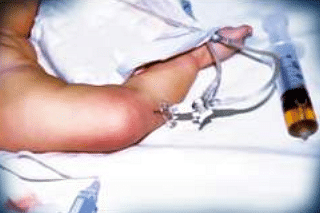
- Identify the procedure being performed in the image given below.
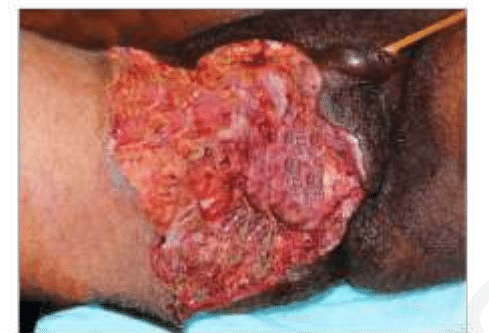
- A diabetic patient presents with sudden-onset perineal pain. On examination, foul-smelling discharge, and necrotic tissue as seen in the image is noted. Which of the following is true about the given condition?
- Which of the following is the most common complication following ligation of the first vessel during abdominoperineal resection for rectal carcinoma?(APR Abdominoperineal resection)
- A patient presents to the clinic with the lesion given in the image. He had a traumatic injury to the chest one year ago. What is the most likely diagnosis?
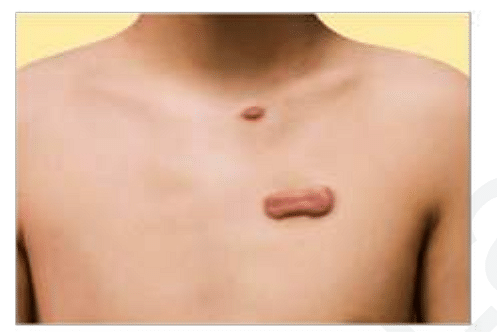
View More Questions
Top NEET PG Penetrating chest trauma and cardiac tamponade Questions
Top NEET PG Questions
- A patient hailing from Delhi presents with fever, arthralgia, and extensive petechial rash for 3 days. Lab investigations revealed a hemoglobin of 9 g/ dL, a white blood cell count of 9000 cells/mm3, a platelet count of 20000 cells/mm3, and a prolonged bleeding time. The clotting time was normal. What is the most likely diagnosis?
- Which of the following statements is true about Trichomonas vaginalis?
- A lady from West Rajasthan presented with an ulcer surrounded by erythema on the right leg. Microscopy of the biopsy from the edge of the ulcer showed organisms with dark staining nuclei and kinetoplast. What is the most likely causative agent?
- A child presents with a fever and a rash. Urine examination showed cells with owl's eye appearance. What is the most likely diagnosis?
- Infection with Clonorchis sinensis is associated with an increased risk of__?
View More Questions