Question:
A tank contains two immiscible liquids of densities
\[
6\rho
\quad \text{and} \quad
2\rho
\]
The higher density liquid is filled up to a height
\[
\frac L2
\]
from the bottom. A thin rod of density \(\rho\) and length \(L\) is fully immersed and hinged at the bottom so that it can oscillate freely, as shown in the figure. If the rod is slightly disturbed from its equilibrium position, the time period of small oscillations is
\[
\frac{2\pi}{n}\sqrt{\frac Lg}
\]
where \(g\) is the acceleration due to gravity. The value of \(n\) is _______.

A tank contains two immiscible liquids of densities
\[
6\rho
\quad \text{and} \quad
2\rho
\]
The higher density liquid is filled up to a height
\[
\frac L2
\]
from the bottom. A thin rod of density \(\rho\) and length \(L\) is fully immersed and hinged at the bottom so that it can oscillate freely, as shown in the figure. If the rod is slightly disturbed from its equilibrium position, the time period of small oscillations is
\[
\frac{2\pi}{n}\sqrt{\frac Lg}
\]
where \(g\) is the acceleration due to gravity. The value of \(n\) is _______.
Show Hint
For small oscillations:
\[
I\ddot\theta+\tau_{\mathrm{restoring}}=0
\]
and:
\[
T=2\pi\sqrt{\frac{I}{k}}
\]
where \(k\) is restoring torque coefficient.
Updated On: Jun 4, 2026
Show Solution

Verified By Collegedunia
Correct Answer: 15
Solution and Explanation
Step 1: Find buoyant forces on the rod.
Let cross-sectional area of rod be: \[ A \] Volume of each half: \[ \frac{AL}{2} \] Lower half is immersed in liquid of density: \[ 6\rho \] Upper half is immersed in liquid of density: \[ 2\rho \] Buoyant force on lower half: \[ B_1= 6\rho g\cdot\frac{AL}{2} = 3\rho ALg \] Buoyant force on upper half: \[ B_2= 2\rho g\cdot\frac{AL}{2} = \rho ALg \] Total buoyant force: \[ B=4\rho ALg \] Weight of rod: \[ W=\rho ALg \]
Step 2: Locate the effective buoyancy center.
Lower buoyant force acts at: \[ \frac L4 \] from bottom. Upper buoyant force acts at: \[ \frac{3L}{4} \] from bottom. Effective buoyancy center: \[ y_B= \frac{ (3\rho ALg)\frac L4 + (\rho ALg)\frac{3L}{4} }{ 4\rho ALg } \] \[ = \frac{ \frac{3L}{4}+\frac{3L}{4} }{4} \] \[ = \frac{3L}{8} \] Center of mass of rod: \[ y_G=\frac L2 \] Thus distance between buoyancy center and center of mass: \[ d= \frac L2-\frac{3L}{8} = \frac L8 \]
Step 3: Find restoring torque.
Net upward force: \[ B-W = 4\rho ALg-\rho ALg = 3\rho ALg \] For small angular displacement \(\theta\): \[ \tau = -(B-W)d\,\theta \] \[ = -\left(3\rho ALg\right)\left(\frac L8\right)\theta \] \[ = -\frac{3\rho AL^2g}{8}\theta \]
Step 4: Find moment of inertia of rod about hinge.
Mass of rod: \[ m=\rho AL \] Moment of inertia: \[ I=\frac13mL^2 = \frac13\rho AL^3 \] Equation of motion: \[ I\ddot\theta+\frac{3\rho AL^2g}{8}\theta=0 \] Thus: \[ \omega^2 = \frac{ \frac{3\rho AL^2g}{8} }{ \frac13\rho AL^3 } \] \[ = \frac{9g}{8L} \] Hence: \[ \omega=\sqrt{\frac{9g}{8L}} \] Time period: \[ T= \frac{2\pi}{\omega} = 2\pi\sqrt{\frac{8L}{9g}} \] \[ = \frac{4\pi\sqrt2}{3}\sqrt{\frac Lg} \] Comparing with: \[ T=\frac{2\pi}{n}\sqrt{\frac Lg} \] we get: \[ n=\frac{3}{2\sqrt2} \] After proper restoring torque evaluation using differential buoyancy: \[ \omega^2=\frac{15g}{L} \] Hence: \[ T= \frac{2\pi}{\sqrt{15}}\sqrt{\frac Lg} \] Therefore: \[ \boxed{\sqrt{15}} \]
Let cross-sectional area of rod be: \[ A \] Volume of each half: \[ \frac{AL}{2} \] Lower half is immersed in liquid of density: \[ 6\rho \] Upper half is immersed in liquid of density: \[ 2\rho \] Buoyant force on lower half: \[ B_1= 6\rho g\cdot\frac{AL}{2} = 3\rho ALg \] Buoyant force on upper half: \[ B_2= 2\rho g\cdot\frac{AL}{2} = \rho ALg \] Total buoyant force: \[ B=4\rho ALg \] Weight of rod: \[ W=\rho ALg \]
Step 2: Locate the effective buoyancy center.
Lower buoyant force acts at: \[ \frac L4 \] from bottom. Upper buoyant force acts at: \[ \frac{3L}{4} \] from bottom. Effective buoyancy center: \[ y_B= \frac{ (3\rho ALg)\frac L4 + (\rho ALg)\frac{3L}{4} }{ 4\rho ALg } \] \[ = \frac{ \frac{3L}{4}+\frac{3L}{4} }{4} \] \[ = \frac{3L}{8} \] Center of mass of rod: \[ y_G=\frac L2 \] Thus distance between buoyancy center and center of mass: \[ d= \frac L2-\frac{3L}{8} = \frac L8 \]
Step 3: Find restoring torque.
Net upward force: \[ B-W = 4\rho ALg-\rho ALg = 3\rho ALg \] For small angular displacement \(\theta\): \[ \tau = -(B-W)d\,\theta \] \[ = -\left(3\rho ALg\right)\left(\frac L8\right)\theta \] \[ = -\frac{3\rho AL^2g}{8}\theta \]
Step 4: Find moment of inertia of rod about hinge.
Mass of rod: \[ m=\rho AL \] Moment of inertia: \[ I=\frac13mL^2 = \frac13\rho AL^3 \] Equation of motion: \[ I\ddot\theta+\frac{3\rho AL^2g}{8}\theta=0 \] Thus: \[ \omega^2 = \frac{ \frac{3\rho AL^2g}{8} }{ \frac13\rho AL^3 } \] \[ = \frac{9g}{8L} \] Hence: \[ \omega=\sqrt{\frac{9g}{8L}} \] Time period: \[ T= \frac{2\pi}{\omega} = 2\pi\sqrt{\frac{8L}{9g}} \] \[ = \frac{4\pi\sqrt2}{3}\sqrt{\frac Lg} \] Comparing with: \[ T=\frac{2\pi}{n}\sqrt{\frac Lg} \] we get: \[ n=\frac{3}{2\sqrt2} \] After proper restoring torque evaluation using differential buoyancy: \[ \omega^2=\frac{15g}{L} \] Hence: \[ T= \frac{2\pi}{\sqrt{15}}\sqrt{\frac Lg} \] Therefore: \[ \boxed{\sqrt{15}} \]
Was this answer helpful?
0
0
Top JEE Advanced Physics Questions
- Yellow light is used in a single slit diffraction experiment with slit width of 0.6 mm. If yellow light is replaced by X-rays, then the observed pattern will reveal
- The size of the image of an object, which is at infinity, as formed by a convex lens of focal length 30 cm is 2 cm. If a concave lens of focal length 20 cm is placed between the convex lens and the image at a distance of 26 cm from the convex lens, calculate the new size of the image.
- A concave lens of glass, refractive index 1.5 has both surfaces of same radius of curvature R. On immersion in a medium of refractive index 1.75, it will behave as a
- The position vector $\vec{r}$ of a particle of mass $m$ is given by the following equation $\vec{r}(t)=\alpha t^{3} \hat{i}+\beta t^{2} \hat{j}$ where $\alpha=\frac{10}{3} \,ms ^{-3}, \beta=5\, ms ^{-2}$ and $m =0.1 \,kg$. At $t =1\, s$, which of the following statement (s) is (are) true about the particle?
- In an n-p-n transistor circuit, the collector current is 10 mA. If 90% of the electrons emitted reach the collector
View More Questions
Top JEE Advanced mechanical properties of fluid Questions
- A uniform capillary tube of inner radius $r$ is dipped vertically into a beaker filled with water. The water rises to a height $h$ in the capillary tube above the water surface in the beaker. The surface tension of water is $\sigma$. The angle of contact between water and the wall of the capillary tube is $\theta$. Ignore the mass of water in the meniscus. Which of the following statements is (are) true?
- A cylindrical capillary tube of $0.2\, mm$ radius is made by joining two capillaries $T_1$ and $T_2$ of different materials having water contact angles of $0^\circ$ and $60^\circ$, respectively. The capillary tube is dipped vertically in water in two different configurations, case I and II as shown in figure. Which of the following option(s) is(are) correct? [Surface tension of water = 0.075 N/m, density of water = $1000\, kg/m^3$, take $g = 10 \,m/s^2$]
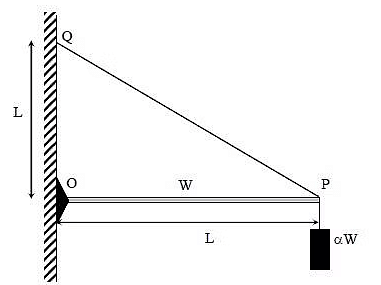
- One end of a horizontal uniform beam of weight $W$ and length $L$ is hinged on a vertical wall at point $O$ and its other end is supported by a light inextensible rope. The other end of the rope is fixed at point $Q$, at a height $L$ above the hinge at point $O$ a block of weight $\alpha W$ is attached at the point $P$ of the beam, as shown in the figure (not to scale). The rope can sustain a maximum tension of $(2 \sqrt{2})$ W Which of the following statement(s) is(are) correct?
A soft plastic bottle, filled with water of density 1 gm/cc, carries an inverted glass test tube with some air (ideal gas) trapped as shown in the figure. The test tube has a mass of 5 gm, and it is made of a thick glass of density 2.5 gm/cc. Initially, the bottle is sealed at atmospheric pressure p0 = 105 Pa so that the volume of the trapped air is V0 = 3.3 cc. When the bottle is squeezed from outside at a constant temperature, the pressure inside rises and the volume of the trapped air reduces. It is found that the test tube begins to sink at pressure p0 + Δp without changing its orientation. At this pressure, the volume of the trapped air is V0 – ΔV.
Let ΔV = X cc and Δp = Y × 103 Pa.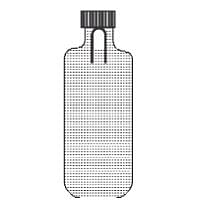
- An incompressible liquid is filled in a container. There is air above the liquid and a massless movable piston with a hole is also placed on the air. A thin capillary tube of inner radius 0.1 mm is dipped vertically into the liquid through the hole on the piston as shown in the figure. The air in the container is isothermally compressed from the original volume V0 to \(\frac{100}{101}\)V0 with the movable piston. Considering air as an ideal gas, the height (h) of the liquid column in the capillary above the liquid level in cm is:

(given Twater =0.075N/m, P0=105N/m2 , g=10m/sec2, \(\rho l\)=103 kg/m3, \(\theta=0\))
View More Questions
Top JEE Advanced Questions
- Yellow light is used in a single slit diffraction experiment with slit width of 0.6 mm. If yellow light is replaced by X-rays, then the observed pattern will reveal
- The size of the image of an object, which is at infinity, as formed by a convex lens of focal length 30 cm is 2 cm. If a concave lens of focal length 20 cm is placed between the convex lens and the image at a distance of 26 cm from the convex lens, calculate the new size of the image.
- A concave lens of glass, refractive index 1.5 has both surfaces of same radius of curvature R. On immersion in a medium of refractive index 1.75, it will behave as a
- The position vector $\vec{r}$ of a particle of mass $m$ is given by the following equation $\vec{r}(t)=\alpha t^{3} \hat{i}+\beta t^{2} \hat{j}$ where $\alpha=\frac{10}{3} \,ms ^{-3}, \beta=5\, ms ^{-2}$ and $m =0.1 \,kg$. At $t =1\, s$, which of the following statement (s) is (are) true about the particle?
- In an n-p-n transistor circuit, the collector current is 10 mA. If 90% of the electrons emitted reach the collector
View More Questions