Question:
A retained stone impacted in the distal common bile duct is seen on a T-tube cholangiogram. What is the best management of the stone?
A retained stone impacted in the distal common bile duct is seen on a T-tube cholangiogram. What is the best management of the stone?
Show Hint
Think of the least invasive proven method for clearing a duct stone.
Updated On: Jul 16, 2026
- Dissolution therapy
- Operative removal
- Endoscopic sphincterotomy and stone extraction
- No active treatment is required
Show Solution

Verified By Collegedunia
The Correct Option is C
Solution and Explanation
Step 1: Understanding the Question:
A stone retained in the distal common bile duct is found on a postoperative T-tube cholangiogram after cholecystectomy, and the question asks for the best way to manage it.
Step 2: Key Concept or Approach:
Retained common bile duct stones found on a T-tube cholangiogram are best managed by the least invasive method that reliably clears them. Endoscopic retrograde cholangiopancreatography (ERCP) with sphincterotomy and stone extraction has become the standard approach because it avoids a second major operation, carries high success rates, has lower morbidity than surgery, and can be performed with the T-tube left in place. Older approaches such as dissolution therapy are slow and unreliable, while repeat operative removal carries far higher morbidity and is reserved for cases where endoscopic clearance fails or the stone is inaccessible endoscopically. Leaving the stone untreated risks cholangitis, obstructive jaundice, and pancreatitis.
Step 3: Working Through the Options:
Dissolution therapy is too slow and unpredictable to be first-line for an obstructing distal stone. Operative removal is effective but far more invasive than necessary when an endoscopic route is available, so it stays a backup option. No active treatment is unsafe, since a retained stone left in the duct predisposes to infection and biliary obstruction. Endoscopic sphincterotomy and stone extraction gives a minimally invasive, high-success clearance of the duct without another operation, making it the best choice.
Step 4: Conclusion:
The best management is endoscopic sphincterotomy and stone extraction.
A stone retained in the distal common bile duct is found on a postoperative T-tube cholangiogram after cholecystectomy, and the question asks for the best way to manage it.
Step 2: Key Concept or Approach:
Retained common bile duct stones found on a T-tube cholangiogram are best managed by the least invasive method that reliably clears them. Endoscopic retrograde cholangiopancreatography (ERCP) with sphincterotomy and stone extraction has become the standard approach because it avoids a second major operation, carries high success rates, has lower morbidity than surgery, and can be performed with the T-tube left in place. Older approaches such as dissolution therapy are slow and unreliable, while repeat operative removal carries far higher morbidity and is reserved for cases where endoscopic clearance fails or the stone is inaccessible endoscopically. Leaving the stone untreated risks cholangitis, obstructive jaundice, and pancreatitis.
Step 3: Working Through the Options:
Dissolution therapy is too slow and unpredictable to be first-line for an obstructing distal stone. Operative removal is effective but far more invasive than necessary when an endoscopic route is available, so it stays a backup option. No active treatment is unsafe, since a retained stone left in the duct predisposes to infection and biliary obstruction. Endoscopic sphincterotomy and stone extraction gives a minimally invasive, high-success clearance of the duct without another operation, making it the best choice.
Step 4: Conclusion:
The best management is endoscopic sphincterotomy and stone extraction.
Was this answer helpful?
0
0
Top NEET PG Surgery Questions
- A 55-year-old male presented with verrucous carcinoma around the glans of the penis. Examination reveals that the inguinal lymph nodes are not enlarged. What is the appropriate management for this patient?
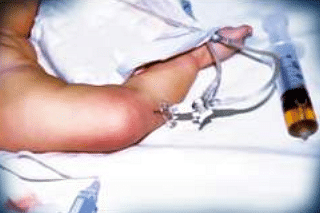
- Identify the procedure being performed in the image given below.
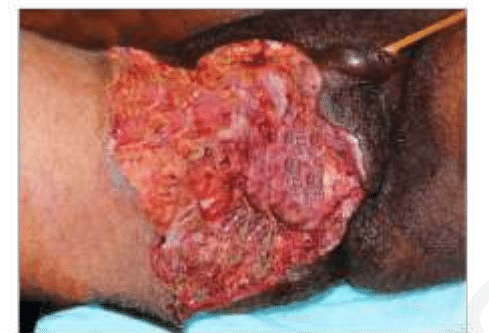
- A diabetic patient presents with sudden-onset perineal pain. On examination, foul-smelling discharge, and necrotic tissue as seen in the image is noted. Which of the following is true about the given condition?
- Which of the following is the most common complication following ligation of the first vessel during abdominoperineal resection for rectal carcinoma?(APR Abdominoperineal resection)
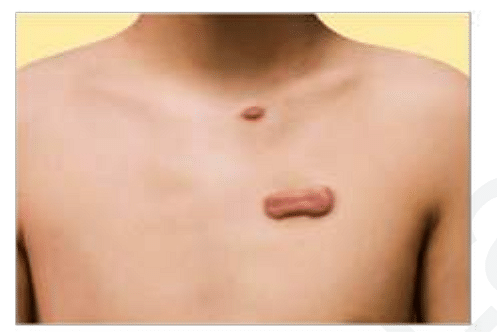
- A patient presents to the clinic with the lesion given in the image. He had a traumatic injury to the chest one year ago. What is the most likely diagnosis?
View More Questions
Top NEET PG Questions
- A patient hailing from Delhi presents with fever, arthralgia, and extensive petechial rash for 3 days. Lab investigations revealed a hemoglobin of 9 g/ dL, a white blood cell count of 9000 cells/mm3, a platelet count of 20000 cells/mm3, and a prolonged bleeding time. The clotting time was normal. What is the most likely diagnosis?
- Which of the following statements is true about Trichomonas vaginalis?
- A lady from West Rajasthan presented with an ulcer surrounded by erythema on the right leg. Microscopy of the biopsy from the edge of the ulcer showed organisms with dark staining nuclei and kinetoplast. What is the most likely causative agent?
- A child presents with a fever and a rash. Urine examination showed cells with owl's eye appearance. What is the most likely diagnosis?
- Infection with Clonorchis sinensis is associated with an increased risk of__?
View More Questions