A rectangle is drawn by lines x=0, x=2, y=0 and y=5. Points A and B lie on coordinate axes. If line AB divides the area of rectangle in 4:1, then the locus of mid-point of AB is?
Circle
Hyperbola
Ellipse
Straight line

The Correct Option is B
Approach Solution - 1
The correct answer is option (B): Hyperbola

A(2h,0), B(0,2k)
Area of \(\Delta\)OAB=8
\(\frac{1}{2}\times 2h\times 2k=8\)
\(hk=4\)
Locus of XY = 4
Approach Solution -2
Let the rectangle \( R \) be defined by the lines \( x = 0, \, x - 2y = 5 \). Thus, the vertices of the rectangle are at \( (0, 0), (5, 0), (0, 5), \) and \( (5, 5) \). The area of the rectangle is given by: \[ \text{Area of rectangle} = 5 \times 5 = 25 \]
Let the coordinates of \( A \) be \( A(\alpha, 0) \) and \( B(0, \beta) \), where \( \alpha \in [0, 5] \) and \( \beta \in [0, 5] \). We are told that the line segment \( AB \) divides the area of the rectangle in the ratio 4:1. This means that the area of triangle \( OAB \) is \( \frac{4}{5} \) of the total area of the rectangle. The area of triangle \( OAB \) is given by: \[ \text{Area of triangle } OAB = \frac{1}{2} \times \alpha \times \beta \] We are given that this area is \( \frac{4}{5} \) of the total area of the rectangle: \[ \frac{1}{2} \times \alpha \times \beta = \frac{4}{5} \times 25 = 20 \] Thus, we have the equation: \[ \alpha \times \beta = 40 \] Now, we know that the midpoint \( M \) of the line segment \( AB \) is given by: \[ M\left( \frac{\alpha}{2}, \frac{\beta}{2} \right) \] Substituting the equation \( \alpha \times \beta = 40 \), we get: \[ M\left( \frac{\alpha}{2}, \frac{\beta}{2} \right) \] This describes a locus of points that satisfies the equation of a hyperbola. Therefore, the midpoint \( M \) lies on a hyperbola.
Top JEE Main Mathematics Questions
- The value of is
- The number of terms of an is even. The sum of the odd terms is and of the even terms is . The last term exceeds the first by . Then the number of terms in the series is ______.
- If , then the general value of is:
- The general solution of
- If the constant term in the binomial expansion of $\left(\frac{x^{\frac{3}{2}}}{2}-\frac{4}{x^l}\right)^9$ is $-84$ and the coefficient of $x^{-3 l}$ is $2^\alpha \beta$, where $\beta<0$ is an odd number, then $|\alpha l-\beta|$ is equal to_____
Top JEE Main Straight lines Questions
- If the sum of squares of all real values of \( \alpha \), for which the lines \( 2x - y + 3 = 0 \), \( 6x + 3y + 1 = 0 \) and \( \alpha x + 2y - 2 = 0 \) do not form a triangle \( p \), then the greatest integer less than or equal to \( p \) is ....
- The vertices of a triangle are A(–1, 3), B(–2, 2) and C(3, –1). A new triangle is formed by shifting the sides of the triangle by one unit inwards. Then the equation of the side of the new triangle nearest to origin is :
- Let the angles made with the positive $x$-axis by two straight lines drawn from the point $P(2,3)$ and meeting the line $x+y=6$ at a distance $\sqrt{\frac{2}{3}}$ from the point $P$ be $\theta_1$ and $\theta_2$. Then the value of $(\theta_1+\theta_2)$ is
- Let the six numbers $a_1, a_2, a_3, a_4, a_5, a_6$, be in AP and $a_1+a_3=10$ If the mean of these six numbers is $\frac{19}{2}$ and their variance is $\sigma^2$, then $8 \sigma^2$ is equal to :
- For $\alpha, \beta \in R$, suppose the system of linear equations $ x-y+z=5 $ $2 x+2 y+\alpha z=8 $ $3 x-y+4 z=\beta$ has infinitely many solutions Then $\alpha$ and $\beta$ are the roots of
Top JEE Main Questions
- Two masses $m$ and $\frac{m}{2}$ are connected at the two ends of a massless rigid rod of length $l$. The rod is suspended by a thin wire of torsional constant $k$ at the centre of mass of the rod-mass system(see figure). Because of torsional constant $k$, the restoring torque is $\tau =k\theta$ for angular displacement $\theta$. If the rod is rota ted by $\theta_0$ and released, the tension in it when it passes through its mean position will be:
What will be the equilibrium constant of the given reaction carried out in a \(5 \,L\) vessel and having equilibrium amounts of \(A_2\) and \(A\) as \(0.5\) mole and \(2 \times 10^{-6}\) mole respectively?
The reaction : \(A_2 \rightleftharpoons 2A\)- The value of is
- The number of terms of an is even. The sum of the odd terms is and of the even terms is . The last term exceeds the first by . Then the number of terms in the series is ______.
A black body is at a temperature of 2880 K. The energy of radiation emitted by this body with wavelength between 499 nm and 500 nm is U1, between 999 nm and 1000 nm is U2 and between 1499 nm and 1500 nm is U3. The Wien's constant, b = 2.88×10⁶ nm-K. Then,
Concepts Used:
Straight lines
A straight line is a line having the shortest distance between two points.
A straight line can be represented as an equation in various forms, as show in the image below:
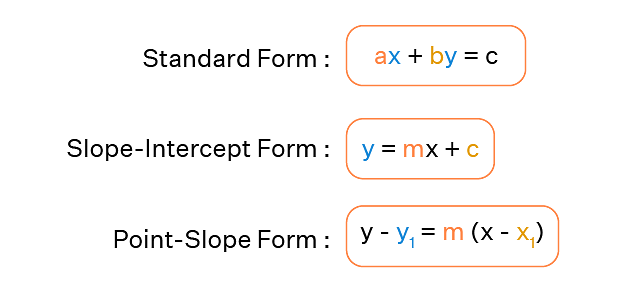
The following are the many forms of the equation of the line that are presented in straight line-
1. Slope – Point Form
Assume P0(x0, y0) is a fixed point on a non-vertical line L with m as its slope. If P (x, y) is an arbitrary point on L, then the point (x, y) lies on the line with slope m through the fixed point (x0, y0) if and only if its coordinates fulfil the equation below.
y – y0 = m (x – x0)
2. Two – Point Form
Let's look at the line. L crosses between two places. P1(x1, y1) and P2(x2, y2) are general points on L, while P (x, y) is a general point on L. As a result, the three points P1, P2, and P are collinear, and it becomes
The slope of P2P = The slope of P1P2 , i.e.
\(\frac{y-y_1}{x-x_1} = \frac{y_2-y_1}{x_2-x_1}\)
Hence, the equation becomes:
y - y1 =\( \frac{y_2-y_1}{x_2-x_1} (x-x1)\)
3. Slope-Intercept Form
Assume that a line L with slope m intersects the y-axis at a distance c from the origin, and that the distance c is referred to as the line L's y-intercept. As a result, the coordinates of the spot on the y-axis where the line intersects are (0, c). As a result, the slope of the line L is m, and it passes through a fixed point (0, c). The equation of the line L thus obtained from the slope – point form is given by
y – c =m( x - 0 )
As a result, the point (x, y) on the line with slope m and y-intercept c lies on the line, if and only if
y = m x +c