Question:
A primigravida presents to the emergency room in the early stage of labor with adequate uterine contractions. On per vaginal examination, a gynecoid pelvis is felt, the membranes are ruptured, and the vertex is felt in the right occipito- posterior position. How will you manage this patient?
A primigravida presents to the emergency room in the early stage of labor with adequate uterine contractions. On per vaginal examination, a gynecoid pelvis is felt, the membranes are ruptured, and the vertex is felt in the right occipito- posterior position. How will you manage this patient?
Updated On: Aug 27, 2026
- Vacuum – assisted delivery
- Cesarean section
Normal vaginal delivery
Forceps delivery n
Show Solution

Verified By Collegedunia
The Correct Option is C
Solution and Explanation
The given scenario describes a primigravida woman in early labor with adequate uterine contractions, a gynecoid pelvis, and the fetal vertex in the right occipito-posterior position after membrane rupture. Let's analyze the management options:
- Pelvic Adequacy: The gynecoid pelvis is favorable for vaginal delivery, providing ample space for the fetus during labor.
- Fetal Position: The right occipito-posterior position suggests the fetal face is towards the mother's back, which can be common. While it may lengthen labor, it doesn't typically necessitate cesarean section.
- Labor Progression: As contractions are adequate, the patient is in active labor, indicating potential for normal progression.
- Membrane Rupture: Since membranes are ruptured, monitoring labor progression and fetal distress signs is crucial.
- Intervention Considerations: While instrument-assisted deliveries like vacuum or forceps are potential choices in certain scenarios, they are generally reserved for when complications arise late in labor or if the labor stalls without progression despite adequate contractions.
- Preferred Management: Given the circumstances, the appropriate management is normal vaginal delivery, which offers the safest and least invasive method when there are no contraindications present. Continuous monitoring of labor and fetal status is needed to ensure the delivery progresses healthily.
Considering the above factors, the correct choice for managing this patient, assuming no unforeseen complications arise, is to opt for Normal vaginal delivery.
Was this answer helpful?
0
0
Top NEET PG Gynaecology and Obstetrics Questions
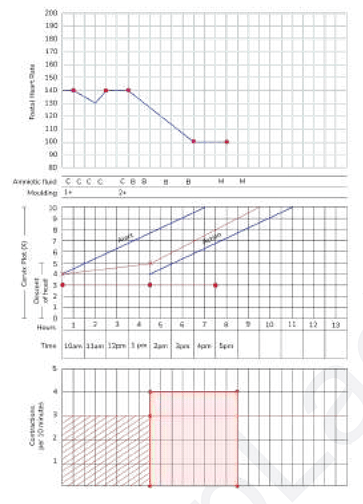
- A partogram of a woman who is in labor is shown below. Oxytocin infusion is already given. How will you manage the condition?
- A woman presents to you at 36 weeks of gestation with complaints of breathlessness and excessive abdominal distension. Fetal movements are normal. On examination, fetal parts are not easily felt and fetal heartbeat is heard but it is muffled. Her symphysis fundal height is 41 cm. Her abdomen is tense but not tender. What is the most likely diagonosis?
- For which of the following procedures in the given OT list, can you preferably do a hysteroscopy ?
- A primigravida presents to you with anemia early in her pregnancy. She is 7 weeks pregnant as seen on ultrasound. Her hemoglobin level is 9 g/dL. When should the iron supplements be started for her?
- A 23-year-old woman accompanied by her mother-in-law comes to the infertility clinic. She has been having regular intercourse for 6 months but is not able to conceive. What is the next best step?
View More Questions
Top NEET PG Physiology of normal pregnancy Questions
- Which of the following is correct regarding placenta?
- Establishment of fetoplacental circulation seen at :
- RDA of iodine in lactation in microgram :
- Peripartum cardiomyopathy occurs at :
- Nerve mostly compressed in pregnancy puerperium:
View More Questions
Top NEET PG Questions
- A patient hailing from Delhi presents with fever, arthralgia, and extensive petechial rash for 3 days. Lab investigations revealed a hemoglobin of 9 g/ dL, a white blood cell count of 9000 cells/mm3, a platelet count of 20000 cells/mm3, and a prolonged bleeding time. The clotting time was normal. What is the most likely diagnosis?
- Which of the following statements is true about Trichomonas vaginalis?
- A lady from West Rajasthan presented with an ulcer surrounded by erythema on the right leg. Microscopy of the biopsy from the edge of the ulcer showed organisms with dark staining nuclei and kinetoplast. What is the most likely causative agent?
- A child presents with a fever and a rash. Urine examination showed cells with owl's eye appearance. What is the most likely diagnosis?
- Infection with Clonorchis sinensis is associated with an increased risk of__?
View More Questions