Question:
A patient presents with epigastric pain after a heavy meal. On examination there is tenderness and rigidity in the upper abdomen, and the chest X-ray shows pneumomediastinum. The most likely cause is:
A patient presents with epigastric pain after a heavy meal. On examination there is tenderness and rigidity in the upper abdomen, and the chest X-ray shows pneumomediastinum. The most likely cause is:
Show Hint
Vomiting then chest pain then air in the mediastinum points to which named syndrome?
Updated On: Jun 23, 2026
- Spontaneous oesophageal rupture (Boerhaave syndrome)
- Penetrating foreign body injury to the oesophagus
- Perforated peptic ulcer
- Rupture of an emphysematous bulla
Show Solution

Verified By Collegedunia
The Correct Option is A
Solution and Explanation
Correct option: Spontaneous oesophageal rupture (Boerhaave syndrome).
Step 1: The history of severe chest or upper-abdominal pain after a large meal or bout of vomiting, with pneumomediastinum on imaging, is classic for Boerhaave syndrome (a full-thickness barotrauma rupture, usually of the lower-left oesophagus).
Step 2: Mackler triad confirms the diagnosis: vomiting, then chest pain, then subcutaneous emphysema. Air tracks into the mediastinum, giving the pneumomediastinum and the V sign of Naclerio on chest X-ray.
Why the others are wrong: There is no history of a swallowed foreign body. A perforated peptic ulcer gives free gas under the diaphragm (pneumoperitoneum), not pneumomediastinum. A ruptured emphysematous bulla causes a pneumothorax in a patient with chronic lung disease, not this post-meal picture.
Ref: Bailey and Love, Short Practice of Surgery, 27th edition, 2018; SRB's Manual of Surgery, 4th edition.
Step 1: The history of severe chest or upper-abdominal pain after a large meal or bout of vomiting, with pneumomediastinum on imaging, is classic for Boerhaave syndrome (a full-thickness barotrauma rupture, usually of the lower-left oesophagus).
Step 2: Mackler triad confirms the diagnosis: vomiting, then chest pain, then subcutaneous emphysema. Air tracks into the mediastinum, giving the pneumomediastinum and the V sign of Naclerio on chest X-ray.
Why the others are wrong: There is no history of a swallowed foreign body. A perforated peptic ulcer gives free gas under the diaphragm (pneumoperitoneum), not pneumomediastinum. A ruptured emphysematous bulla causes a pneumothorax in a patient with chronic lung disease, not this post-meal picture.
Ref: Bailey and Love, Short Practice of Surgery, 27th edition, 2018; SRB's Manual of Surgery, 4th edition.
Was this answer helpful?
0
0
Top NEET PG Surgery Questions
- A 55-year-old male presented with verrucous carcinoma around the glans of the penis. Examination reveals that the inguinal lymph nodes are not enlarged. What is the appropriate management for this patient?
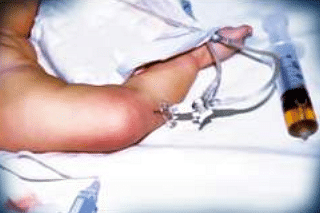
- Identify the procedure being performed in the image given below.
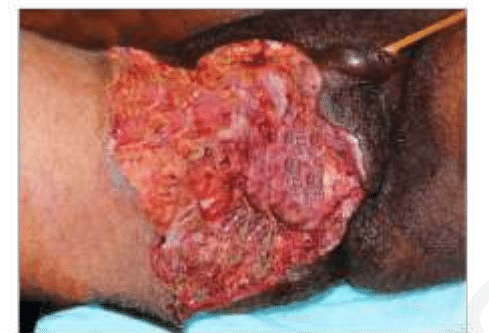
- A diabetic patient presents with sudden-onset perineal pain. On examination, foul-smelling discharge, and necrotic tissue as seen in the image is noted. Which of the following is true about the given condition?
- Which of the following is the most common complication following ligation of the first vessel during abdominoperineal resection for rectal carcinoma?(APR Abdominoperineal resection)
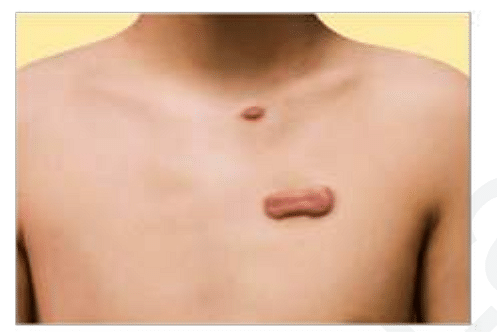
- A patient presents to the clinic with the lesion given in the image. He had a traumatic injury to the chest one year ago. What is the most likely diagnosis?
View More Questions
Top NEET PG Questions
- A patient hailing from Delhi presents with fever, arthralgia, and extensive petechial rash for 3 days. Lab investigations revealed a hemoglobin of 9 g/ dL, a white blood cell count of 9000 cells/mm3, a platelet count of 20000 cells/mm3, and a prolonged bleeding time. The clotting time was normal. What is the most likely diagnosis?
- Which of the following statements is true about Trichomonas vaginalis?
- A lady from West Rajasthan presented with an ulcer surrounded by erythema on the right leg. Microscopy of the biopsy from the edge of the ulcer showed organisms with dark staining nuclei and kinetoplast. What is the most likely causative agent?
- A child presents with a fever and a rash. Urine examination showed cells with owl's eye appearance. What is the most likely diagnosis?
- Infection with Clonorchis sinensis is associated with an increased risk of__?
View More Questions