Question:
A patient arrives in the ER following a road traffic accident with hypotension, respiratory distress and subcutaneous emphysema with no entry of air on one side. What will be the best management?
A patient arrives in the ER following a road traffic accident with hypotension, respiratory distress and subcutaneous emphysema with no entry of air on one side. What will be the best management?
Show Hint
Air is trapped under pressure; let it out before anything else.
Updated On: Jun 23, 2026
- Needle decompression in the 5th intercostal space in the midaxillary line
- Continue positive pressure ventilation
- Shift to ICU and intubate
- Secure IV line and start fluid resuscitation after insertion of a wide-bore IV line
Show Solution

Verified By Collegedunia
The Correct Option is A
Solution and Explanation
Diagnosis: Hypotension, respiratory distress, surgical emphysema and absent air entry on one side after trauma describe a tension pneumothorax. This is a clinical emergency; do not wait for a chest X-ray.
Why option A: Tension pneumothorax is treated by immediate needle decompression to convert it to a simple (open) pneumothorax, followed by a chest tube. Of all the options, only A is an actual decompression, so it is the life-saving step. Current ATLS guidance accepts the 5th intercostal space in the anterior or mid-axillary line as a valid decompression site (the older teaching was the 2nd intercostal space, midclavicular line).
Why the others are wrong: Continuing positive pressure ventilation (B) forces more air into the pleural space and worsens the tension. Shifting to ICU and intubating (C) wastes time on a patient who is about to arrest. Fluids alone (D) do not relieve the trapped air, which is the cause of the obstructive shock.
Mechanism: A one-way valve leak lets air enter the pleura but not escape, collapsing the lung, shifting the mediastinum and kinking the great veins, dropping venous return and blood pressure.
Ref: Bailey and Love, Short Practice of Surgery, 27e, Pg 367, 920.
Why option A: Tension pneumothorax is treated by immediate needle decompression to convert it to a simple (open) pneumothorax, followed by a chest tube. Of all the options, only A is an actual decompression, so it is the life-saving step. Current ATLS guidance accepts the 5th intercostal space in the anterior or mid-axillary line as a valid decompression site (the older teaching was the 2nd intercostal space, midclavicular line).
Why the others are wrong: Continuing positive pressure ventilation (B) forces more air into the pleural space and worsens the tension. Shifting to ICU and intubating (C) wastes time on a patient who is about to arrest. Fluids alone (D) do not relieve the trapped air, which is the cause of the obstructive shock.
Mechanism: A one-way valve leak lets air enter the pleura but not escape, collapsing the lung, shifting the mediastinum and kinking the great veins, dropping venous return and blood pressure.
Ref: Bailey and Love, Short Practice of Surgery, 27e, Pg 367, 920.
Was this answer helpful?
0
0
Top NEET PG Surgery Questions
- A 55-year-old male presented with verrucous carcinoma around the glans of the penis. Examination reveals that the inguinal lymph nodes are not enlarged. What is the appropriate management for this patient?
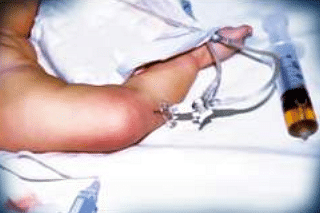
- Identify the procedure being performed in the image given below.
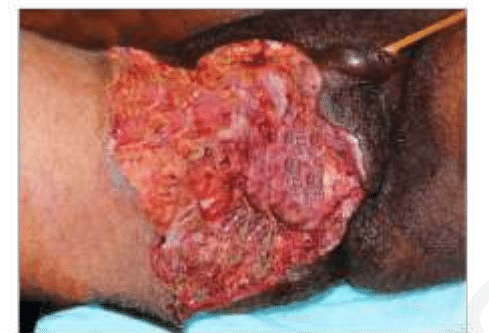
- A diabetic patient presents with sudden-onset perineal pain. On examination, foul-smelling discharge, and necrotic tissue as seen in the image is noted. Which of the following is true about the given condition?
- Which of the following is the most common complication following ligation of the first vessel during abdominoperineal resection for rectal carcinoma?(APR Abdominoperineal resection)
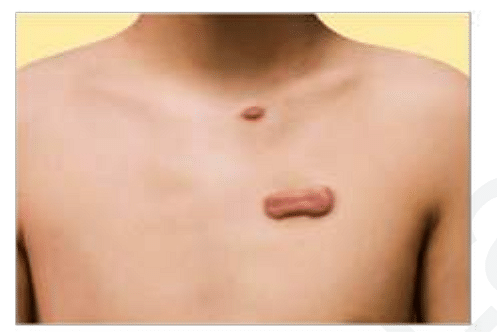
- A patient presents to the clinic with the lesion given in the image. He had a traumatic injury to the chest one year ago. What is the most likely diagnosis?
View More Questions
Top NEET PG Tension pneumothorax Questions
Top NEET PG Questions
- A patient hailing from Delhi presents with fever, arthralgia, and extensive petechial rash for 3 days. Lab investigations revealed a hemoglobin of 9 g/ dL, a white blood cell count of 9000 cells/mm3, a platelet count of 20000 cells/mm3, and a prolonged bleeding time. The clotting time was normal. What is the most likely diagnosis?
- Which of the following statements is true about Trichomonas vaginalis?
- A lady from West Rajasthan presented with an ulcer surrounded by erythema on the right leg. Microscopy of the biopsy from the edge of the ulcer showed organisms with dark staining nuclei and kinetoplast. What is the most likely causative agent?
- A child presents with a fever and a rash. Urine examination showed cells with owl's eye appearance. What is the most likely diagnosis?
- Infection with Clonorchis sinensis is associated with an increased risk of__?
View More Questions