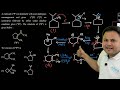
A molecule (P) on treatment with acid undergoes rearrangement and gives (Q). (Q) on ozonolysis followed by reflux under alkaline condition gives (R). The structure of (R) is given below. The structure of (P) is:

A molecule (P) on treatment with acid undergoes rearrangement and gives (Q). (Q) on ozonolysis followed by reflux under alkaline condition gives (R). The structure of (R) is given below. The structure of (P) is:
Show Hint


- Both Option 2 and 3 are correct.

The Correct Option is A
Solution and Explanation
The first reaction on 'P' is treatment with acid which causes a rearrangement giving 'Q'. Then 'Q' undergoes ozonolysis followed by reflux with alkali to produce 'R'. Ozonolysis will cleave the double bond so let's label the side to add at ketone. Ozonolysis followed by reflux with alkali gives the ketone functionality is. The given product can undergo aldol condensation
If the product given here after reflux with alkali would produce
Given product means Q after ozonolysis with alkaline treatment gave. The first reaction involves acid that give is that the alcohol give alkylene as show n by structure.
Hence, Both Option 2 and 3 are Correct.

Learn with videos:
Top JEE Main Chemistry Questions
What will be the equilibrium constant of the given reaction carried out in a \(5 \,L\) vessel and having equilibrium amounts of \(A_2\) and \(A\) as \(0.5\) mole and \(2 \times 10^{-6}\) mole respectively?
The reaction : \(A_2 \rightleftharpoons 2A\)- At equilibrium the concentrations of and in a sealed vessel at . What will be for the reaction
- Find out the major products from the following reactions

Cobalt chloride when dissolved in water forms pink colored complex $X$ which has octahedral geometry. This solution on treating with cone $HCl$ forms deep blue complex, $\underline{Y}$ which has a $\underline{Z}$ geometry $X, Y$ and $Z$, respectively, are
- The correct order of atomic radii is:
Top JEE Main Organic Chemistry Questions
- Example of vinylic halide is
- Structure of 4-Methylpent-2-enal is
- In the given reactions identify the reagent A and reagent B

- Given below are two statement one is labeled as Assertion (A) and the other is labeled as Reason (R).
Assertion (A): CH2 = CH – CH2 – Cl is an example of allyl halide
Reason (R): Allyl halides are the compounds in which the halogen atom is attached to sp2 hybridised carbon atom.
In the light of the two above statements, choose the most appropriate answer from the options given below - Following is a confirmatory test for aromatic primary amines. Identify reagent (A) and (B)

Top JEE Main Questions
- Two masses $m$ and $\frac{m}{2}$ are connected at the two ends of a massless rigid rod of length $l$. The rod is suspended by a thin wire of torsional constant $k$ at the centre of mass of the rod-mass system(see figure). Because of torsional constant $k$, the restoring torque is $\tau =k\theta$ for angular displacement $\theta$. If the rod is rota ted by $\theta_0$ and released, the tension in it when it passes through its mean position will be:
What will be the equilibrium constant of the given reaction carried out in a \(5 \,L\) vessel and having equilibrium amounts of \(A_2\) and \(A\) as \(0.5\) mole and \(2 \times 10^{-6}\) mole respectively?
The reaction : \(A_2 \rightleftharpoons 2A\)- The value of is
- The number of terms of an is even. The sum of the odd terms is and of the even terms is . The last term exceeds the first by . Then the number of terms in the series is ______.
A black body is at a temperature of 2880 K. The energy of radiation emitted by this body with wavelength between 499 nm and 500 nm is U1, between 999 nm and 1000 nm is U2 and between 1499 nm and 1500 nm is U3. The Wien's constant, b = 2.88×10⁶ nm-K. Then,