Question:
A male patient presented with a bone fracture following a road traffic accident. After 2 days he developed dyspnea, petechiae involving the whole body, and a fall in oxygen saturation. What is the likely diagnosis?
A male patient presented with a bone fracture following a road traffic accident. After 2 days he developed dyspnea, petechiae involving the whole body, and a fall in oxygen saturation. What is the likely diagnosis?
Updated On: Aug 27, 2026
- Fat embolism
- Air embolism
- Venous thromboembolism
- Pulmonary hypertension
Show Solution

Verified By Collegedunia
The Correct Option is A
Solution and Explanation
The question describes a male patient who developed specific symptoms such as dyspnea, petechiae, and hypoxemia following a bone fracture due to a road traffic accident. To determine the likely diagnosis, consider the following explanations:
- Fat embolism: This condition commonly occurs after a fracture of long bones, like the femur, where fat globules are released into the bloodstream. Symptoms typically appear 24-72 hours post-injury and include respiratory distress (dyspnea), petechiae (small red or purple spots on the skin), and reduced oxygen saturation. Based on the patient's symptoms and timeline, this is the most probable diagnosis.
- Air embolism: This occurs when air enters the veins, which is more common in procedures like surgeries or intravenous catheter insertion, not typically after bone fractures in road accidents.
- Venous thromboembolism: While this involves blood clots that can travel to the lungs causing pulmonary embolism, the presence of petechiae is not characteristic of this condition.
- Pulmonary hypertension: This condition involves high blood pressure in the pulmonary arteries and is not associated with sudden onset after trauma.
Given the context and symptoms—especially the petechial rash and respiratory distress following a fracture—the most plausible diagnosis is fat embolism.
Was this answer helpful?
0
0
Top NEET PG Surgery Questions
- A 55-year-old male presented with verrucous carcinoma around the glans of the penis. Examination reveals that the inguinal lymph nodes are not enlarged. What is the appropriate management for this patient?
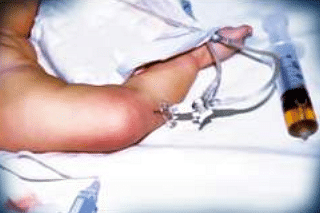
- Identify the procedure being performed in the image given below.
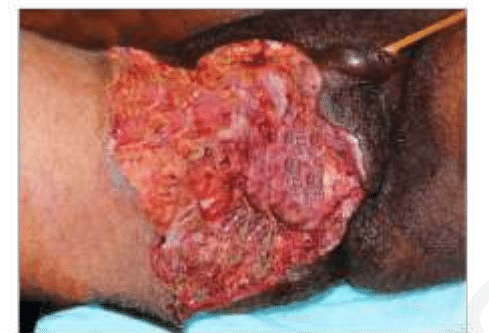
- A diabetic patient presents with sudden-onset perineal pain. On examination, foul-smelling discharge, and necrotic tissue as seen in the image is noted. Which of the following is true about the given condition?
- Which of the following is the most common complication following ligation of the first vessel during abdominoperineal resection for rectal carcinoma?(APR Abdominoperineal resection)
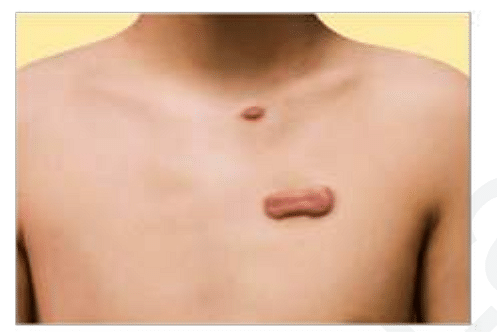
- A patient presents to the clinic with the lesion given in the image. He had a traumatic injury to the chest one year ago. What is the most likely diagnosis?
View More Questions
Top NEET PG Therapeutic Orthopaedics Questions
- Muscles affected in De quervain tenosynovitis -
- You are posted as an intern in causality.Which among the following patients with fracture will be your 1st priority to call ortho PG and inform?
- \(8^{th}\) and \(9^{th}\) rib costal cartilage forms which type of joint?
- Which of the following is the topical use of the medicine shown in the image:

- A post tonsillectomy child was lying in the ward. He started bleeding in the ward. Which of the following should be done
View More Questions
Top NEET PG Questions
- A patient hailing from Delhi presents with fever, arthralgia, and extensive petechial rash for 3 days. Lab investigations revealed a hemoglobin of 9 g/ dL, a white blood cell count of 9000 cells/mm3, a platelet count of 20000 cells/mm3, and a prolonged bleeding time. The clotting time was normal. What is the most likely diagnosis?
- Which of the following statements is true about Trichomonas vaginalis?
- A lady from West Rajasthan presented with an ulcer surrounded by erythema on the right leg. Microscopy of the biopsy from the edge of the ulcer showed organisms with dark staining nuclei and kinetoplast. What is the most likely causative agent?
- A child presents with a fever and a rash. Urine examination showed cells with owl's eye appearance. What is the most likely diagnosis?
- Infection with Clonorchis sinensis is associated with an increased risk of__?
View More Questions