Question:
A lady presented to the emergency department with a stab injury to the left side of the abdomen. She was haemodynamically stable and a contrast-enhanced CT scan revealed a laceration in the spleen. Laparoscopy was planned, but the patient's pO2 suddenly dropped as soon as the pneumoperitoneum was created. What is the most likely cause?
A lady presented to the emergency department with a stab injury to the left side of the abdomen. She was haemodynamically stable and a contrast-enhanced CT scan revealed a laceration in the spleen. Laparoscopy was planned, but the patient's pO2 suddenly dropped as soon as the pneumoperitoneum was created. What is the most likely cause?
Show Hint
Open vein plus pressurised CO2 the moment you insufflate equals gas in the circulation.
Updated On: Jun 24, 2026
- Gas embolism through splenic vessels
- Injury to the left lobe of the diaphragm
- Inferior vena cava compression
- Injury to the colon
Show Solution

Verified By Collegedunia
The Correct Option is A
Solution and Explanation
Step 1: The key event is an abrupt fall in pO2 at the exact moment carbon dioxide pneumoperitoneum is created, in a patient who has an open laceration of a vascular organ, the spleen.
Step 2: Pneumoperitoneum is made by insufflating CO2 into the abdomen under positive pressure. The lacerated splenic vessels provide an open, low-pressure venous channel directly exposed to that pressurised gas.
Step 3: The high intra-abdominal CO2 pressure can be forced into the opened splenic veins, producing a gas (CO2) embolism. The gas travels to the right heart and pulmonary circulation, blocking gas exchange and causing a sudden drop in pO2 and oxygen saturation.
Step 4: A diaphragmatic injury (option B) can cause respiratory compromise but would not classically produce an instantaneous desaturation precisely synchronised with insufflation. IVC compression (option C) lowers venous return and blood pressure rather than causing an acute hypoxic drop. Colonic injury (option D) does not cause acute hypoxia.
Step 5: The temporal link between creating pneumoperitoneum and the sudden hypoxia in a patient with open splenic vessels points to CO2 gas embolism.
Answer: A. Gas embolism through splenic vessels.
Step 2: Pneumoperitoneum is made by insufflating CO2 into the abdomen under positive pressure. The lacerated splenic vessels provide an open, low-pressure venous channel directly exposed to that pressurised gas.
Step 3: The high intra-abdominal CO2 pressure can be forced into the opened splenic veins, producing a gas (CO2) embolism. The gas travels to the right heart and pulmonary circulation, blocking gas exchange and causing a sudden drop in pO2 and oxygen saturation.
Step 4: A diaphragmatic injury (option B) can cause respiratory compromise but would not classically produce an instantaneous desaturation precisely synchronised with insufflation. IVC compression (option C) lowers venous return and blood pressure rather than causing an acute hypoxic drop. Colonic injury (option D) does not cause acute hypoxia.
Step 5: The temporal link between creating pneumoperitoneum and the sudden hypoxia in a patient with open splenic vessels points to CO2 gas embolism.
Answer: A. Gas embolism through splenic vessels.
Was this answer helpful?
0
0
Top NEET PG Surgery Questions
- A 55-year-old male presented with verrucous carcinoma around the glans of the penis. Examination reveals that the inguinal lymph nodes are not enlarged. What is the appropriate management for this patient?
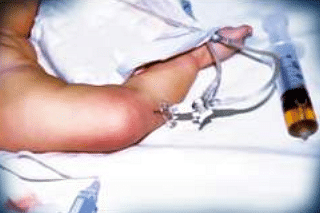
- Identify the procedure being performed in the image given below.
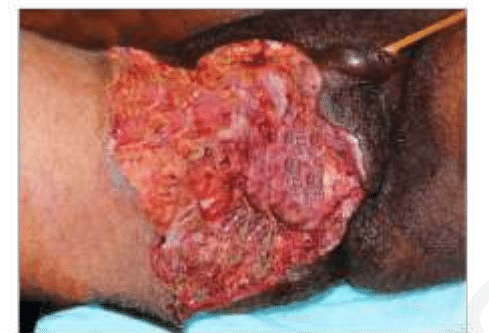
- A diabetic patient presents with sudden-onset perineal pain. On examination, foul-smelling discharge, and necrotic tissue as seen in the image is noted. Which of the following is true about the given condition?
- Which of the following is the most common complication following ligation of the first vessel during abdominoperineal resection for rectal carcinoma?(APR Abdominoperineal resection)
- A patient presents to the clinic with the lesion given in the image. He had a traumatic injury to the chest one year ago. What is the most likely diagnosis?
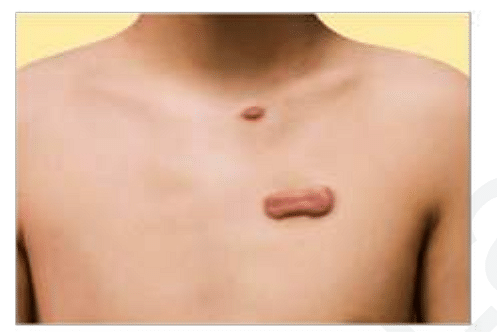
View More Questions
Top NEET PG Questions
- A patient hailing from Delhi presents with fever, arthralgia, and extensive petechial rash for 3 days. Lab investigations revealed a hemoglobin of 9 g/ dL, a white blood cell count of 9000 cells/mm3, a platelet count of 20000 cells/mm3, and a prolonged bleeding time. The clotting time was normal. What is the most likely diagnosis?
- Which of the following statements is true about Trichomonas vaginalis?
- A lady from West Rajasthan presented with an ulcer surrounded by erythema on the right leg. Microscopy of the biopsy from the edge of the ulcer showed organisms with dark staining nuclei and kinetoplast. What is the most likely causative agent?
- A child presents with a fever and a rash. Urine examination showed cells with owl's eye appearance. What is the most likely diagnosis?
- Infection with Clonorchis sinensis is associated with an increased risk of__?
View More Questions