Question:
A blind man lives in an apartment containing 2 rooms. Each day before going to work he enters any one room randomly, picks up a bag and leaves home. One of the rooms contains 3 blue, 4 green and 5 red bags and the other contains 2 blue, 1 green and 3 red bags. What is the probability that he takes a green bag to his workplace?
A blind man lives in an apartment containing 2 rooms. Each day before going to work he enters any one room randomly, picks up a bag and leaves home. One of the rooms contains 3 blue, 4 green and 5 red bags and the other contains 2 blue, 1 green and 3 red bags. What is the probability that he takes a green bag to his workplace?
Show Hint
Apply the law of total probability over the two equally likely rooms.
Updated On: Jul 21, 2026
- \(\dfrac{1}{4}\)
- \(\dfrac{1}{3}\)
- \(\dfrac{1}{2}\)
- \(\dfrac{2}{3}\)
Show Solution

Verified By Collegedunia
The Correct Option is A
Solution and Explanation
Step 1: Find the chance of a green bag in each room.
The first room has \(3+4+5=12\) bags in total, with 4 green, so \(P(\text{green} \mid \text{room 1}) = \dfrac{4}{12} = \dfrac{1}{3}\).
The second room has \(2+1+3=6\) bags in total, with 1 green, so \(P(\text{green} \mid \text{room 2}) = \dfrac{1}{6}\).
Step 2: Account for the random room choice.
The man enters either room with equal chance, so \(P(\text{room 1}) = P(\text{room 2}) = \dfrac{1}{2}\).
Step 3: Combine using the law of total probability.
\(P(\text{green}) = P(\text{room 1}) \times P(\text{green} \mid \text{room 1}) + P(\text{room 2}) \times P(\text{green} \mid \text{room 2})\).
\(P(\text{green}) = \dfrac{1}{2} \times \dfrac{1}{3} + \dfrac{1}{2} \times \dfrac{1}{6} = \dfrac{1}{6} + \dfrac{1}{12}\).
Step 4: Add the fractions.
\(\dfrac{1}{6} + \dfrac{1}{12} = \dfrac{2}{12} + \dfrac{1}{12} = \dfrac{3}{12} = \dfrac{1}{4}\).
Final Answer:
The probability of taking a green bag is \(\dfrac{1}{4}\). \[ \boxed{\dfrac{1}{4}} \]
The first room has \(3+4+5=12\) bags in total, with 4 green, so \(P(\text{green} \mid \text{room 1}) = \dfrac{4}{12} = \dfrac{1}{3}\).
The second room has \(2+1+3=6\) bags in total, with 1 green, so \(P(\text{green} \mid \text{room 2}) = \dfrac{1}{6}\).
Step 2: Account for the random room choice.
The man enters either room with equal chance, so \(P(\text{room 1}) = P(\text{room 2}) = \dfrac{1}{2}\).
Step 3: Combine using the law of total probability.
\(P(\text{green}) = P(\text{room 1}) \times P(\text{green} \mid \text{room 1}) + P(\text{room 2}) \times P(\text{green} \mid \text{room 2})\).
\(P(\text{green}) = \dfrac{1}{2} \times \dfrac{1}{3} + \dfrac{1}{2} \times \dfrac{1}{6} = \dfrac{1}{6} + \dfrac{1}{12}\).
Step 4: Add the fractions.
\(\dfrac{1}{6} + \dfrac{1}{12} = \dfrac{2}{12} + \dfrac{1}{12} = \dfrac{3}{12} = \dfrac{1}{4}\).
Final Answer:
The probability of taking a green bag is \(\dfrac{1}{4}\). \[ \boxed{\dfrac{1}{4}} \]
Was this answer helpful?
0
0
Top IBSAT Quantitative Aptitude Questions
If the price of a commodity increases by 25%, by what percentage should the consumption be reduced to keep the expenditure the same?
- What is the next number in the series: 2, 3, 5, 7, 11, ?
- A train travels 240 km in 4 hours. If the speed is increased by 20\%, how much time will it take to cover the same distance?
A shopkeeper marks his goods 40% above cost price and offers a 10% discount. What is his percentage profit?
- Sugar worth 15 per kg and 16 per kg is mixed with a third variety of some other cost in the ratio 1 : 1 : 2. If the mixture is of worth 20 per kg, what would be the cost of the third variety of sugar per kg?
View More Questions
Top IBSAT Probability Questions
- A box contains 4 blue, 2 green and 3 red balls and another box contains 4 red, 3 green, and 5 blue balls. A ball is picked up at random from one of the boxes. What is the probability that the ball is blue?
- A blind man lives in an apartment containing 2 rooms. Each day before going to work he enters any one room randomly, picks up a bag and leaves home. One of the rooms contains 3 blue, 4 green and 5 red bags and the other contains 2 blue, 1 green and 3 red bags. What is the probability that he takes a green bag to his workplace?
- What is the probability that a two-digit positive integer N has the property that the difference of N and the number obtained by reversing the order of its digits is a perfect cube?
- In a shooting competition, all the shooters should hit the letter space in which letter 'A' is written as shown on the target board below. What is the probability that the shooter will hit that space?
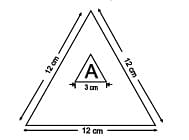
- What is the probability that a two-digit positive integer N has the property that the sum of N and the number obtained by reversing the order of its digits is a perfect square?
View More Questions
Top IBSAT Questions
If the price of a commodity increases by 25%, by what percentage should the consumption be reduced to keep the expenditure the same?
- Choose the word that is most similar in meaning to "ELOQUENT":
- In a certain code, "APPLE" is written as "BQQMF". How is "BANANA" written in that code?
- What is the next number in the series: 2, 3, 5, 7, 11, ?
- If all cats are animals and some animals are dogs, which of the following conclusions is definitely true?
View More Questions