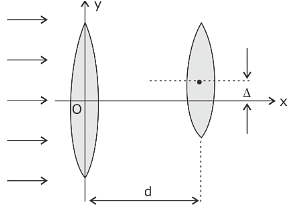
A biconvex lens having radius of curvature \(20\,\text{cm}\) for both surfaces and one side of the lens is silvered as shown in the figure. Object is at distance \(x\) cm from the lens. Find \(x\) such that image is on the object itself. Given \( \mu = 1.5 \).
Concept:
This system acts as a combination of a lens and a mirror.
The light first passes through the lens, reflects from the silvered surface (mirror), and again passes through the lens.
Key relations:
Mirror focal length:
\[
f_m = \frac{R}{2}
\]
Lens maker formula for symmetric biconvex lens:
\[
f_L = \frac{R}{2(\mu-1)}
\]
Equivalent focal length for lens–mirror combination:
\[
\frac{1}{F} = \frac{1}{f_m} - \frac{2}{f_L}
\]
Step 1:Find focal length of the mirror.
\[
f_m = \frac{R}{2} = \frac{20}{2} = 10
\]
Since reflection occurs,
\[
f_m = -10\,\text{cm}
\]
Step 2:Find focal length of the lens.
\[
f_L = \frac{R}{2(\mu-1)}
\]
\[
f_L = \frac{20}{2(1.5-1)}
\]
\[
f_L = \frac{20}{1} = 20\,\text{cm}
\]
Step 3:Find equivalent focal length of the system.
\[
\frac{1}{F} = \frac{1}{f_m} - \frac{2}{f_L}
\]
\[
\frac{1}{F} = \frac{1}{-10} - \frac{2}{20}
\]
\[
\frac{1}{F} = -\frac{1}{10} - \frac{1}{10}
\]
\[
\frac{1}{F} = -\frac{1}{5}
\]
\[
F = -5\,\text{cm}
\]
Step 4:Condition for image to coincide with object.
For image to form at the same position as the object:
\[
u = 2|F|
\]
\[
u = 2 \times 5 = 10\,\text{cm}
\]
\[
\boxed{x = 10\,\text{cm}}
\]