Question:
A 6-hour rainfall of 6 cm at a station was found to have a return period of 40 years. The probability that a 6-hour rainfall of this or larger magnitude will occur at least once in 20 successive years at that station is ______ (rounded off to three decimal places).
A 6-hour rainfall of 6 cm at a station was found to have a return period of 40 years. The probability that a 6-hour rainfall of this or larger magnitude will occur at least once in 20 successive years at that station is ______ (rounded off to three decimal places).
Show Hint
Use p = 1/T for the annual exceedance probability, then P(at least once in n years) = 1 - (1-p)^n.
Updated On: Aug 14, 2026
Show Solution

Verified By Collegedunia
Correct Answer: 0.397
Solution and Explanation
Step 1: Write down what is given. The 6-hour, 6 cm rainfall has a return period \(T = 40\) years, and we need the probability that a rainfall of this magnitude or larger occurs at least once in \(n = 20\) successive years.
Step 2: Find the annual exceedance probability. The return period and the probability of exceedance in any one year are related by \(p = \dfrac{1}{T}\). So \(p = \dfrac{1}{40} = 0.025\).
Step 3: Find the probability of the event NOT occurring in one year. The probability of the rainfall not being equalled or exceeded in a given year is \(q = 1-p = 1-0.025 = 0.975\).
Step 4: Find the probability of the event not occurring in all 20 years. Treating each year as an independent trial, the probability that the rainfall is not equalled or exceeded in any of the 20 successive years is \(q^{n} = (0.975)^{20}\). Evaluating this, \((0.975)^{20} \approx 0.603\).
Step 5: Find the probability of at least one exceedance. The probability of at least one occurrence in \(n\) years is the complement of the above, \(P = 1-q^{n} = 1-(0.975)^{20} \approx 1-0.603 = 0.397\).
Step 6: State the result. The probability that this 6-hour rainfall or larger will occur at least once in 20 successive years is approximately \(0.397\), which lies well within the accepted range of \(0.350\) to \(0.450\).
Step 2: Find the annual exceedance probability. The return period and the probability of exceedance in any one year are related by \(p = \dfrac{1}{T}\). So \(p = \dfrac{1}{40} = 0.025\).
Step 3: Find the probability of the event NOT occurring in one year. The probability of the rainfall not being equalled or exceeded in a given year is \(q = 1-p = 1-0.025 = 0.975\).
Step 4: Find the probability of the event not occurring in all 20 years. Treating each year as an independent trial, the probability that the rainfall is not equalled or exceeded in any of the 20 successive years is \(q^{n} = (0.975)^{20}\). Evaluating this, \((0.975)^{20} \approx 0.603\).
Step 5: Find the probability of at least one exceedance. The probability of at least one occurrence in \(n\) years is the complement of the above, \(P = 1-q^{n} = 1-(0.975)^{20} \approx 1-0.603 = 0.397\).
Step 6: State the result. The probability that this 6-hour rainfall or larger will occur at least once in 20 successive years is approximately \(0.397\), which lies well within the accepted range of \(0.350\) to \(0.450\).
Was this answer helpful?
0
0
Top GATE ES Water Resources and Environmental Hydraulics Questions
- In the context of fluid flow, which of the following statement(s) is/are correct?
- In a rectangular open channel, the flow is critical, and the flow depth is 2 m. Select the correct statement(s)
- Consider second order kinetics ($r = −kC^2$) under steady state condition. The ratio of volume of a complete mixed reactor (CMR) to that of a plug flow reactor (PFR) to achieve 90% reduction in the concentration is _______ .
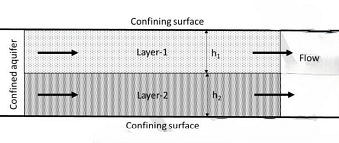
Inlet concentrations in both the reactors are same. - Consider two horizontal layers of an aquifer as shown in figure. Each layer is isotropic and homogeneous. Flow is parallel to the stratification. Thickness and horizontal hydraulic conductivity of layer-1 are $h_1$i and $K_1$, respectively. Thickness and horizontal hydraulic conductivity of layer-2 are $h_2$ and $K_2$, respectively, where $h_1$ is not equal to $h_2$. The equivalent horizontal conductivity $K_x$ for the aquifer system is given by _____
- Water is flowing FULL through a rectangular tunnel of size 3 m (width) × 2 m (height). The average velocity of flow is 1 m/s. The frictional head loss is observed to be 1 m per km. Consider acceleration due to gravity (g) as 10 \(m/s^2\). The correct statement(s) is/are
View More Questions
Top GATE ES Questions
- Ten cards in a pack are numbered as 1, 2, 3, . . .10. The probability of drawing a card with an even number or a number which is a multiple of 5 from the pack is
- Hardness in water is NOT caused by ______
- The maximum coordination number of \( \text{Sn}^{4+} \) is \(\_\_\_\_\)
- Rod shaped bacterial cells are called _______.
- Tuberculosis is predominantly caused by ________.
View More Questions