Question:
36 year old G3P3 patient had LCB 6 years ago, no medical evaluation since then. She now complains of excessive vaginal itching, skin pigmentation, lethargy, lack of axillary and body hair, cold intolerance, hoarseness of voice. On examination, her vagina is found to be atrophic. Which of these agents is NOT likely to improve her condition?
36 year old G3P3 patient had LCB 6 years ago, no medical evaluation since then. She now complains of excessive vaginal itching, skin pigmentation, lethargy, lack of axillary and body hair, cold intolerance, hoarseness of voice. On examination, her vagina is found to be atrophic. Which of these agents is NOT likely to improve her condition?
Show Hint
Think about Sheehan syndrome after postpartum hemorrhage and which listed drug is not a missing pituitary-driven hormone.
Updated On: Jul 8, 2026
- Insulin
- Thyroid extract
- Prednisolone
- Estrogen
Show Solution

Verified By Collegedunia
The Correct Option is A
Solution and Explanation
Step 1: Put the clues together.
This woman had a complicated delivery (her last childbirth) six years ago and never had a medical checkup after that. She now has cold intolerance and hoarseness, pointing to low thyroid hormone, lethargy, pointing to low cortisol, and vaginal atrophy with loss of axillary and pubic hair and vaginal itching, pointing to low estrogen and androgen.
Step 2: Name the condition.
A difficult delivery is often complicated by severe postpartum bleeding, which can starve the pituitary gland of blood and destroy part of it. This is Sheehan syndrome, a form of hypopituitarism that follows postpartum hemorrhage. Because the pituitary makes several trophic hormones, its damage causes a combined shortage of thyroid stimulating hormone, adrenocorticotropic hormone, and the gonadotropins that drive the ovaries, which explains why the thyroid, adrenal, and gonadal systems are all underactive at once.
Step 3: Work out what treatment does and does not help.
Because the hormone shortages are due to gland failure, replacing each missing hormone brings the system back toward normal. Thyroid extract corrects the low thyroid hormone state, easing the cold intolerance and hoarseness. Prednisolone, a corticosteroid, replaces the missing cortisol driven by low ACTH and treats the lethargy and weakness. Estrogen replaces what the ovaries are no longer being told to make, reversing the vaginal atrophy, itching, and loss of body hair.
Step 4: Explain why insulin does not help.
Sheehan syndrome is not diabetes, and it does not cause high blood sugar. In fact, the loss of cortisol and growth hormone, both of which normally push blood sugar up, makes these patients more sensitive to insulin and prone to low blood sugar. Giving insulin would not correct any of her symptoms and could instead push her into dangerous low blood sugar.
Step 5: Final answer.
Insulin is the one agent among the choices that does not improve, and can actually worsen, her condition.
\[ \boxed{\text{Insulin}} \]
This woman had a complicated delivery (her last childbirth) six years ago and never had a medical checkup after that. She now has cold intolerance and hoarseness, pointing to low thyroid hormone, lethargy, pointing to low cortisol, and vaginal atrophy with loss of axillary and pubic hair and vaginal itching, pointing to low estrogen and androgen.
Step 2: Name the condition.
A difficult delivery is often complicated by severe postpartum bleeding, which can starve the pituitary gland of blood and destroy part of it. This is Sheehan syndrome, a form of hypopituitarism that follows postpartum hemorrhage. Because the pituitary makes several trophic hormones, its damage causes a combined shortage of thyroid stimulating hormone, adrenocorticotropic hormone, and the gonadotropins that drive the ovaries, which explains why the thyroid, adrenal, and gonadal systems are all underactive at once.
Step 3: Work out what treatment does and does not help.
Because the hormone shortages are due to gland failure, replacing each missing hormone brings the system back toward normal. Thyroid extract corrects the low thyroid hormone state, easing the cold intolerance and hoarseness. Prednisolone, a corticosteroid, replaces the missing cortisol driven by low ACTH and treats the lethargy and weakness. Estrogen replaces what the ovaries are no longer being told to make, reversing the vaginal atrophy, itching, and loss of body hair.
Step 4: Explain why insulin does not help.
Sheehan syndrome is not diabetes, and it does not cause high blood sugar. In fact, the loss of cortisol and growth hormone, both of which normally push blood sugar up, makes these patients more sensitive to insulin and prone to low blood sugar. Giving insulin would not correct any of her symptoms and could instead push her into dangerous low blood sugar.
Step 5: Final answer.
Insulin is the one agent among the choices that does not improve, and can actually worsen, her condition.
\[ \boxed{\text{Insulin}} \]
Was this answer helpful?
0
0
Top NEET PG Gynaecology and Obstetrics Questions
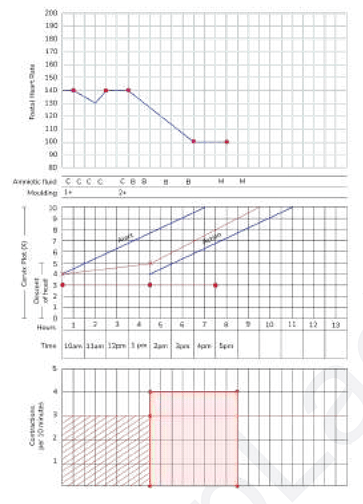
- A partogram of a woman who is in labor is shown below. Oxytocin infusion is already given. How will you manage the condition?
- A woman presents to you at 36 weeks of gestation with complaints of breathlessness and excessive abdominal distension. Fetal movements are normal. On examination, fetal parts are not easily felt and fetal heartbeat is heard but it is muffled. Her symphysis fundal height is 41 cm. Her abdomen is tense but not tender. What is the most likely diagonosis?
- For which of the following procedures in the given OT list, can you preferably do a hysteroscopy ?
- A primigravida presents to you with anemia early in her pregnancy. She is 7 weeks pregnant as seen on ultrasound. Her hemoglobin level is 9 g/dL. When should the iron supplements be started for her?
- A 23-year-old woman accompanied by her mother-in-law comes to the infertility clinic. She has been having regular intercourse for 6 months but is not able to conceive. What is the next best step?
View More Questions
Top NEET PG Questions
- A patient hailing from Delhi presents with fever, arthralgia, and extensive petechial rash for 3 days. Lab investigations revealed a hemoglobin of 9 g/ dL, a white blood cell count of 9000 cells/mm3, a platelet count of 20000 cells/mm3, and a prolonged bleeding time. The clotting time was normal. What is the most likely diagnosis?
- Which of the following statements is true about Trichomonas vaginalis?
- A lady from West Rajasthan presented with an ulcer surrounded by erythema on the right leg. Microscopy of the biopsy from the edge of the ulcer showed organisms with dark staining nuclei and kinetoplast. What is the most likely causative agent?
- A child presents with a fever and a rash. Urine examination showed cells with owl's eye appearance. What is the most likely diagnosis?
- Infection with Clonorchis sinensis is associated with an increased risk of__?
View More Questions